When the universe looks the same in all directions?
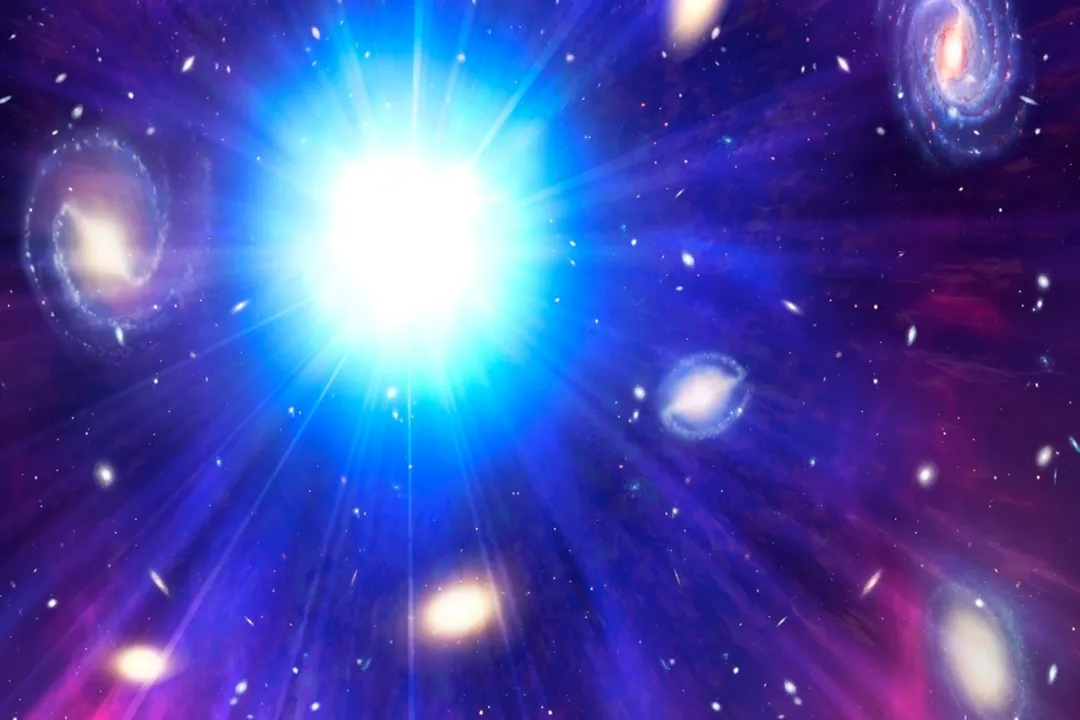
The notion that the cosmos appears fundamentally the same no matter where you point your telescope, a concept central to modern cosmology, represents a profound assumption about the nature of reality on the largest scales. This idea, often summarized as the universe being isotropic—looking the same in every direction—is not just a convenient simplification; it is a foundational pillar upon which our standard model of the universe, the Big Bang theory, is built. [9] Without this apparent uniformity, the mathematical descriptions we use to model the universe's evolution, from its earliest moments to its current accelerated expansion, would largely crumble.
# Cosmic Principle
The idea that the universe is isotropic is coupled with another critical assumption: homogeneity, meaning that on large enough scales, the distribution of matter is uniform across all locations. [9][8] Together, these two properties form the Cosmological Principle. When scientists speak of the universe looking the same in all directions, they are primarily referring to isotropy. This observation is tested by examining cosmic structures and radiation across the entire celestial sphere. [8] If the universe were significantly different when observed along one axis compared to another, it would imply a preferred direction, or an anisotropy, which would radically alter our understanding of cosmic origins and destiny. [1]
It is important to recognize the scale dependence of this principle. On small scales, like within a galaxy or even a local cluster of galaxies, the universe is clearly not homogeneous; you have stars, dust, voids, and dense structures everywhere. [8] However, as we zoom out, averaging over volumes that contain millions of galaxies, the lumps and voids begin to smooth out. The Cosmological Principle states that this smoothing continues indefinitely until, at the largest observable scales, the universe achieves a statistically uniform, isotropic appearance. [9]
# CMB Viewpoint
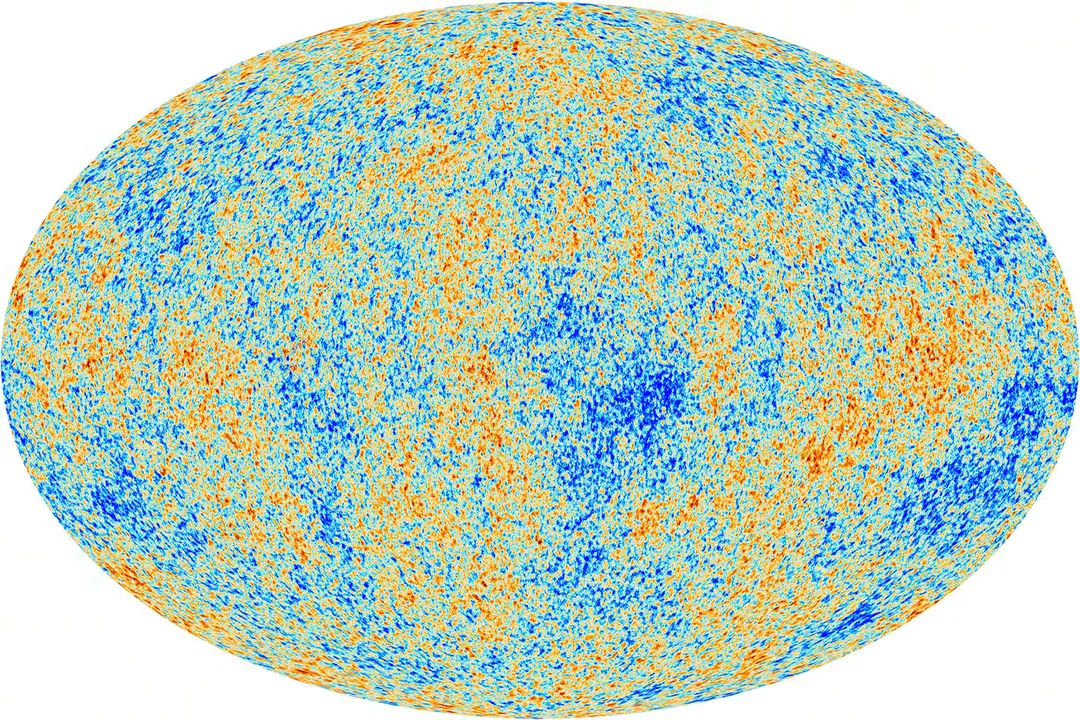
The most powerful evidence supporting this uniformity comes from the faint afterglow of the Big Bang: the Cosmic Microwave Background (CMB) radiation. [4] This ancient light permeates all of space, originating from a time about 380,000 years after the Big Bang, when the universe cooled enough for photons to travel freely. [4]
When we map the temperature of the CMB across the entire sky, what we find is astonishing uniformity. The temperature difference from one direction to another is minuscule, on the order of one part in 100,000. [4] If the universe were not isotropic, we would expect to see systematic temperature variations—a "hot spot" here and a "cold spot" there that correlate with the direction of observation rather than random, small-scale quantum fluctuations. [4] Animations tracing these temperature variations visually confirm this near-perfect isotropy across the sky, showcasing the residual blueprint of the early cosmos. [4]

# Expansion Time
A frequent point of confusion arises when considering the immense distances and the finite speed of light. If looking deep into space is equivalent to looking back in time, how can we claim the universe looks the same in all directions now, given that light hasn't had time to travel across the entire span of existence to homogenize different regions?[6][5] This apparent paradox touches upon the Horizon Problem.
If the universe began with a Big Bang and has been expanding ever since, two distant patches of the universe that are currently visible to us may never have been in causal contact; light from one patch simply hasn't reached the other yet. [5] Yet, their CMB temperatures match almost perfectly. [5] This implies that the uniformity observed now across the entire observable volume cannot be solely due to local processes distributing heat or information after the Big Bang. This observation strongly suggests that the initial conditions themselves—the state of the universe when it was very young and small—were already isotropic and homogeneous. [5]
The expansion itself adds a layer of complexity. While the Cosmological Principle generally refers to space being uniform at any given time, observations suggest that the rate of expansion might not be identical in every direction. Recent findings have indicated that the expansion of the universe could be slightly lopsided, a finding that directly challenges the assumption of strict isotropy. [2] If the expansion rate varies depending on the viewing angle, the universe would be anisotropic, even if the distribution of matter appears uniform on certain scales. [1][2]
# Lopsided Universe
The idea of a lopsided universe, or a significant anisotropy, would have major consequences for standard Lambda-CDM cosmology. Scientists have looked for these directional variations in the data, often focusing on large-scale structures and the CMB. [1] Some measurements, for example, have hinted at preferred orientations in the distribution of galaxy clusters or peculiar velocities—the local motions of galaxies influenced by gravitational pulls that deviate from the uniform Hubble flow. [7]
One specific area of tension involves what are sometimes called "cosmic axis" anomalies in the CMB data. [1] If the universe were perfectly uniform, the largest fluctuations in the CMB temperature map should behave in a certain statistical way. However, some early analyses suggested that the largest temperature variations seemed aligned along a particular axis relative to our solar system’s motion, hinting at a preferred direction in the early universe's structure. [1] This lopsidedness, if confirmed, would represent a fundamental crack in the current cosmological model, suggesting that the universe might be evolving differently along different spatial lines. [1]
If we think about this in practical terms, consider mapping the structure of a perfectly smooth, expanding balloon. If you mark points on it, they move away from each other uniformly. Now, imagine the balloon is being inflated slightly faster along the north-south axis than the east-west axis; the distances between points in the north-south direction would grow more rapidly. If the early universe expanded like this, the resulting structure of galaxies today, viewed from Earth, would betray that initial directional preference in the expansion history. [2]
# Refining Uniformity
The conflict between the remarkably smooth CMB and hints of large-scale directional preferences necessitates extremely careful measurement and interpretation. The precision of the measurements is key. If a perceived anisotropy is found to be smaller than the statistical noise, it is simply dismissed as a fluctuation within an otherwise isotropic universe. [1]
A key analytical step that astronomers take is accounting for our own motion. The Earth is orbiting the Sun, the Sun is orbiting the Milky Way, and the Milky Way is moving within the Local Group, which is being pulled toward the Great Attractor. All these local movements create a dipole anisotropy in the CMB—a hot spot in the direction we are moving and a cold spot in the opposite direction. [4] This directional difference is expected and is not a flaw in the universe's uniformity; it's a feature of our perspective. [4] Cosmologists must subtract this kinematic effect precisely to reveal the true, intrinsic uniformity (or lack thereof) of the early universe.
| Scale of Observation | Primary Feature | Consistency with Principle | Implication |
|---|---|---|---|
| Small (Galaxies/Clusters) | Clumpy matter distribution | Low (Not Homogeneous) | Local structure dominates |
| Intermediate (Superclusters) | Filamentary structures | Medium (Apparent flow) | Gravitational influence visible |
| Large ( Mpc+) | CMB Temperature | High (Isotropic) | Cosmological Principle holds |
| Largest (CMB Fluctuations) | Large-scale alignments | Potential Tension | Possible expansion/initial condition anomaly [1][2] |
When interpreting data, it is vital to consider how distance affects our perception of uniformity. For instance, while the CMB shows uniformity when looking back about 13.8 billion years, matter distribution today shows large-scale alignment, suggesting that the universe may have become isotropic only after the matter was sufficiently spread out by expansion, meaning the early universe was more uniform than the present universe on certain scales, which is an interesting inversion of the expected smoothing process. [8] If we could plot the statistical variance of matter density against the scale size, we'd likely see the variance drop sharply as the scale crosses the approximately 140 Megaparsec mark, confirming the scale threshold for homogeneity. [9]
The consistency of observations across multiple independent instruments measuring different phenomena (like galaxy clustering versus CMB polarization) builds tremendous trust in the underlying model, even when minor anomalies persist. [1] It requires extremely high confidence to overturn a principle that explains so much of what we see. When a potential anomaly appears, scientists investigate whether it stems from a systematic error in the measurement apparatus or a genuine physical effect that necessitates a revision to the standard model. [1]
# New Frontiers
The search for directional dependence in the universe continues because of its profound implications. If we definitively proved a non-zero anisotropy in the expansion or the initial conditions, it would necessitate revisiting theories like Inflation, the hypothetical period of extremely rapid expansion in the first fraction of a second after the Big Bang. [5] Inflation is one of the leading mechanisms proposed to explain why the universe is so nearly isotropic today, smoothing out initial inhomogeneities. [5] A confirmed large-scale anisotropy suggests either a flawed inflationary model or a completely different physical process dominating the universe's earliest moments.
The ability to observe the universe looking the same in all directions is, therefore, a testament to the underlying physics governing its creation and evolution. It allows for the construction of a single, elegant mathematical description that applies everywhere. While the current evidence strongly supports isotropy on the largest scales, the ongoing hunt for those persistent, subtle deviations serves as the engine of discovery in modern cosmology, pushing the boundaries of measurement precision and testing the very limits of our most successful theories. [1][2]
Related Questions
#Citations
Our Universe Appears Lopsided, And It Could Break Cosmology ...
Universe's Expansion May Not Be The Same In All Directions - NASA
Why is it said that universe has expanded in all directions at once?
Universe's Expansion May Not Be The Same In All Directions
It is said that the universe looks the same from every direction. Does ...
If Looking Into Space is Like Looking Back in Time, Why is it the ...
How can the universe be observed as older and smaller ... - Facebook
Cosmological Principle - University of Oregon