What are the seven stages of the universe?
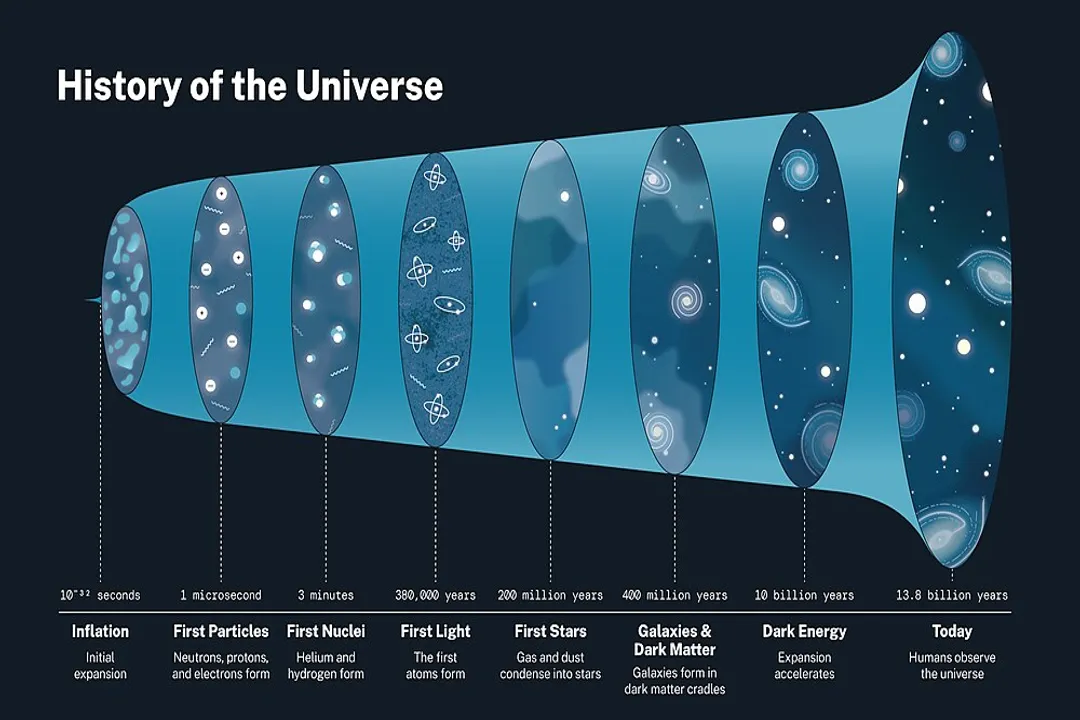
The concept of the universe unfolds across definite periods, a chronological sequence that scientists strive to map out with increasing precision. When we ask about the "seven stages of the universe," we are immediately presented with a fascinating duality: are we discussing the hard physics of cosmic history—the epochs following the Big Bang—or are we referring to the analogous, multi-stage developmental processes described in philosophical or spiritual traditions? While the cosmos we inhabit today, governed by known laws, can be mapped onto many sequences, the standard cosmological timeline, though possessing many named phases, can be distilled into seven overarching eras to provide a useful structure for understanding our physical origins. We must begin at the start, approximately 13.8 billion years ago, according to modern estimates.
# The Initial Surge
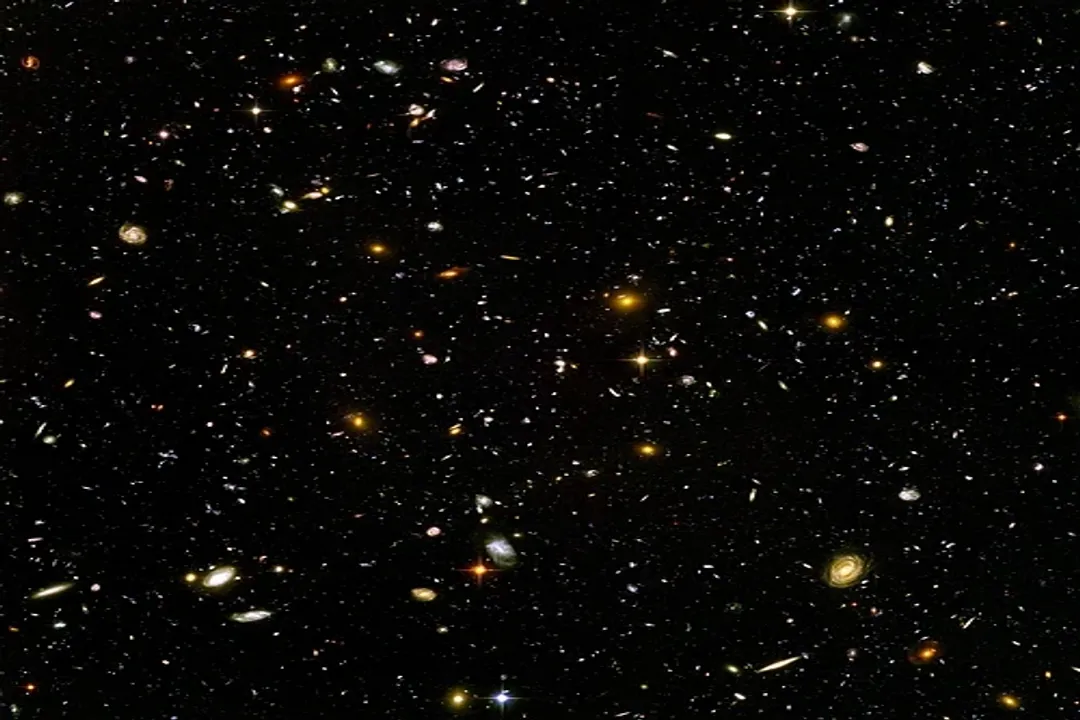
The very beginning, before time itself had a measurable coordinate, is characterized by a process so extreme that our current physics begins to break down at the Planck epoch, around seconds. This initial period is often placed before the standard Big Bang model, existing in the realm of cosmogenesis where concepts like time and space are still unconfirmed.
The first widely supported stage in standard cosmology is Cosmic Inflation. This was not merely rapid expansion; it was an exponential expansion where space grew by a factor of at least in a span lasting only from about to seconds. The energy driving this immense stretch is hypothesized to have come from a scalar field called the inflaton field. This inflation period is critical because it took the tiny, quantum-level fluctuations present at the smallest scales and stretched them across the nascent universe, providing the initial density differences that would eventually grow into galaxies and clusters.
Immediately following this, the universe entered the Reheating phase. As the inflaton field decayed, its massive potential energy was released, transforming into a thermal bath of Standard Model particles—a dense, hot mixture that marked the true beginning of the Hot Big Bang era. This reheating process effectively set the initial conditions for everything that followed.
# Soup and Separation

The next phase centers on fundamental particle interactions and symmetry breaking. After reheating, the universe was a quark-gluon plasma—a superheated soup of fundamental constituents where the laws of physics, as we recognize them, were still crystallizing.
Stage two is marked by the Electroweak Phase Transition. Occurring around seconds, as the temperature dropped below approximately 150 GeV/kB, the electromagnetic and weak nuclear forces separated. Before this, the associated force carriers (bosons) were massless; afterward, the W and Z bosons gained mass, drastically limiting the range of the weak nuclear force, while the photon remained massless. This separation is a major step in establishing the fundamental interactions we observe today.
The third distinct particle-level event is the Quantum Chromodynamics Phase Transition, which ended the "quark epoch" around seconds. At this point, the universe had cooled enough for quarks to bind together into hadrons—protons and neutrons—forming the building blocks for atomic nuclei. This was followed shortly by Baryogenesis, the mysterious process where a slight asymmetry favored matter over antimatter, leaving the residue of matter that constitutes everything we see today, with about one extra particle of matter for every pairs that annihilated into photons.
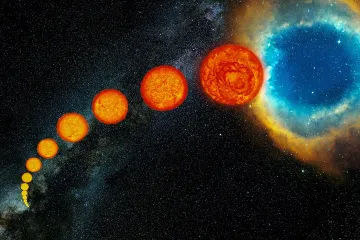
# The First Elements
The fourth stage is Big Bang Nucleosynthesis (BBN), which took place roughly between 2 minutes and 20 minutes after the Big Bang. Before this, the universe was too hot for stable nuclei to hold together; any nuclei formed would instantly break apart due to energetic photons. Once the temperature dropped below the threshold required for fusion, protons and neutrons began to combine.
The key output of BBN was the universe's initial elemental composition: primarily hydrogen and helium-4, with trace amounts of deuterium and lithium-7. The calculated prediction is that about 25% of all nucleons ended up as helium. This measured abundance of light elements today serves as one of the strongest pieces of evidence supporting the entire Big Bang framework.
# Clearing the Fog
The fifth major stage arrives much later, around 370,000 years post-Big Bang, in an event known as Recombination and Photon Decoupling. Before this time, the universe was an ionized plasma of nuclei and free electrons. Photons constantly scattered off these free charges, making the cosmos opaque, or "foggy"—there was light, but no way to see through it.
As the universe cooled to about 4000 K, the energy dropped enough for atomic nuclei to finally capture electrons, forming the first neutral atoms—mostly hydrogen. This cleared the fog: electrons were no longer free to scatter photons effectively, and the universe became transparent to electromagnetic radiation for the first time. The photons released at this exact moment of decoupling, redshifted by billions of years of expansion, are what we detect today as the Cosmic Microwave Background (CMB) radiation. This image of the universe at 370,000 years old is the oldest direct view we possess.

# The Great Silence
Stage six is the Dark Ages. Following recombination, the universe was transparent to light, but it was also dark. The intense glow of the plasma had faded, and there were no stars yet to produce new, visible light. The universe cooled from the CMB's initial 4000 K down towards about 60 K over hundreds of millions of years. During this span, the primary components were neutral hydrogen and helium, with the only background radiation being the redshifted CMB and the faint 21 cm spin-line emission from neutral hydrogen itself.
The Dark Ages persisted until gravity began to assemble the first massive structures. This phase transition, marking the end of the Dark Ages and the beginning of structure formation, is known as Reionization, starting perhaps as early as 250 million years after the Big Bang. The intense ultraviolet radiation from the first stars (Population III stars) and early galaxies broke the neutral hydrogen atoms back into plasma, making the intergalactic medium transparent to higher-energy light once more.
# Building Worlds and Future Horizons
The seventh stage encompasses the universe we inhabit and its ultimate fate. Once reionization was well underway (around 1 billion years), the universe entered the Stelliferous Era. This is the period of matter domination, where gravitational attraction shaped the cosmos into the familiar filaments, clusters, and superclusters of galaxies we observe. For about 12.8 billion years, the universe has looked relatively similar, though matter density decreased as it expanded.
Crucially, around 9.8 billion years ago, the balance shifted, initiating the Dark Energy-Dominated Era, where the expansion began to accelerate, driven by an unknown repulsive energy that now constitutes about 68.3% of the universe’s mass-energy budget. This is the present state.
Looking beyond the present structure, the final stage is The Far Future. This era begins when star formation ceases (the end of the Stelliferous Era, perhaps in 100 trillion years). Theoretical outcomes include Heat Death (infinite expansion leading to thermodynamic equilibrium and cold particles), the Big Rip (where acceleration becomes so extreme it tears apart spacetime itself), or the unlikely Big Crunch.
It is interesting to compare this time-based scientific chronology with alternative frameworks. For instance, one theoretical proposal suggests the universe’s creation passed through three main eras—pre-compression, compression, and the finite universe era—defined by the interaction between matter and energy. This model posits that Dark Matter is the simplest massable particle, fully colonized by Dark Energy, and that this relationship—not gravity alone—drives expansion. This view fundamentally contrasts with the standard model, which treats Dark Matter and Dark Energy as distinct components whose densities merely dominate at different cosmic times. Such cognitive models, which rely less on observation from the earliest moments and more on foundational logic regarding matter and energy essence, challenge the idea that compression must lead to a singularity, suggesting instead a finite, energized system.
Furthermore, the recurring theme of seven stages is not unique to cosmology. In metaphysical contemplation, stages of spiritual awakening or planetary evolution are also frequently divided into seven steps. For example, one schema details seven steps from "Common sense" to "Cosmic consciousness" through phases like "Revelation" and "Illumination". Another, referencing The Urantia Book, outlines seven stages of a world's progress toward "light and life," ranging from the "Planetary Stage" to the "Superuniverse Stage". It’s a curious observation that humanity often maps complex evolutionary processes, whether subatomic or self-aware, onto this specific number, suggesting a deep-seated affinity for triads and septets in ordering reality, even when the underlying mechanisms—particle physics versus spiritual attainment—are completely different. One might speculate that this numerical preference reflects a fundamental limitation or organizational capacity within the human mind for categorizing immense timescales or complex transformations into digestible, sequential measures.
Ultimately, mapping the universe's life is a story of decreasing energy density and increasing structural complexity. It starts as pure, undifferentiated energy potential, transitions to an extremely hot, simple particle soup, allows for the basic chemical ingredients to form, clears the way for light to travel, enters a period of waiting for structures to coalesce, builds the familiar structures we see, and finally faces an accelerating expansion toward an unknown conclusion.
#Videos
The 7 Levels of The Universe | Space Documentary 2025 - YouTube
The 7 Stages of Awakening Everyone Will Face | Alan Watts
Related Questions
#Citations
The 7 Levels of The Universe | Space Documentary 2025 - YouTube
Chronology of the universe - Wikipedia
7 Stages of Spiritual Awakening or “The Self” Awakening - Medium
The Seven Stages of Enlightenment -
[PDF] The Stages of the Universe Formation: A Matter/ Energy Interaction ...
The Spheres of Light and Life - TruthBook
Cosmic History - NASA Science
The Universe In Seven Stages While The Space Was Alone