What is the process of the core collapse?
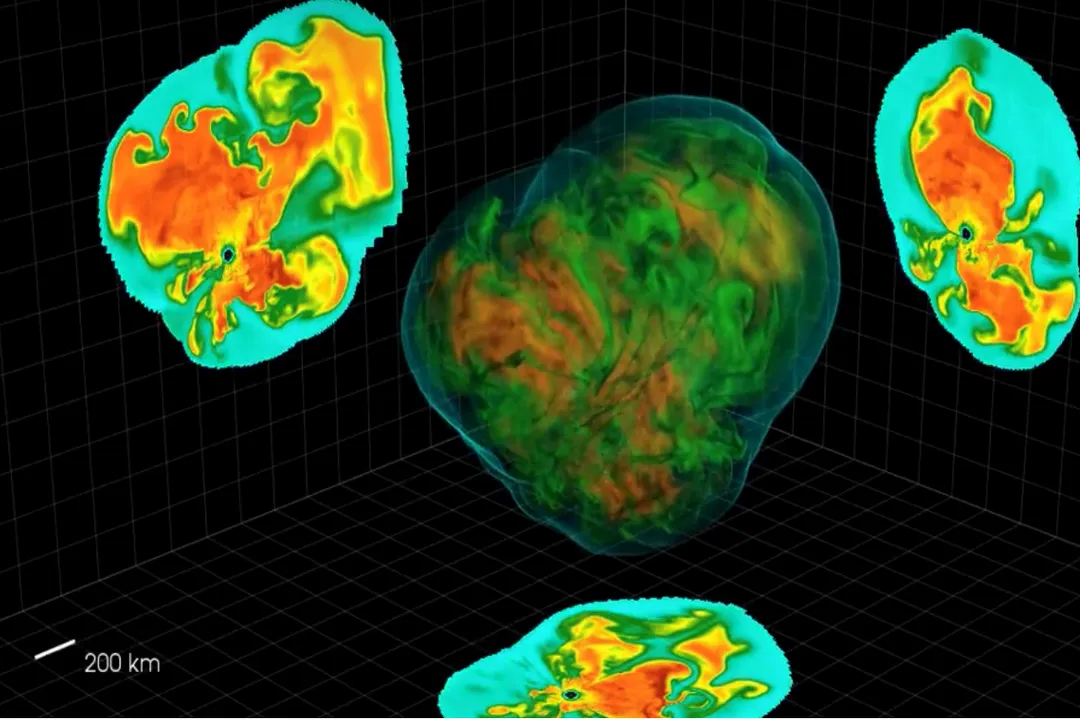
The final moments of a truly massive star—one significantly larger than our Sun, often eight times its mass or more—involve a catastrophic, swift implosion known as the core collapse. [1][2] This is not a gentle fade to white dwarf status; it is the dramatic preamble to one of the universe's most energetic events: a core-collapse supernova. For a general reader, picturing this process requires focusing on a battle between the relentless pull of gravity and the quantum mechanical resistance of matter, a battle gravity ultimately wins, at least initially. [6]
# Fuel Exhaustion
The star has spent millions of years in a delicate equilibrium. Hydrogen fuses to helium, helium to carbon, and so on, building heavier elements in concentric shells, much like an onion. [6] Each fusion stage generates the outward pressure necessary to counteract the star’s immense self-gravity. However, this sequence of energy production ends abruptly at iron. [2] Fusing iron atoms actually consumes energy rather than releasing it, meaning the thermonuclear furnace goes cold precisely when it is needed most. [6]
When the iron core grows too massive—exceeding the Chandrasekhar limit, which is about $1.4$ times the Sun’s mass, though the exact value depends on the star's overall structure—the outward thermal pressure vanishes. [2] Gravity, unopposed, takes over the stage. This is the trigger for the collapse, a process that happens with terrifying speed. [6] In just a fraction of a second, a core that might be the size of Earth collapses down to a radius of just a few kilometers. [1] It is fascinating to consider that the entire life cycle of the star, perhaps tens of millions of years, culminates in a final implosion lasting less than a breath. [6]
# Pressure Overcome
As the iron core shrinks, the density skyrockets. Initially, the collapse is somewhat resisted by electron degeneracy pressure, a quantum mechanical effect where electrons refuse to occupy the same space, stiffening the matter against compression. [6] However, in these massive stellar cores, gravity is so overpowering that it overcomes this pressure easily. [1][2]
This failure of electron degeneracy pressure leads directly to a profound transformation of matter. Electrons are squeezed into the atomic nuclei, combining with protons to form neutrons and releasing a flood of nearly massless particles called neutrinos. [6] This key reaction is written simply as . [1] This process, called electron capture, removes the very particles that were providing the primary resistance to gravity, accelerating the collapse even further. [2]
The density quickly reaches levels comparable to that of an atomic nucleus, roughly . [1] At this point, the core is no longer a dense gas; it is essentially a giant, incredibly stiff ball of pure neutrons, which forms the proto-neutron star. [6]

# Neutrino Release
The energy released during this compression and particle transformation is staggering, but it is not primarily light or heat that escapes first. The vast majority of the gravitational energy released during the core’s implosion—upwards of $99%$ of the total energy of the resulting supernova explosion—is carried away by these newly created neutrinos. [1][2]
Imagine a standard supernova releasing joules of kinetic energy in the visible explosion; the neutrino burst carries about joules. [5] This outflow of neutrinos is so immense that for a brief period, the neutrino luminosity exceeds the light output of every star in the observable universe combined. [1] The crucial point here is that these neutrinos interact so weakly with ordinary matter that most of them stream out of the star almost instantly, escaping the dense layers before they can deposit their energy into driving the explosion. [2]
# Stellar Bounce
When the core collapses into the ultra-dense configuration of the proto-neutron star, it effectively runs into an impenetrable wall. [1] The forces holding neutrons apart—the strong nuclear force, which becomes repulsive at extremely short distances—finally dominate gravity, halting the infall. [6] The core, having reached nuclear density, stiffens instantaneously. [2]
The infalling material, still rushing inward at a significant fraction of the speed of light, slams into this incompressible, newly formed object. [1] This collision causes a violent recoil known as the core bounce. [6] This bounce generates a powerful, outward-propagating shockwave moving through the star's outer layers. [1] The initial shockwave is born from the sudden cessation of collapse and the stiffening of the nuclear matter. [5]
It is interesting to analyze the initial viability of this shockwave. In many theoretical models, the shockwave stalls relatively quickly as it plows through the star's outer envelope, which is still falling inward and carrying away the shock's energy. [5] This stall is a critical turning point; if the shockwave stalls permanently, the star will simply implode further into a black hole without a visible explosion. The mere formation of a neutron star is not, by itself, a guarantee of a visible supernova. [9]
# Revival Shock
The difference between a silent implosion to a black hole and a brilliant core-collapse supernova hinges on how that stalled shockwave is revitalized. This is where the overwhelming neutrino flux becomes essential. [5][9]
The stalled shockwave sits just outside the dense proto-neutron star. The ceaseless torrent of neutrinos streaming out from the hot core—the very particles that carried away the initial gravitational energy—begin to interact with the dense layers of matter right behind the stalled shock. [2][5] A tiny fraction of these neutrinos are absorbed by the heavy nuclei in this region. This absorption reheats the material, injecting enough energy back into the shock to make it "re-launch," pushing it outward with renewed vigor. [5][9] This process is often referred to as neutrino-driven explosion or shock revival. [5]
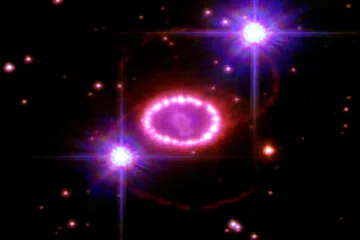
If the shock successfully revives and breaks through the stellar surface, the result is a magnificent core-collapse supernova, temporarily outshining its entire host galaxy. [4] The successful revival requires the progenitor star to be less massive, or perhaps requires specific, rapid rotational conditions that help facilitate the necessary energy deposition behind the shock front. [9]
# Remnant Mass
The final state of the collapsed core determines whether we witness a brilliant flash or a quiet cosmic void. This final remnant mass is a crucial, though highly dependent, factor. [9]
If the mass of the core left behind after the explosion (the proto-neutron star) remains below a critical threshold, typically estimated to be around $2$ to $3$ solar masses, the internal pressure from neutron degeneracy and thermal support can stabilize it, leaving behind a neutron star. [9] These objects are incredibly compact, perhaps only 20 kilometers across, yet harbor more mass than the Sun. [1]
If, however, the initial core was so massive, or the explosion so inefficient, that the remnant mass exceeds this stability limit, no known force in physics can halt the inward crush. [9] Gravity wins the second, decisive battle, and the core continues to collapse indefinitely, squeezing past nuclear density until it forms a black hole. [9] In these events, the outward shockwave loses its momentum entirely, and the star's light simply winks out as the matter is swallowed completely. [9]
| Progenitor Mass Range | Final Core Fate | Typical Resulting Object |
|---|---|---|
| to | Successful Revived Shock | Neutron Star + Supernova |
| (or high core mass) | Stalled Shock/Failure to Revive | Black Hole (Direct Collapse) |
It is important to observe how observations guide theory. Astronomers occasionally detect supernova events that appear to lack the standard bright visual explosion but show evidence of a central object rapidly forming a black hole, suggesting that the second scenario in the table above is a real possibility for the most massive stars. [9] The study of these different outcomes helps astrophysicists refine the exact equations of state used to model the behavior of matter under such extreme pressures. [6]
# Nucleosynthesis Imprint
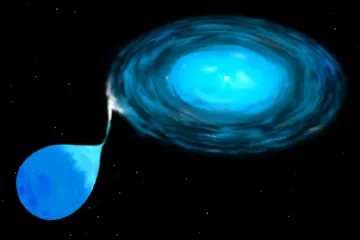
While the explosion itself is luminous, the core collapse process is also the universe's primary factory for heavy elements. The star has already synthesized elements up to iron during its life, but the supernova explosion creates everything heavier. [4]
The intense flood of neutrons, created during the collapse and explosion, drives the rapid neutron-capture process, or r-process. [4] This process involves atomic nuclei rapidly absorbing neutrons before they have time to radioactively decay, building up elements far heavier than iron, such as gold, platinum, and uranium. [4] The material ejected in the supernova shockwave seeds the interstellar medium with these newly forged heavy elements, which will eventually form new stars, planets, and perhaps life itself. Without the swift violence of the core collapse, the chemical complexity of our solar system would be severely limited. Thinking about the origin of the rare elements in our own bodies, knowing that the process began with the instantaneous pressure failure of a star light-years away offers a profound sense of connection to cosmic history. [1][4] The sheer physics involved—quantum pressure failing against a gravitational field strong enough to warp spacetime itself—is arguably the most extreme event occurring regularly in the cosmos today.
#Videos
A Detailed Breakdown of Core Collapse Supernovae
Related Questions
#Citations
Core-collapse | COSMOS
Core collapse
A Detailed Breakdown of Core Collapse Supernovae
DOE Explains...Supernovae
Core-collapse supernovae - MPA Garching
Core Collapse Supernovae
Core Collapse Supernovae - How a Supernova Works
Core-collapse supernovae
Core-Collapse Supernova: Neutron Star or Black Hole Remnant