How does a cloud collapse?

The process behind a massive cloud in space—often a gigantic reservoir of gas and dust—giving way to collapse is a fundamental mechanism driving cosmic structure, most notably the birth of stars and galaxies. This dramatic event isn't a sudden implosion but rather a tipping point where the inward pull of gravity finally overpowers all the outward forces attempting to keep the cloud puffed up and stable. Think of it as an intense tug-of-war happening across millions of miles of interstellar medium. [1][5]
# Force Balance

To understand why a cloud collapses, we first need to appreciate the opposing forces at play. A diffuse cloud of gas and dust naturally resists collapse due to internal pressure, which acts to keep it expanded. [9] This pressure can arise from the thermal motion of the gas particles—hotter gas pushes outward more strongly—or from magnetic fields and turbulence within the cloud. [2][5] Gravity, on the other hand, is always trying to pull the cloud's mass inward toward its center of mass. [5][9]
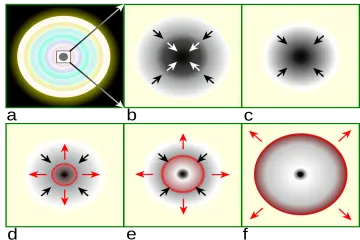
For a cloud to remain stable, or in hydrostatic equilibrium, the outward pressure forces must effectively counteract the inward gravitational force. [9] Gravitational collapse only begins when gravity achieves dominance; this means that for some region within the cloud, the mass is great enough, or the internal pressure is low enough, that the gravitational attraction cannot be resisted by the existing support mechanisms. [1][2]
The nature of this support is multifaceted. While thermal pressure is the classic opposing force, in the environments where stars form, turbulence—the chaotic, large-scale motion of gas—is often a major contributor to resisting gravitational contraction in the initial stages. [8] It is when the gravitational pull exceeds all these forms of internal support that the breakdown begins.
Here is a simple comparison illustrating the primary mechanisms cloud must overcome for gravity to win:
| Resistance Force | Mechanism | Impact on Stability |
|---|---|---|
| Thermal Pressure | Kinetic energy of heated gas particles [2] | Acts uniformly outward. Decreases if the cloud cools. |
| Turbulence | Large-scale, chaotic gas motion [8] | Creates local pressure support, often suppressing large-scale collapse initially. |
| Rotation | Centrifugal force from spinning motion [4] | Creates outward force, particularly strong near the rotation axis. |
# Critical Threshold

The precise condition that dictates when gravity wins has been rigorously defined by the Jeans criterion, leading to the concept of the Jeans mass and Jeans length. [2] A region of gas will begin to collapse gravitationally if its mass exceeds the Jeans mass for its given temperature and density, or if its physical size is smaller than the Jeans length. [1][2]
If a cloud fragment is below the Jeans mass, its internal thermal pressure is sufficient to resist gravity, and it will remain stable or simply bounce back if slightly compressed. If it exceeds this critical mass, gravity dominates, and the collapse commences inexorably, leading to fragmentation over time. [2]
This concept is especially powerful because it highlights that collapse isn't always an all-or-nothing event for the entire cloud. Instead, gravitational instability can set in locally. A large, seemingly stable cloud can contain many small, dense pockets that are individually massive enough to trigger their own collapse, even if the cloud as a whole is supported by lower average pressure or turbulence. [7]
When considering the scale, the Jeans length essentially defines the smallest size a structure can be while being gravitationally bound under specific conditions. If a density fluctuation is smaller than this length scale, the pressure gradient across it is strong enough to prevent collapse, essentially smoothing out the bump. [1]
A point worth noting, which often gets overlooked when discussing simple thermal pressure, is that for massive clouds in the interstellar medium, cooling mechanisms are highly effective. Because molecular clouds can radiate energy away efficiently, the thermal pressure does not increase as rapidly during initial compression as one might naively expect, which allows gravity to quickly overtake the thermal support mechanism if a region becomes sufficiently dense. [2]
# Cloud Genesis

Understanding collapse also requires knowing how these vast structures form in the first place. Star-forming clouds, for instance, are not primordial; they arise from the complex dynamics of the interstellar medium (ISM). [3] These are often molecular clouds—regions of the ISM that are cool and dense enough for hydrogen atoms to bond into molecules (). [3][6]
These clouds often form through the compression of diffuse gas. This compression can be triggered by external events, such as the shock waves generated by supernovae explosions or spiral density waves passing through a galaxy's disk. [3] As these waves sweep through the ISM, they pile up the gas, increasing the local density until it crosses a threshold where gravity begins to assert itself. [7] In essence, the external event provides the initial "nudge"—the high-density region—that allows the cloud to approach or exceed its Jeans mass. [3]
An interesting observation in this context is that the formation of these clouds often involves an initial state of significant substructure. Think of the initial cloud as being inherently "lumpy" due to the turbulent processes that created it. [8] These pre-existing density enhancements are the seeds of future star formation.
If we model the initial state of a collapsing region, we can see that the density contrast is key. A region with 10% higher density than its surroundings is far more likely to collapse than a region that is only 1% denser, assuming all other conditions like temperature are equal. This means the formation of a star is often the result of a long history of small-scale fluctuations being amplified by compression, rather than the whole cloud collapsing uniformly from a perfectly smooth start. [7] This cascade of local instability is what leads to the hierarchical structure we observe in star-forming regions.
# The Role of Spin

While gravity pulls inward and pressure pushes outward, there's a third major factor that complicates the story of collapse: rotation. [4] Almost everything in space, including interstellar gas clouds, possesses some degree of angular momentum, meaning they spin. [4]
As a cloud begins to contract under gravity, one of the physical laws that must be obeyed is the conservation of angular momentum. This principle dictates that as the radius of the spinning object decreases, its rotational speed must increase proportionally to maintain the conserved quantity of momentum. [4] Imagine an ice skater pulling their arms in; they spin faster.
This increasing spin creates a centrifugal force that acts outward, much like pressure, counteracting gravity, especially near the equator of the rotating cloud. [4] If the initial angular momentum is too high relative to the cloud's mass, this centrifugal barrier can become stronger than the gravitational force before the cloud shrinks significantly. When this happens, the collapse along the equatorial plane halts, and the material flattens out into a rotating disk rather than continuing to collapse into a single, centrally condensed object. [4] This process is critically important because these flattened, spinning structures are the progenitors of planetary systems.
The difference between an object that successfully collapses into a single star and one that forms a binary system or a star with a surrounding disk often hinges on how efficiently the initial angular momentum can be shed or redistributed outward during the contraction phase. [4] If the gas can somehow transfer its spin to the outer layers or external environment, the core can continue collapsing; otherwise, the spin arrests the central infall. [4]

# Destabilizing Factors
The collapse, once initiated, is not guaranteed to proceed to completion or even to the formation of a single object. The interstellar medium is dynamic, and several factors work actively to disrupt or slow down gravitational contraction. [8]
Turbulence is one of the primary antagonists to gravitational collapse on larger scales. While the internal turbulence might provide momentary support (as mentioned earlier), the continuous injection of energy—from stellar winds, supernovae, or the formation of new stars—creates intense, chaotic motions. [8] These vigorous, churning motions can shear apart a collapsing core, injecting momentum that effectively "heats up" the gas dynamically, increasing the pressure support and halting the free-fall. [8] If the rate at which turbulent energy is injected is greater than the rate at which the cloud can dissipate that energy (usually through radiation), the cloud structure is maintained against gravity.
This constant struggle between formation (gravity leading to collapse) and destruction (turbulence/feedback leading to expansion or fragmentation) is a major area of astrophysical study. [8] Star-forming regions are not static; they are constantly being churned and energized by the very stars they are trying to create. The cycle often involves local regions collapsing to form protostars, which then emit energy that blows away the surrounding gas, sometimes preventing neighboring, less dense clumps from ever reaching their Jeans mass. [8]
Furthermore, magnetic fields, which permeate the ISM, also exert pressure and can resist collapse. [5] While less frequently emphasized than thermal pressure or turbulence in introductory discussions, a strong enough magnetic field threading a cloud can provide a significant outward force that must be overcome before gravitational contraction can proceed efficiently. [1]
If we were to outline a "checklist" for a successful, large-scale collapse, it would look something like this:
- Initial State: Density must be significantly above average, creating regions that approach or exceed the Jeans Mass. [7]
- Cooling Efficiency: The region must be able to radiate away internal energy quickly so thermal pressure doesn't rise too fast as density increases. [2]
- Angular Momentum Management: The cloud must either start with very little spin or possess an efficient mechanism to shed angular momentum as it shrinks, preventing centrifugal forces from becoming dominant. [4]
- Turbulence Mitigation: External feedback or internal energy dissipation must allow the local region to settle down long enough for gravity to concentrate the mass past the critical threshold. [8]
The ultimate outcome of a cloud collapse, whether it results in a single star, a binary system, or a cluster of stars, is determined by this complex, multi-scale competition between the relentless inward force of gravity and the various forms of internal and external support resisting that fall. [1][8] The universe is messy, and the collapse of a cloud reflects that beautiful complexity in the way it dictates where and how new stars shine into existence. [6]
Related Questions
#Citations
Gravitational collapse - Wikipedia
molecular cloud collapse
How do star-forming clouds and star clusters arise? | Lee Hartmann
Everything in space spins it seems, so how could an enormous ...
Gravitational Collapse
The Outer Planets: A Star is Born
Why does the gas cloud collapse in regions of high density?
Making and Breaking Clouds - AAS Nova
The formation of a star begins as a cloud of gas and dust - Facebook