What is the actual color of a cloud?

The question of why something made of water, which is transparent, appears bright white or deep grey in the sky is a fascinating look into atmospheric optics. Clouds are not colored objects in the way a painted wall is colored; their hue is entirely dependent on how they interact with sunlight, making their apparent color a dynamic function of their structure and the sun's position. [1][5] The true color of a cloud, if we define it as the light reflected from its structure, is actually white, but this simplicity breaks down quickly when we consider the sheer volume and depth of these atmospheric masses. [7]
# Cloud Composition

Before diving into the light show, it is helpful to recall precisely what a cloud is. Fundamentally, a cloud is a visible mass of minute water droplets or frozen crystals suspended in the atmosphere. [3] These are not vapor, which is an invisible gas, but liquid or ice suspended high above the surface. [8] The World Meteorological Organization (WMO) classifies clouds based on various factors, including their appearance and altitude, but the color phenomenon we observe stems from the physics of light interacting with these tiny particles. [2]
# Light Interaction
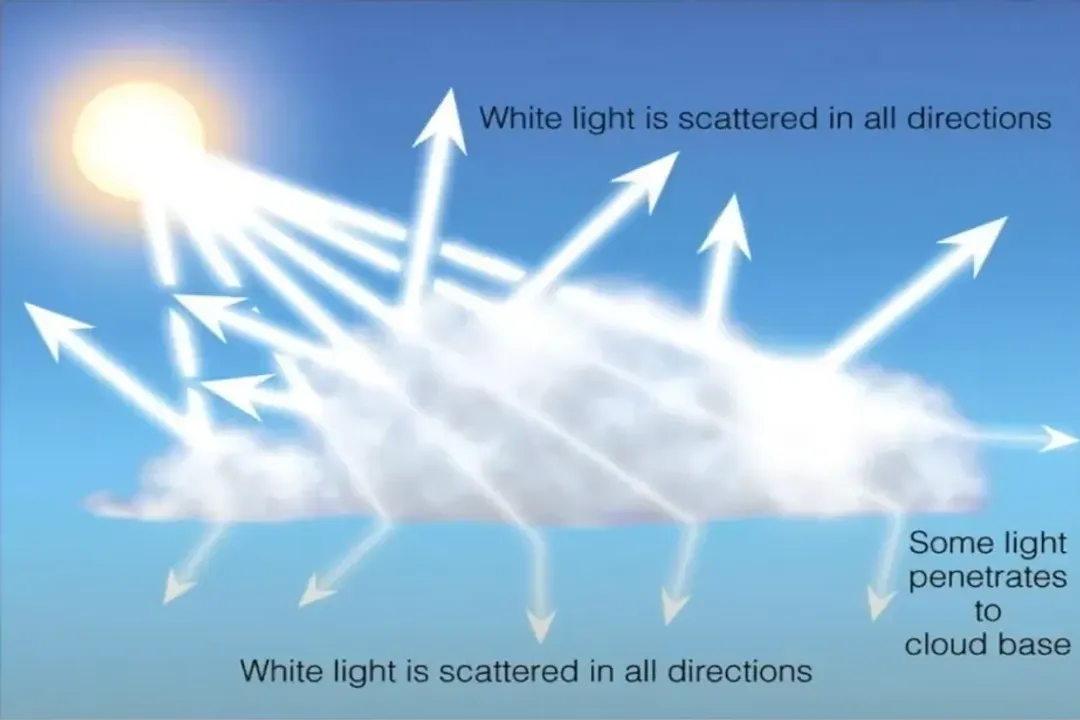
When sunlight—which is white light, composed of all colors of the spectrum—hits these water droplets, the interaction is governed by particle size. If the water droplets are small, roughly the same size as or larger than the wavelength of visible light, they cause what is known as Mie scattering. [5] This is the key mechanism for whiteness. Unlike the gas molecules in the clear sky, which preferentially scatter shorter, bluer wavelengths (Rayleigh scattering) to make the sky blue, [9] the larger water droplets in a cloud scatter all visible wavelengths—red, orange, yellow, green, blue, and violet—almost equally. [5][7] When all colors are scattered back toward our eyes in equal measure, the result is white. [7]
# Size Matters
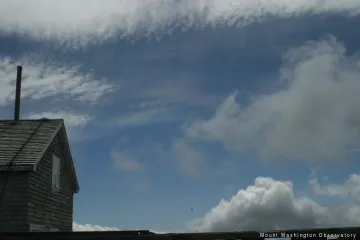
Consider the difference between a thin wisp of cirrus cloud and a towering cumulonimbus. A thin cloud or a cloud composed of very small droplets will appear brilliant white because nearly all the incident sunlight is scattered back to the observer without significant loss. [1][2] However, the moment a cloud layer thickens, the story changes. The process of light entering, scattering multiple times, and eventually exiting the cloud volume becomes critical. [5]
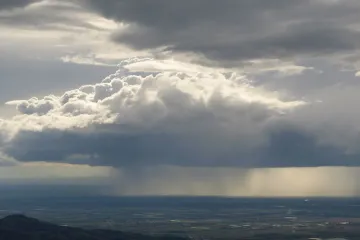
For a cloud to appear dark, the light must be prevented from reaching the observer's eye. This happens not because the water droplets absorb the light effectively (they don't, much more than clear air does) but because the path length of the light through the cloud becomes too long. [1][7] In a very thick cloud, such as a heavy rain cloud or a large cumulonimbus, light entering the top surface is scattered forward, upward, and downward so many times that much of it is scattered back out the top or is simply absorbed into the cloud's deep interior before it can travel all the way down to the base observer. [1][5] The base of the cloud, therefore, appears grey or even black because it is primarily illuminated by the ambient light that managed to penetrate the entire depth, which is significantly less intense than the direct sunlight striking the cloud tops. [7]
| Cloud Density Factor | Primary Light Effect | Perceived Color |
|---|---|---|
| Very Thin/Small Droplets | Near-perfect Mie scattering of all wavelengths | Brilliant White [1][2] |
| Moderate Thickness | Increased internal scattering path length | Lighter Grey [7] |
| Very Thick/Deep | Significant light attenuation/backscatter from top | Dark Grey to Black Base [1][5] |
# Atmospheric Hues
While the default state based on Mie scattering is white, the most dramatic colors occur when the sun is near the horizon, such as during sunrise or sunset. [4] This phenomenon is a consequence of the increased distance sunlight must travel through the atmosphere to reach the observer when the sun is low in the sky. [9]
# Long Path Scattering
When the sun is low, its rays travel through a far greater volume of atmosphere than when it is overhead. [9] During this long transit, the shorter wavelengths—the blues and violets—are scattered away by air molecules so efficiently that very little of that light reaches the observer or illuminates the clouds directly. [4] What remains in the direct beam are the longer wavelengths: reds, oranges, and yellows. [9] When these deeply saturated colors strike the white water droplets in the cloud, the Mie scattering process faithfully reflects these surviving colors back down to the ground, painting the cloud bases in fiery hues. [4] A high-altitude cirrus cloud, being thin, can catch this light brilliantly, while a low, thick stratus cloud might only show a subtle orange tinge on its very lowest layer. [2]
This is where one can appreciate the dual nature of atmospheric optics. The sky near the low sun appears red because the blue light has been scattered out of the line of sight, [9] while the clouds appear red/orange because they are reflecting the light that remains in the line of sight after that scattering has occurred. [4]
# Perception Versus Reality

It's worth spending a moment differentiating between the perceived color and the physical state. When we see a cloud as yellow, it is not because the water itself has changed its refractive or reflective properties to favor yellow light; it is because the illumination source has been filtered by the atmosphere. [5] An astronaut viewing clouds from above, looking down at the unscattered sunlight reflecting off the cloud tops, would likely see them as pure, blinding white, irrespective of the sunset occurring below. [1]
One interesting observation is how quickly color shifts can occur. During a rapid sunset, the transition from brilliant white-gold to deep crimson can take mere minutes. [4] If you track a single, stationary cumulus cloud, you might notice its base shifting from bright white (midday sun overhead) to a dull grey (late afternoon shadow) to a vibrant orange, all without the cloud moving or changing its internal water content; only the angle of the illumination source has changed. [9]
If you are trying to gauge the general health of a storm system, look not just at the base, but at the contrast between the illuminated top and the shadowed base. [6] A high-contrast structure—a brilliant, almost metallic white top casting a very dark, purplish-grey shadow on the base—indicates a very deep cloud with immense vertical development, often signifying strong updrafts and potential severe weather. The intensity of the shadow is often a better indicator of the cloud's energy than the color of the base alone. [6]
# Uncommon Colors
While white, grey, and sunset tones dominate, clouds can occasionally display other striking colors, primarily pinks, greens, or even blues.
# Pink and Red
Beyond sunset, intense pinks and reds can sometimes be observed. This is often due to very specific conditions where the atmosphere is filled with fine particles, perhaps from smoke or volcanic ash, which increase the scattering of light even further than normal air molecules do. [4] These fine particles act like a secondary filter, emphasizing the red end of the spectrum even when the sun is slightly higher than the typical sunset angle.
# Green Tints
Green clouds are rare and often associated with severe weather, particularly large hailstorms or intense thunderstorms. [4] The physics behind this is still debated, but the leading theory suggests it is related to the massive volume of water or ice within the storm cloud interacting with the reddish light of a setting or low sun. [4] The cloud effectively filters out the red and yellow light that manages to penetrate its depths, leaving the surviving light that reaches the observer slightly skewed toward the blue-green end of the spectrum, a subtle effect amplified by the immense depth of the water load. [4]
# Cloud Type Coloring
The appearance defined by the WMO often reflects the physics of thickness and altitude. [2]
- Cirrus: These high-altitude clouds are thin, composed of ice crystals. They scatter light very efficiently without significant attenuation, so they appear brilliant white, often exhibiting iridescence if the crystals are uniformly sized. [2]
- Cumulus: These are the classic puffy clouds. The tops are brilliant white due to excellent Mie scattering. However, if they grow vertically into Cumulus congestus or Cumulonimbus, the bases become shaded grey because of the distance light must travel to illuminate the bottom. [3][7]
- Stratus: These are featureless, sheet-like clouds that often cover the entire sky. If thin, they are a uniform pale grey-white. If thick and low, they are often a dull, uniform grey because the sun is completely obscured, and they are only reflecting diffused, weak ambient light. [2]
Observing cloud color provides a direct, real-time assessment of atmospheric conditions. If you find yourself under a cloud base that seems to be absorbing nearly all light—a very dark, flat grey—it is worth noting the time of day. If it is midday, the cloud is likely dense enough to hold significant moisture or is extremely deep. If it is near sunset, the darkness might just be the result of a thick veil blocking the low, directional light, rather than an indication of extreme internal activity, which is a nuance essential for non-meteorologists to grasp. [2][6] Pay attention to the ground where the cloud casts a shadow; if the shadow is almost invisible or nearly black, the cloud overhead is significantly thicker than one casting a distinct, blue-tinted shadow.
In essence, the "actual color" of a cloud is white, the color of sunlight perfectly scattered by uniform, relatively small water droplets. [5] Every variation—from the deepest thundercloud black to the most vibrant sunset red—is a visual fingerprint documenting the precise path length, density, and angle of illumination that the light has experienced on its way to your eye. [9]
Related Questions
#Citations
What is the true colour of clouds? - Quora
Colour | International Cloud Atlas
Cloud - National Geographic Education
The Colorful Canvas Above: Decoding Why Clouds Display Such ...
The colour of clouds - Physics Stack Exchange
what is the color of clouds and why? - Facebook
Eli5: If water is transparent, why are clouds white? : r/explainlikeimfive
Cloud - Wikipedia
The Color of Clouds and The Color of the Sky: A Dance of Light and ...