What is the rarest cloud color?

The most extraordinary colors painted across the sky are rarely random splashes of pigment; they are the result of precise atmospheric physics interacting with light, often requiring clouds composed of materials or existing at altitudes far outside the norm. While vibrant sunsets and the deep blue of a clear day are common, truly rare cloud coloration typically involves the phenomenon of light diffraction, which breaks sunlight down into its constituent spectral colors, mimicking a rainbow directly upon the cloud structure itself. [2][5] These striking displays hint at conditions few observers ever witness, involving ice crystals or water droplets of a specific, uniform size suspended in the atmosphere. [5]
# Cloud Iridescence Explained

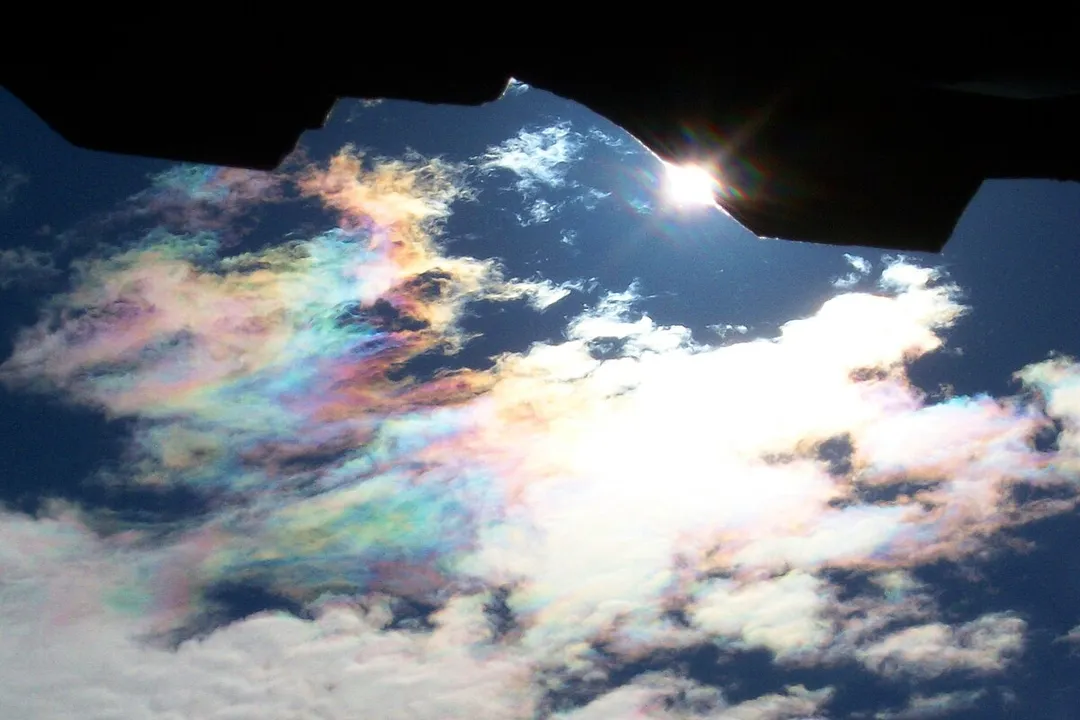
The visual effect often sought after when searching for rare cloud color is known as cloud iridescence. [5] This phenomenon is characterized by patches of pastel colors, sometimes vibrant, appearing within or adjacent to a cloud, often near the sun or moon. [2][5] It is distinct from a traditional rainbow, which is caused by refraction and reflection within individual raindrops. [2] Iridescence occurs through diffraction, where light waves bend as they pass around the edges of very small, uniformly sized water droplets or ice crystals within the cloud. [5]
The uniformity of the particles is key. If the water droplets or ice crystals are nearly identical in size, they scatter the light coherently, leading to distinct bands of color. [2] If the particle sizes vary significantly, the colors overlap and mix, resulting in a washed-out or milky appearance. [5] Typically, the brightest and most distinct iridescence is observed when the sun is relatively close to the cloud—usually less than 10 degrees away—and the cloud itself is thin and composed of supercooled water droplets or tiny ice particles. [2][8] Clouds frequently exhibiting this quality include altocumulus, cirrocumulus, and lenticular clouds. [5][8]
If you find yourself watching the sky and notice patches of pink, green, or violet within a high-altitude cloud near the sun, you are likely witnessing iridescence. [9] This effect can occasionally be seen near the moon as well, although the colors are typically much fainter because moonlight is reflected sunlight, already significantly dimmer. [2]
# Electric Blue Skies
While iridescent colors offer a spectrum, another distinct, rare color associated with an extremely high cloud type is the electric blue or silvery hue of Noctilucent Clouds (NLCs). [1] These are the highest clouds in Earth's atmosphere, often called "night-shining clouds" because they become visible long after sunset or before sunrise. [1]
NLCs are fascinating because they exist in the mesosphere, roughly 47 to 53 miles (76 to 85 kilometers) above the surface. [1] At these altitudes, they are illuminated by sunlight that has already passed below the horizon for the observer on the ground. [1] Their characteristic bluish-white or electric blue color comes from the scattering of sunlight by the extremely tiny ice crystals that make up these clouds. [1] Because they are so high, they can appear to linger in the sky during twilight hours when lower-level clouds are already shadowed. [1]
Thinking about the required conditions, the extreme altitude of NLCs means they form where the atmosphere is incredibly thin, requiring water vapor to freeze onto meteor smoke or other fine particles. [1] This makes them rare to see not because of a temporary atmospheric alignment like iridescence, but because they require a specific, sustained climatic regime at the very edge of space. [1]
# Stratospheric Secrets Nacreous Clouds
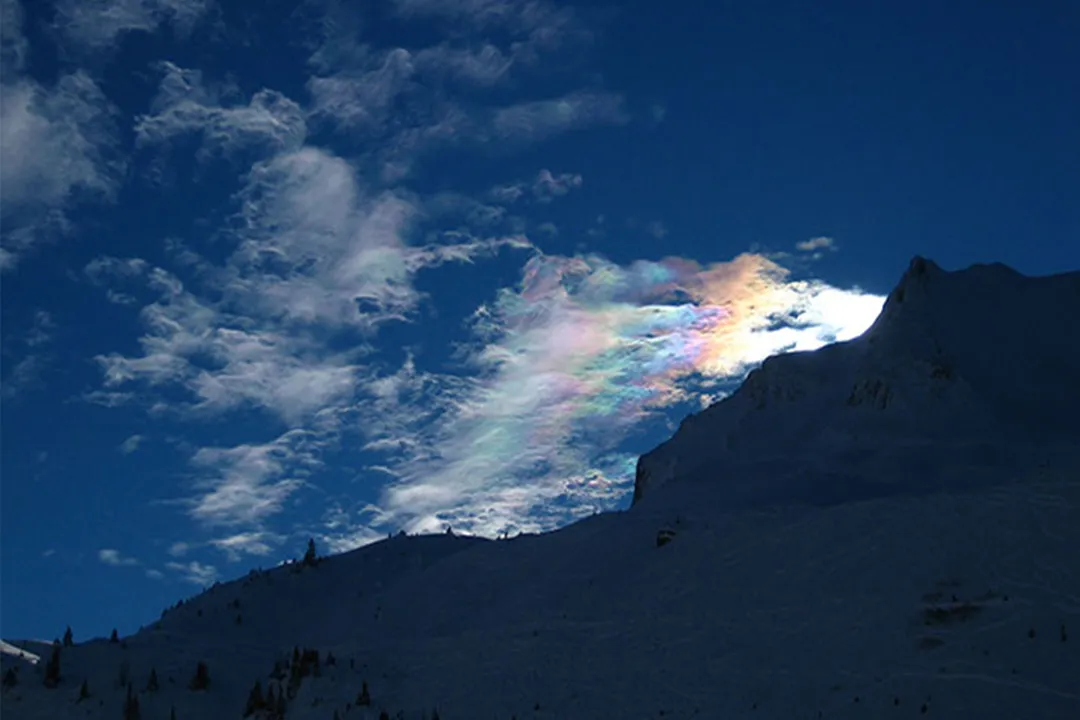
When trying to pinpoint the absolute rarest cloud color or phenomenon, attention turns to the stratosphere, far beneath the NLCs but still much higher than typical weather clouds: Nacreous Clouds. [7][9] These clouds are also known by their scientific name, Polar Stratospheric Clouds (PSCs). [7] They are described as a gorgeous, super rare phenomenon that vividly displays rainbow-like coloration. [7][9]
The color displayed by Nacreous Clouds is essentially an extreme form of iridescence. [9] Because they form in the stratosphere, typically between 49,000 and 82,000 feet (15,000 to 25,000 meters), they catch the sun when it is significantly below the horizon, creating exceptionally bright and vivid iridescence compared to lower-level displays. [7] The name "nacreous" itself refers to mother-of-pearl, describing the shimmering, pearlescent quality of their colors. [7]
These clouds are considered much rarer than standard iridescence or even NLCs because their formation requires very specific conditions: extremely low temperatures in the stratosphere, usually below -78°C (-108°F). [7] While iridescence can happen on any given afternoon with the right thin cloud, Nacreous Clouds generally require the deep cold of winter in polar or near-polar regions, although they have occasionally been spotted further south in places like Scotland. [7] The presence of these PSCs is also chemically significant, as they can provide surfaces for ozone-depleting chemical reactions, linking their beautiful, rare color to important atmospheric chemistry concerns. [7]
If we compare the known occurrences, while iridescent clouds are an intermittent event visible globally under the right circumstances, Nacreous Clouds are confined by geography and extreme cold, marking them as the most elusive colorful spectacle mentioned here. [2][7][9]
# Viewing the Rarities
Understanding where and when to look significantly impacts the chance of seeing any of these colorful anomalies. For the common, albeit lovely, iridescence, the best time is when thin cirrus or altocumulus clouds are present, and the sun or moon is low in the sky—often within 30 degrees of the horizon, though less than 10 degrees provides the best diffraction. [2][8] A person might associate the sudden appearance of pink and green flashes in a cloud layer with an approaching weather front, given the necessary moisture dynamics involved in forming the requisite particle distribution. [5]
For the highest clouds, the NLCs, observation must occur during deep twilight, when the sky immediately above the horizon is dark enough to provide contrast against the sunlit high-altitude ice crystals. [1] The electric blue they exhibit is a strong marker distinguishing them from any other twilight glow.
The rarest sights, the Nacreous Clouds, demand winter conditions in high latitudes, or very rare, extremely cold stratospheric intrusions elsewhere. [7] They shine brightest when the observer is in shadow, viewing the stratosphere above the darker horizon, similar to NLCs, but their location is much lower than NLCs, yet significantly higher than tropospheric clouds. [7] One key difference in experience between viewing NLCs and Nacreous Clouds is that while NLCs look thin and wispy against the blackness of space, Nacreous Clouds often display a more substantial, almost sculptural quality due to their density in the stratosphere, leading to that pronounced mother-of-pearl sheen. [1][7]
A helpful consideration for the dedicated sky watcher is recognizing that while the color of iridescence is caused by particle size, the color of NLCs is determined by the scattering properties of their ice, and the intense color of Nacreous Clouds is a product of both particle composition (which can include nitric acid and water) and their extreme illumination angle. [1][5][7] This means seeking out iridescence is a matter of cloud type and sun angle, whereas seeking out the rarest colored clouds is a matter of extreme altitude and temperature. [1][7]
# Analyzing Atmospheric Requirements
The distinction between the rarest cloud color and simply a colorful cloud lies in the atmospheric layers involved. Tropospheric clouds (where most weather happens) can produce iridescence. [5] To get this, you need liquid water droplets or ice crystals that are nearly identical in size, usually around 10 micrometers or less. [2] The sporadic nature of this display relates to the brief lifespan of these perfectly sized droplets before they grow or evaporate, ending the diffraction effect. [5]
However, both NLCs and PSCs exist in stable, very cold layers far above where weather systems churn. NLCs are nearly pure ice suspended on meteor dust in the mesosphere. [1] PSCs are chemically more complex, involving nitric acid and water to form ice crystals in the stratosphere. [7] The rarity of the Nacreous Cloud's vibrant color, therefore, is not just about light scattering, but about the confluence of polar winter conditions that allow that specific chemical composition to freeze out at that specific height. [7] If the stratosphere warms even slightly, the clouds dissipate, and the rare color vanishes.
It might be interesting to note that while many online accounts featuring spectacular cloud colors are often tagged as "UFOs" or "sky anomalies" due to their unreal appearance, [3][7] learning the science behind diffraction (for iridescence) and extreme altitude ice formation (for NLCs and PSCs) demystifies them while simultaneously increasing appreciation for the precise conditions required to paint the sky so vividly. [2][5] For instance, one common mistake observers make is confusing the wide-angle spectrum of a low-hanging rainbow caused by large raindrops with the tight, patchy colors of true iridescence occurring high up in a thin veil of cloud. [2][9] The latter requires far less water vapor in the atmosphere overall, but highly controlled particle size distribution.
# A Sky-Watcher's Guide to Rare Color Hunting
For those aiming to witness the rarest of these sights—the iridescent colors of the Nacreous Clouds—the approach is different from casual viewing. First, prioritize latitude; look towards the northern or southern extremes during winter months, ideally near the winter solstice when twilight lasts longer, maximizing the hours the sun illuminates high-altitude layers while the ground remains dark. [7] Second, monitor local forecasts not just for weather, but for the possibility of strong stratospheric cooling, which is the prerequisite for PSC formation. [7]
If you are aiming for general iridescence, which is more frequently seen, remember that you must look toward the sun. [2] Do not stare directly at the sun, but rather examine the clouds immediately adjacent to it or just past the edge of a partial obstruction like a building or a nearby, thicker cloud patch. [8] If the cloud patch appears to have distinct, overlapping color bands—especially blues, greens, and pinks—that shift slightly as the cloud moves, you are successfully observing diffraction. [5] In contrast, if you are looking for the electric blue of NLCs, you must wait until the sun is about 6 to 16 degrees below the horizon, and look towards the northern horizon in the Northern Hemisphere. [1] The color will be unmistakable against the darkening sky. [1] These observational requirements—specific timing, specific sky location, and specific cloud texture—illustrate why these colorful events remain special; they demand patience aligned with meteorological chance. [1][2][7]
Related Questions
#Citations
Noctilucent Clouds : a rare phenomenon happening this summer
What Are Rainbow Clouds? | NESDIS
Cloud Iridescence and Rainbow Colors in Clouds - Facebook
A Rare Cloud Phenomena #snow #outdoors #northernlights ...
Cloud iridescence - Wikipedia
it's called cloud iridescence. This rare atmospheric phenomenon ...
A rare phenomenon called nacreous clouds. They are formed high ...
Iridescent Clouds - Mount Washington Observatory
Gorgeous, super-rare cloud looks like a rainbow portal - Grist