Why do clouds collapse?
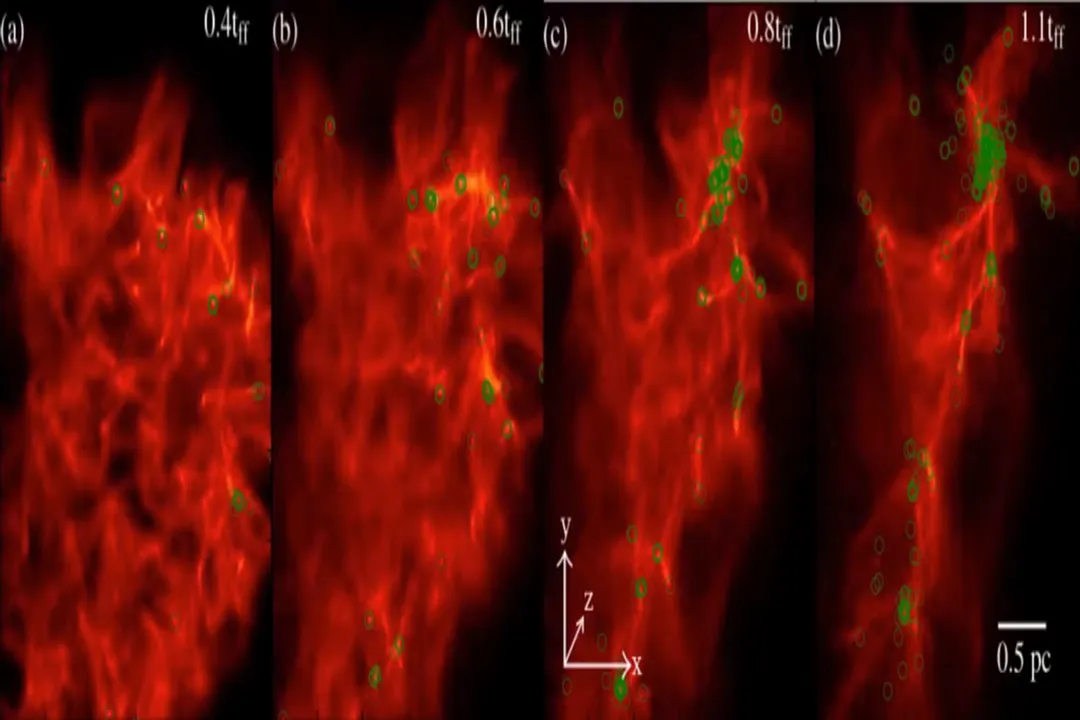
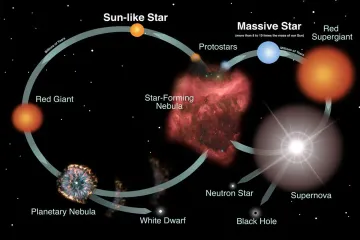
The descent of a vast cloud of gas and dust, often spanning light-years across the cosmos, into a more compact, structured form is one of the most fundamental processes in astrophysics. Whether this process results in the birth of a star or the final state of a dying stellar remnant, the underlying mechanism is a battle between inward pull and outward push. [1] These interstellar clouds, known as molecular clouds when cold enough to form molecules, are the nurseries of the galaxy. [3][5] For collapse to commence, the cloud’s inherent self-gravity must somehow overcome the various pressures attempting to keep it puffed up and stable. [1][4]
# Cloud Makeup
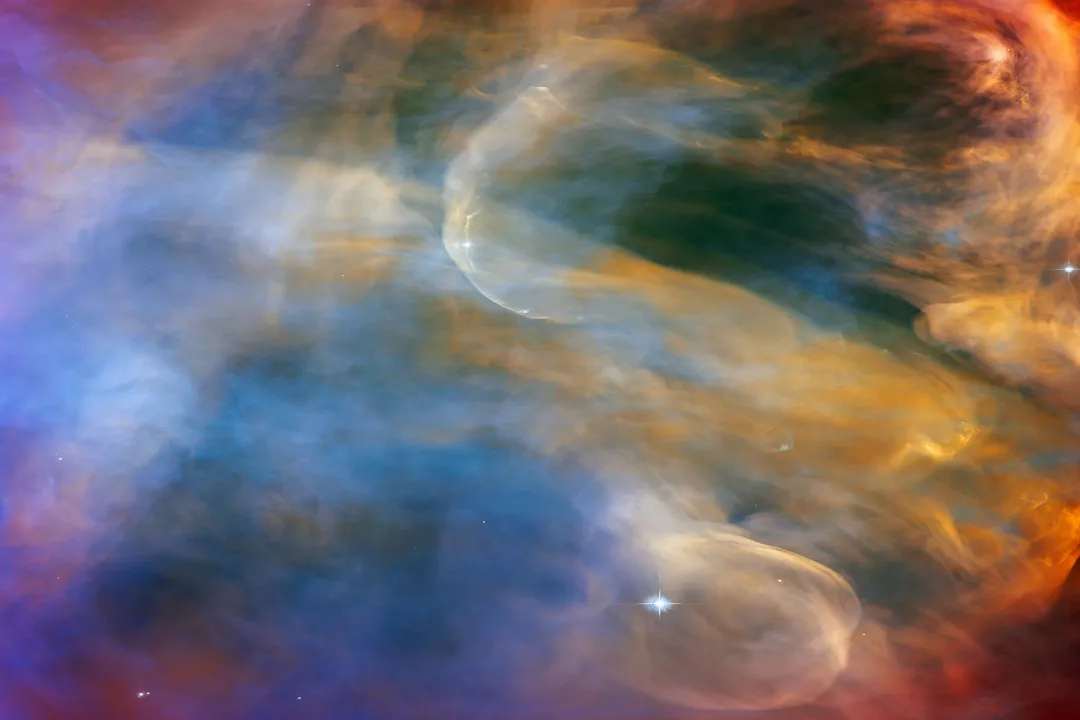
The material making up these cosmic structures is far from uniform. While we often speak of "gas clouds," these regions, particularly those poised to form stars, are complex mixtures of molecular hydrogen, atomic hydrogen, helium, and traces of heavier elements condensed into microscopic dust grains. [3][5] For gravitational instability to set in, the cloud must often be relatively cold, possessing low internal thermal energy, which minimizes the outward thermal pressure. [4] Although the overall density of a large molecular cloud might seem insignificant compared to air on Earth, local regions within them—cores—can achieve densities millions of times greater than the average interstellar medium. [5]
# Force Balance
Gravitational collapse hinges on a dynamic equilibrium, or rather, the breaking of one. The primary outward forces resisting gravity are thermal pressure, magnetic field pressure, and turbulent motion within the cloud. [4][6] Thermal pressure results from the random motion of the gas particles; hotter gas exerts a stronger outward push. [4] Magnetic fields, frozen into the plasma component of the cloud, can also exert a significant resistance, sometimes acting like an elastic spring opposing compression. [6]
Turbulence—the chaotic, swirling motions of gas within the cloud—is often the most significant non-thermal pressure source resisting collapse in large, cold clouds. [4] Turbulence effectively acts to stir the cloud, preventing gravity from collecting material in one place effectively. [6] Therefore, a cloud begins to collapse not just because gravity exists, but because gravity manages to overcome this combined outward resistance. [1][4]
# Jeans Criterion
The physical condition determining whether a cloud will collapse under its own weight is mathematically described by the Jeans Instability. [4] This concept defines a critical threshold known as the Jeans Mass (). If a region of the cloud has a mass greater than its Jeans Mass under the current temperature and density conditions, gravity will inevitably win, leading to collapse. [1][4] Conversely, if the mass is less than the Jeans Mass, the internal pressure is sufficient to support the cloud against its own gravity. [4]
The Jeans Mass is inversely related to the square of the temperature and directly related to the density of the gas. [4] This relationship highlights a critical pathway for collapse: if the cloud cools down, its Jeans Mass drops dramatically. Even if the cloud’s total mass remains the same, it can suddenly find itself exceeding this new, lower mass limit, triggering collapse. [6] It is often localized cooling, rather than a massive increase in total mass, that pushes a specific region past its critical instability point. [4]
To place this in context, a cloud might be stable overall, but if density fluctuations occur—perhaps a slight local increase in particle count—that specific over-dense region might cross its local Jeans Mass threshold while the rest of the cloud remains stable. [8]
| Condition Change | Effect on Jeans Mass () | Resulting Stability |
|---|---|---|
| Temperature (Heating) | Less likely to collapse | |
| Density (Compression) | More likely to collapse | |
| Turbulence Damping | Effective Pressure | More likely to collapse |
| Magnetic Field Strength | Effective Pressure | Less likely to collapse |
If we consider a very large, cold molecular cloud, its Jeans Mass might be hundreds or even thousands of solar masses. However, within that structure, smaller clumps form, each with its own local Jeans Mass. The process of star formation is thus a cascade where these smaller clumps collapse first, fragmenting the larger structure over time. [5][6] A local environment that is slightly colder or slightly denser than its surroundings has a distinct advantage in initiating its own gravitational fate, even if the bulk of the gas remains loosely bound.
# External Triggers
While internal instability driven by the Jeans Criterion is the ultimate cause, external events often provide the necessary initial "nudge" to make a marginally stable cloud suddenly unstable. [7] These environmental factors are crucial for seeding the initial density enhancements needed for star formation to begin across the galaxy. [7]
One powerful trigger involves the collision of molecular clouds. [7] When two massive clouds collide, the resulting shock front compresses the gas dramatically over a vast region, instantaneously increasing the local density far beyond what internal dynamics might achieve alone. [7] This rapid compression pushes many areas across the threshold, initiating numerous collapse events simultaneously. [7]
Similarly, nearby energetic events can serve as external compressors. The expanding shell of gas ejected by a supernova explosion acts like a cosmic snowplow, sweeping up and compressing the diffuse interstellar medium in its path. [7] If this swept-up material happens to be a pre-existing, marginally stable molecular cloud, the shock compression can force it into gravitational collapse. [7] Even the movement of gas through the spiral arms of a galaxy can create sufficient shearing and compression to initiate the process. [7] In these scenarios, the external agent is not providing the energy for the final collapse, but rather providing the condition—the requisite high density—that allows gravity’s existing pull to become dominant.
# Collapse Dynamics
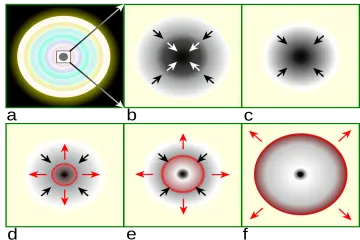
Once gravity wins and the Jeans criterion is violated, the collapse process itself is complex and not uniform. The gas does not simply fall straight inward onto a single point; instead, the cloud fragments into smaller, denser clumps. [5] This fragmentation is driven by the fact that as the initial cloud collapses, the density increases, which in turn lowers the Jeans Mass for the newly formed sub-regions, causing them to become gravitationally unstable and collapse independently. [6]
This fragmentation creates a hierarchy of collapsing cores, leading to the formation of star clusters rather than isolated single stars in most cases. [5] Furthermore, the initial turbulence that was once a stabilizing force becomes coupled with the collapse. As the core contracts, the internal motions must either dissipate or be overcome by the gravitational infall velocity. [6] If the collapse is rapid and the turbulence is overcome, a protostar begins to form at the center of the collapsing region. [4] The process is inherently dynamic; what begins as a slow, diffuse pressure battle rapidly transitions into an accelerating inward rush once the critical density is achieved.
Related Questions
#Citations
Gravitational collapse - Wikipedia
Collapsing Clouds - an overview | ScienceDirect Topics
How do star-forming clouds and star clusters arise? | Lee Hartmann
In the context of the formation of stars, how is a gravitational collapse ...
Gravitational Collapse
molecular cloud collapse
When Clouds Collide, Destruction and Creation Go Hand-in-Hand
Why does the gas cloud collapse in regions of high density?
Entropy of turbulent-gravitating molecular cloud collapse - NASA ADS