What process creates layers in planets based on composition and density?
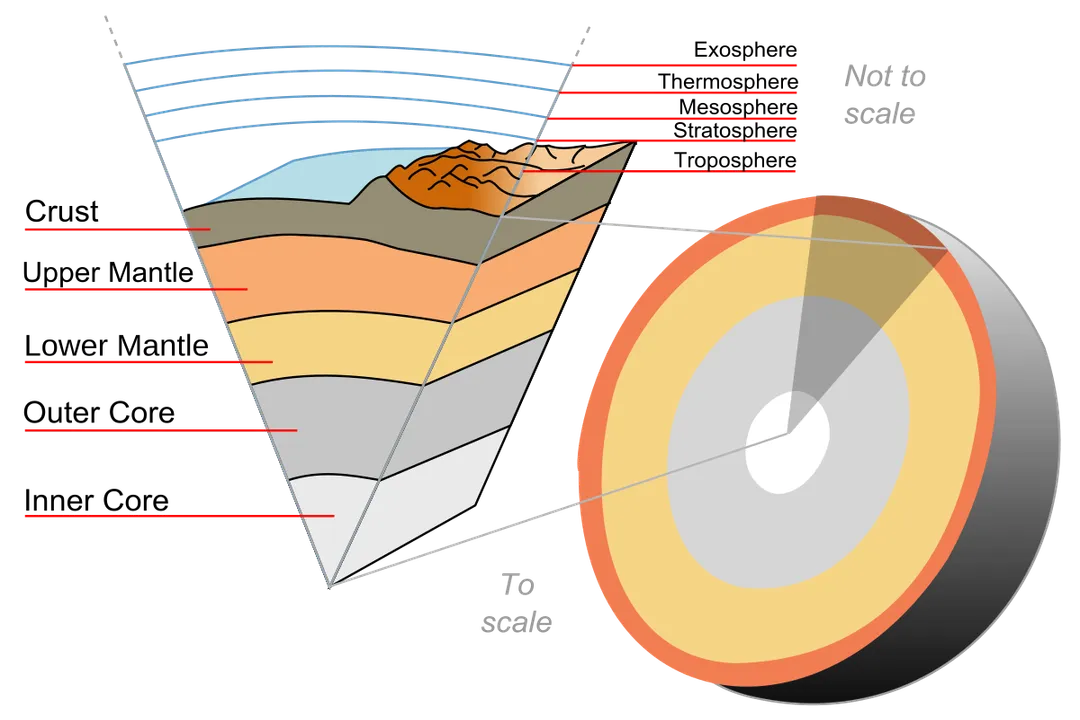
The process that sculpts planets into distinct, concentric layers—like an onion sliced through its center—is a fundamental concept in planetary science known as planetary differentiation. [1][5] This happens because, early in a planet’s life, the bulk of its material sorts itself out based on composition and, critically, density, driven primarily by the relentless pull of gravity. [1][3][9] Think of it as a massive, planet-sized settling process, where the heaviest components sink toward the center while the lightest constituents float toward the surface. [9]
# Gravity Sorting
The engine driving this stratification is simply density. In the early stages of a planet's formation, when it is still very hot, the rock and metal that make up the body are not rigidly fixed in place; they possess a degree of fluidity, whether fully molten or soft enough to creep over geological timescales. [5][6] Gravity acts upon these materials, seeking to minimize the planet’s overall gravitational potential energy. [1][3]
Denser materials, such as iron and nickel, have a greater mass packed into the same volume, making them heavier under a planet’s gravity than less dense materials like silicate minerals. [2][9] Therefore, the heavy stuff moves inward, sinking through the less dense material until it reaches the center, forming the metallic core. [2][5] Conversely, the lighter materials, like the silicates that form rock, migrate outward, rising toward the surface to create the mantle and eventually the crust. [9][4] This separation isn't a single event but a prolonged phase in a planet's evolution, often happening within the first tens of millions of years after accretion. [5][2] For rocky planets, the end result is typically a differentiation into a metallic core, a silicate mantle, and a thin crust. [3]
# Energy Drivers
For gravity to effectively sort matter, the material must be mobile. A cold, solid planet would resist this sorting, leaving a largely homogeneous mixture of rock and metal mixed together. The key to unlocking differentiation is heat. [5] A planet needs to reach a temperature high enough to melt or partially melt a significant portion of its interior. [5][9]
The initial heat required to kickstart this process comes from three main sources related to planetary assembly:
- Accretional Heating: As smaller planetesimals collide and stick together to build a planet, the kinetic energy of those impacts is converted into thermal energy, heating the growing body. [2][5]
- Compression: The immense weight of overlying material compresses the interior, generating heat, similar to how a bicycle pump gets hot when compressing air. [2]
- Radioactive Decay: Early in a solar system's life, there was a higher concentration of short-lived, highly radioactive isotopes (like Aluminum-26). The decay of these elements within the planet’s interior provided a long-lasting internal furnace, keeping the rock fluid for extended periods. [5][2]
Once this temperature threshold is crossed and the planet enters a molten state, the density sorting can proceed rapidly. [5] This molten phase allows the iron to dissolve out of the silicate magma and pool in the center. [2]
# Layer Formation
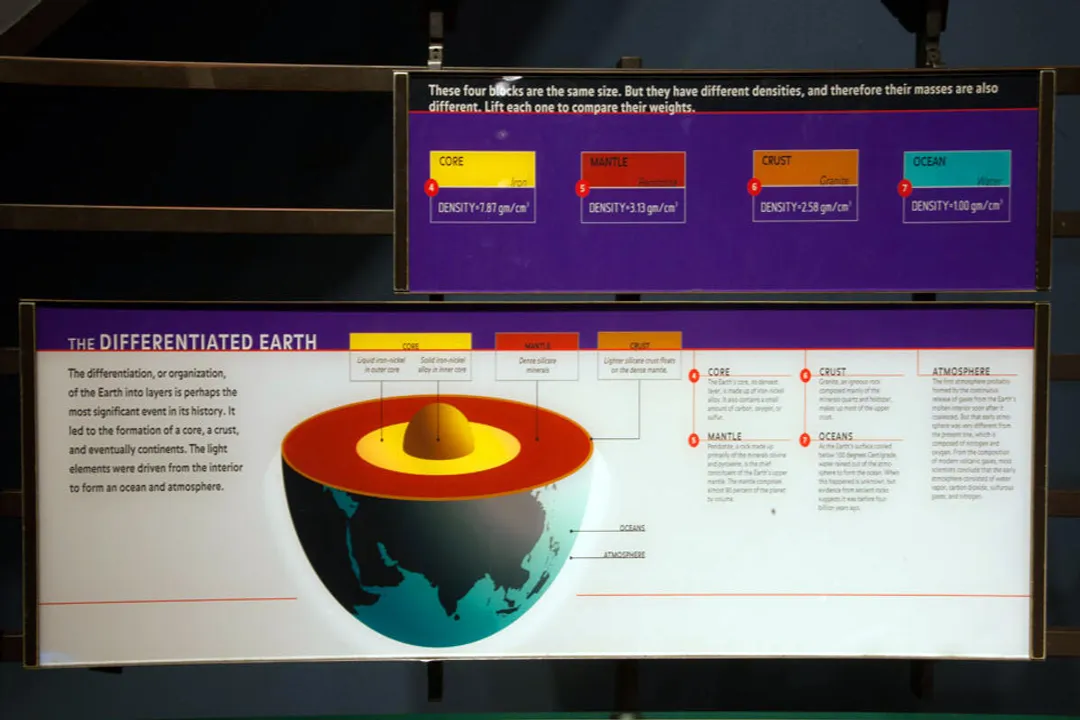
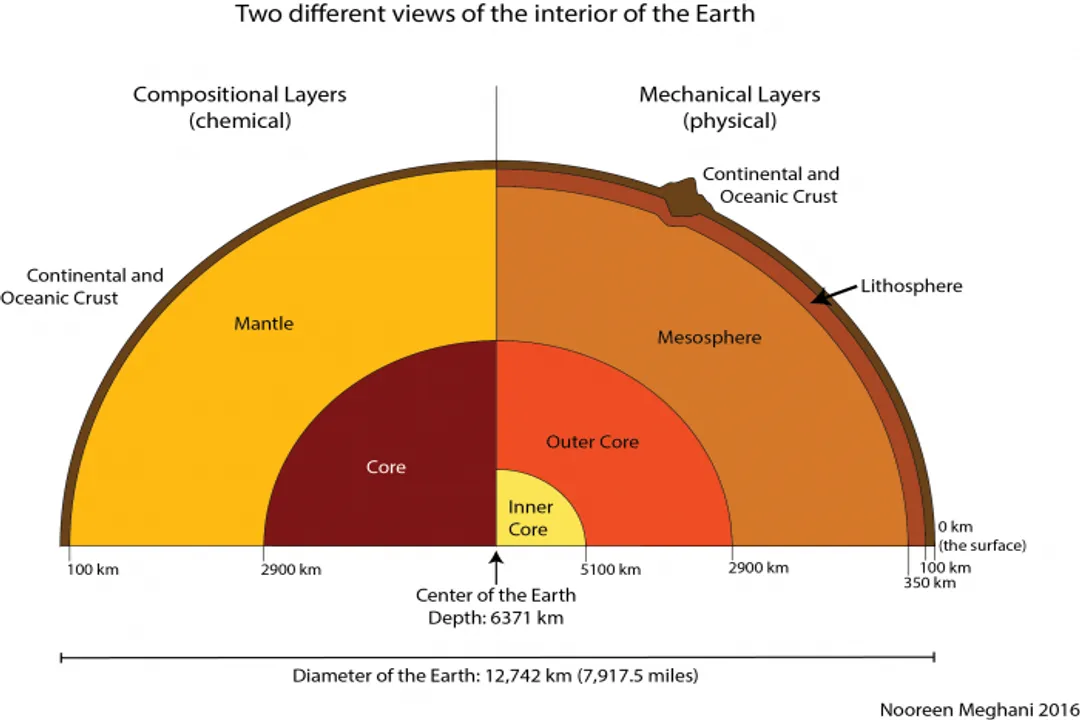
The mechanics of differentiation result in specific, chemically distinct shells. On Earth, for example, the differentiation process created three primary layers, though the core itself is often split into two sub-layers. [4][8]
The densest elements, primarily iron and nickel, sink to form the core. [2][9] Because the Earth is so large, the pressure at the center is so intense that the inner core, despite being hotter than the outer core, is forced into a solid state. [2] The slightly less dense, yet still overwhelmingly metallic, material sits in the outer core, which remains liquid, allowing for convection currents that generate our planet’s magnetic field. [2]
Above the core sits the mantle, a thick layer composed mostly of silicate minerals rich in magnesium and iron. [2][4] While rock, the mantle material is under extreme heat and pressure, allowing it to deform and flow very slowly over millions of years—a critical process for plate tectonics. [8] Finally, the lightest silicate materials—those depleted in heavier elements like iron—rise to the top, forming the crust. [2][9]
When examining the major components by volume and average density, the progression is clear:
| Layer | Primary Composition | Approximate Density (g/cm³) | State |
|---|---|---|---|
| Crust | Silicates (light) | Solid | |
| Mantle | Silicates (Mg, Fe rich) | Mostly solid, ductile | |
| Outer Core | Iron, Nickel | Liquid | |
| Inner Core | Iron, Nickel | Solid |
Understanding this stratification helps us interpret remote sensing data from other worlds. If a planet has a very high bulk density relative to its size, we can infer that a larger proportion of its mass is composed of heavier elements near the center, suggesting a very efficient differentiation process compared to a less dense body of similar size. [6]
# Terrestrial Result
Earth provides the best-studied example of a fully differentiated body. [4][8] The separation of iron into the core is a massive chemical shift; if the Earth were not differentiated, its surface rocks would contain far more iron than they currently do. [2] The movement of that molten iron not only formed the core but also fundamentally altered the chemistry of the surface and the atmosphere, as lighter, volatile elements were released from the interior during outgassing. [2]
It is interesting to consider that while the primary differentiation event sorts iron and silicates, a secondary differentiation process happens within those layers over billions of years. [1] For instance, in the mantle, lighter minerals can migrate upward relative to heavier ones, and in the core, the lighter elements dissolved in the liquid outer core can precipitate out onto the solid inner core, effectively purifying the inner core over time. [1]

# Other Worlds
Planetary differentiation is not exclusive to Earth; it is a process expected for any body large enough and hot enough to undergo melting. [4][6]
For other terrestrial planets like Mars and Venus, evidence suggests they also differentiated into core, mantle, and crust, though their final structures differ due to size and thermal history. [4] Mars, being smaller, cooled faster and thus has a proportionally smaller core than Earth. [6] Venus, however, may have had a more recent period of intense resurfacing, suggesting its differentiation history is more complex or protracted than Earth’s. [4] Mercury, being very small and having lost much of its original mantle, presents an extreme case with a disproportionately large metallic core. [6]
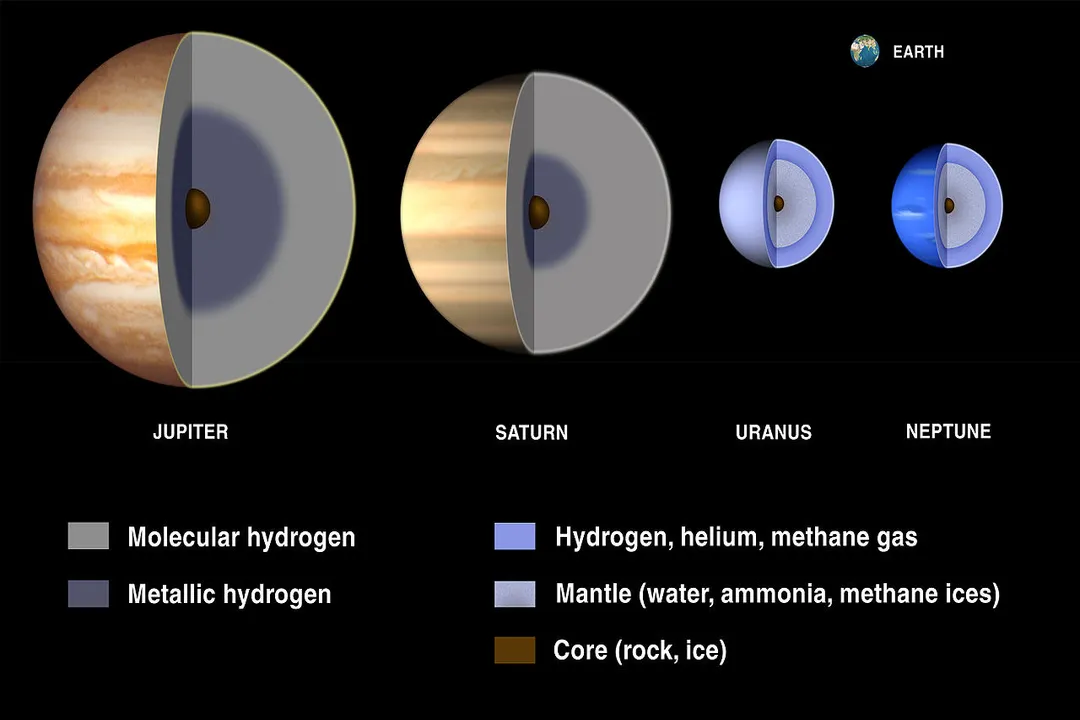
The giants present a different picture. Gas giants like Jupiter and Saturn are primarily composed of hydrogen and helium, which never undergo the same rock/metal separation process. [4] Their structure is defined by gradients in pressure and temperature, leading to layers of gaseous, liquid metallic, and perhaps a dense, fluid or rocky core, but the driving force for the rock/metal separation observed in terrestrial planets is absent in the dominant outer layers. [4][6]
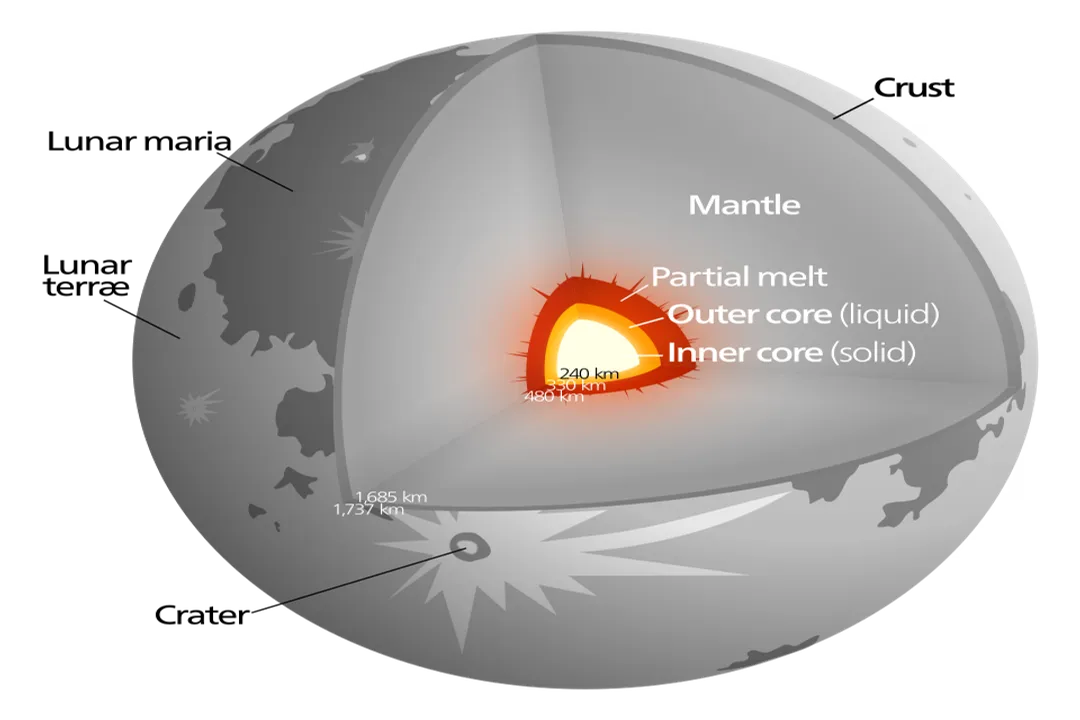
The speed at which a body cools dictates how complete its differentiation is. Small bodies, such as asteroids or the Moon, experienced less accretion heating and less internal heat from radioactive decay. They may have only undergone partial differentiation, or perhaps just enough heating to cause some iron droplets to segregate into small pockets rather than forming a single, large core. [6][9] A planetary body must retain enough heat for long enough to allow significant material migration. If the planet cools too quickly, the viscosity of the mantle increases rapidly, effectively freezing the less-sorted material in place before the heaviest elements can fully settle. This means the initial size of the protoplanet strongly influences its final internal architecture, setting the stage for its long-term magnetic field generation and volcanic activity. [5]
Related Questions
#Citations
Planetary differentiation
Earth's differentiation | Research Starters
3.3 Differentiation and Internal Structure
7.2 Composition and Structure of Planets | Astronomy
The Differentiated Earth
Planetary differentiation | Exoplanetary Science Class Notes
Tracing the Origins of Core, Mantle, and Crust - Big History
Layers of Earth | manoa.hawaii.edu/ExploringOurFluidEarth
Why does the Earth have Layers?