Why don't stars collapse?

The immense gravitational force pulling a star inward is relentless, an inescapable consequence of packing so much mass into a relatively small volume. It seems intuitive that any object that large should simply crush itself out of existence, yet stars like our Sun have been shining steadily for billions of years, maintaining a size that belies the crushing weight they carry. The answer to why stars don't collapse lies in a delicate, yet powerful, standoff between this inward pull of gravity and an equally strong outward push generated by the star's internal engine. [1][5]
# Force Balance
The key concept governing a star's stable existence is hydrostatic equilibrium. [1] Imagine a gigantic, perfectly balanced scale: on one side is the constant, overwhelming desire of all the star's mass to rush toward its center due to gravity, and on the other side is an opposing pressure generated by the superheated material within. [1][9] As long as these two forces are equal, the star remains stable, neither expanding nor contracting dramatically. [1]
This equilibrium is not static in the sense that nothing is moving; rather, it's a dynamic balance. Particles are constantly moving, reacting to minute changes in pressure and gravity, but the net effect is that the star maintains its shape and size for vast stretches of cosmic time. [1]
# Core Power
For stars like our Sun that are currently in their primary, or main-sequence, phase of life, the source of the outward pressure is thermal pressure generated by nuclear fusion occurring deep within the core. [2][4] In the Sun's core, temperatures are high enough—around $15$ million degrees Celsius—to force hydrogen nuclei to fuse together, creating helium nuclei and releasing enormous amounts of energy in the process. [2]
This energy is released primarily as photons (light and heat) and kinetic energy of the resulting particles. This intense heat causes the gas inside the star to expand outward, creating the necessary pressure to counteract gravity. [4][5] If the core starts to cool slightly, gravity momentarily gains the upper hand, squeezing the core further. This compression increases the density and temperature, which, in turn, speeds up the rate of fusion, generating more heat and restoring the outward pressure needed to push back against gravity. [1] This self-regulating mechanism is what keeps main-sequence stars shining predictably for billions of years. [1]
A useful way to frame this is to consider the structure: the pressure gradient must increase dramatically toward the center to support the overlying material. [9] In the Sun, the core produces the energy necessary to sustain this pressure gradient against the weight of everything above it. [1]
# Quantum Resistance
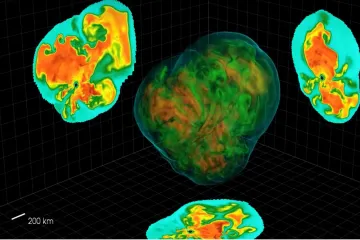
The story doesn't end when the central fuel—hydrogen—runs out. When a star exhausts the usable hydrogen in its core, fusion slows down or stops, the thermal pressure drops, and gravity begins to win, causing the core to contract and heat up again. [8] For stars that aren't massive enough to ignite heavier elements like carbon or oxygen, the collapse is eventually halted by an entirely different, non-thermal mechanism rooted in the strange rules of quantum mechanics: degeneracy pressure. [8]
This concept involves the Pauli Exclusion Principle, which states that no two identical fermions (like electrons or neutrons) can occupy the same quantum state simultaneously. [8] When gravity squeezes matter to extreme densities, as happens when a star exhausts its fuel, the electrons or neutrons become packed so tightly that this principle resists further compression, providing a powerful outward pressure that is independent of temperature. [8]
For stars similar to or less massive than the Sun, the remnant core stabilizes as a white dwarf, supported by electron degeneracy pressure. [4][8] This pressure is incredibly strong; it can resist the gravitational force of a mass comparable to the Sun, all contained within a sphere roughly the size of Earth. [8]
If the star is more massive, the collapse continues despite the electron degeneracy pressure. Gravity overcomes this support, forcing the electrons to combine with protons to form neutrons. The stellar remnant then contracts until it is supported by neutron degeneracy pressure, forming a neutron star. [8] This pressure is even stronger, compacting mass roughly $1.4$ to $3$ times the mass of the Sun into a sphere only about $20$ kilometers across. [8]
The contrast between the two main stabilizing methods is significant:
| Stabilization Method | Source of Pressure | Dependence on Temperature | Typical Stellar Remnant |
|---|---|---|---|
| Thermal Pressure | Kinetic energy from high-speed particle motion due to fusion heat [4][5] | High (Requires active fusion) | Main Sequence Star |
| Degeneracy Pressure | Quantum mechanical resistance to overlapping quantum states [8] | None (Quantum effect) | White Dwarf or Neutron Star |
This distinction shows that a star’s survival mechanism evolves. While fusion provides the active support for most of its life, degeneracy provides the passive, ultimate failsafe against complete collapse for lower-mass stars. [8]
# Mass Limits Stability
The ultimate fate of a star, and whether it can avoid collapsing entirely, is dictated by its mass, or more accurately, the mass of its collapsed core. [4] The supporting pressures, both thermal and degeneracy, have their limits. [8]
For low-mass stars, the remnant core mass stays below the Chandrasekhar limit (about $1.4$ solar masses), where electron degeneracy pressure is sufficient to maintain equilibrium, resulting in a stable white dwarf. [4] These stars simply run out of fuel, fade, and cease nuclear reactions, but they do not explode as supernovae because their gravity never becomes powerful enough to crush through the electron degeneracy barrier. [4]
If the remaining core mass exceeds this limit, the pressure can no longer hold. Gravity wins the battle against the electrons, triggering further collapse into a neutron star, which is supported by neutron degeneracy pressure. [4] If the core mass is even greater—exceeding the Tolman-Oppenheimer-Volkoff limit, which is a few solar masses—even neutron degeneracy pressure is overcome. [8] In this extreme scenario, nothing known can stop the collapse, and the object continues to shrink indefinitely, forming a black hole. [6][8] Gravitational collapse, in this ultimate sense, is only prevented if the residual mass is below a certain threshold. [6]
If we consider the immense gravitational binding energy involved, it highlights the sheer magnitude of the internal forces required to maintain stability. For instance, even a slight increase in core temperature in a main-sequence star leads to a rapid increase in fusion rate, causing the star to push back strongly, a phenomenon that is essential for its survival over billions of years. [1]
# Conceptualizing Equilibrium
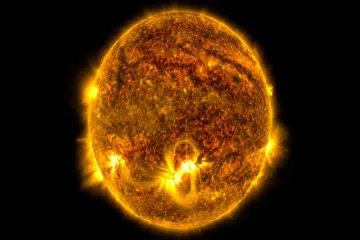
To appreciate the stability, consider the immense distances involved in the forces at play. The structure of the star is maintained by a gradient of pressure that varies across millions of kilometers, balancing the weight of the stellar material above. If you were to take a conceptual cross-section through a star like the Sun, you would find the density in the core is about $150$ times that of water, while the surface density is negligible. [2] Supporting that massive gradient requires a near-perfect balancing act between the density/temperature gradient (pressure) and the mass distribution (gravity). [9]
One interesting way to think about the stability of a star is that it is always collapsing, just very, very slowly, unless external energy is added. When fusion is active, the energy released creates a rate of expansion that perfectly offsets the rate of collapse due to gravity. When fusion stops, the star collapses rapidly until the next quantum barrier is reached, providing a new, temperature-independent balancing point. [8] This means the "why doesn't it collapse" answer depends entirely on which stage of stellar evolution you are observing.
# Stability in Crowds
The principle of balancing gravity applies even on the scale of star systems, though the mechanics differ. For example, globular clusters are dense collections of hundreds of thousands of stars gravitationally bound together. [7] With so many stars packed into a relatively small volume, one might expect the cluster's gravity to cause a rapid, centralized collapse into a single massive object.
However, these clusters remain relatively stable for very long periods. [7] This is because the stars within the cluster are moving with significant velocities, and the system is not perfectly uniform. [7] Interactions redistribute kinetic energy over time, allowing the system to gradually shed energy, which slows down the overall tendency toward collapse, preventing an immediate catastrophic implosion. [7] The process is incredibly slow, happening over timescales much longer than the age of the universe for most existing clusters. [7]
In summary, the reason a star does not collapse is not due to a single magical force, but rather a hierarchy of physical principles that assert themselves as the star ages and contracts. [8] Initially, it is the magnificent outward thermal push from nuclear fusion maintaining hydrostatic equilibrium. [1][2] When that fuel is spent, the star relies on the bizarre but powerful resistance offered by quantum mechanics—degeneracy pressure—to find a new, lower-energy equilibrium, unless the star's mass is so great that gravity simply overwhelms even that ultimate quantum shield. [8]
#Videos
Why Don't Main Sequence Stars Explode Or Collapse? - YouTube
Related Questions
#Citations
Why do stars not collapse under their own weight? - Reddit
Stars - Imagine the Universe! - NASA
Why don't stars collapse on themselves? - Quora
Why don't less massive stars explode in form of supernovas?
Why Don't Main Sequence Stars Explode Or Collapse? - YouTube
Gravitational collapse - Wikipedia
Astroquizzical: Why doesn't a globular cluster collapse? - Medium
When stars run out of fuel, they collapse. (And honestly? Same.) But ...
Page 3 model: Why don't stars collapse? - Chalkdust