Why do larger stars spend less time in main sequence?
The question of stellar longevity is one of the most profound in astronomy, and the answer lies almost entirely in one factor: mass. When observing a star cluster that formed at the same time, we see a predictable pattern on the Hertzsprung-Russell (HR) diagram: the most massive, brightest stars are the first to disappear from the main sequence, while their smaller, dimmer companions remain. This seemingly counterintuitive fact—that a star with more fuel burns out faster—is a direct consequence of the extreme physics governing the interiors of high-mass stars.
# Stellar Life Stage
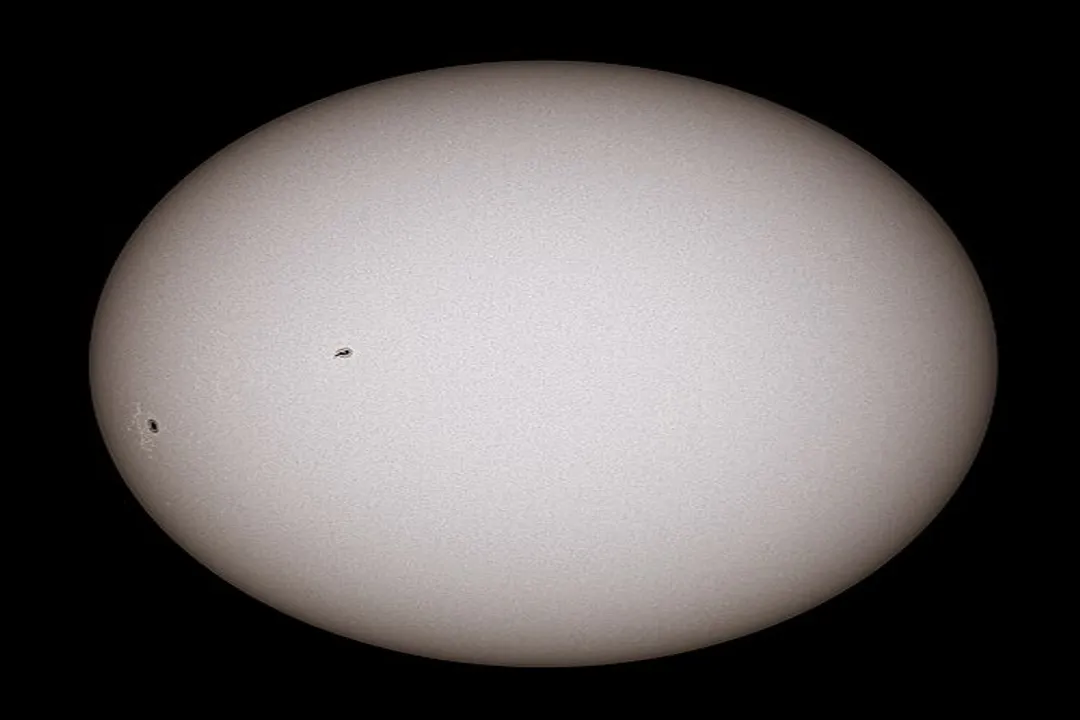
The main sequence is the primary, stable hydrogen-burning phase of a star’s existence. It begins when a protostar's core reaches sufficient temperature and density to ignite sustained nuclear fusion, converting hydrogen into helium. During this period, the star maintains hydrostatic equilibrium: the outward thermal pressure generated by core fusion perfectly counteracts the relentless inward crush of its own gravity. Our Sun, a relatively average star, has been on the main sequence for about $4.5$ billion years and is expected to spend roughly $10$ billion years there in total. This phase constitutes about $90%$ of a typical star's active life.
# Fuel Consumption
Intuitively, a star with $60$ times the mass of the Sun should have $60$ times the fuel supply, suggesting a lifespan sixty times longer. However, the reality is dramatically different. The critical factor is not how much fuel a star has, but how fast it consumes it.
This consumption rate is quantified by the star's luminosity (), the total energy radiated per unit time. For main-sequence stars within a broad range, luminosity is highly dependent on mass (), often approximated by the mass-luminosity relation: .
Because lifetime () is directly related to the fuel available () and inversely related to the rate of consumption (), we can derive the lifespan estimate:
This mathematical relationship dictates that lifespan falls off extremely sharply as mass increases.
Consider a concrete example derived from stellar models. A star $10$ times the mass of the Sun has $10$ times the hydrogen fuel compared to the Sun, but its luminosity is roughly , or over $3,000$ times greater than the Sun’s. This means it burns its fuel more than $300$ times faster than the Sun, resulting in a main sequence life of only about $20$ million years, compared to the Sun's $10$ billion years. For the most massive stars, like the $60$ solar mass 'O' types, the effect is staggering: $60$ times the fuel, but burning it nearly $1.4$ million times faster, yielding a main sequence life of less than half a million years. Conversely, a star with only half the Sun's mass can remain on the main sequence for over $20$ billion years.

# Core Energy Drivers
The extreme rate of fuel burning in massive stars is not arbitrary; it is a necessary response to the star's own gravity. A star with significantly more mass exerts a crushing inward gravitational force that must be counteracted. To generate the immense outward pressure needed to resist this titanic gravitational pull, the core must become much hotter and denser.
The temperature difference dictates the type of fusion occurring, which dramatically affects efficiency. Stars less massive than about $1.5$ solar masses, like our Sun, primarily rely on the proton-proton (PP) chain reaction to fuse hydrogen into helium. This process is relatively gentle.
In stars above this threshold—the upper main sequence—the core temperature is high enough ( million Kelvin or more) to favor the CNO cycle. The CNO cycle uses carbon, nitrogen, and oxygen atoms as catalysts to convert hydrogen to helium. The energy output from the CNO cycle scales much more steeply with temperature than the PP chain does, leading to a runaway effect: a small increase in core temperature, required by higher mass, leads to an exponential increase in energy generation, hence the higher luminosity.
This heightened energy generation is precisely what allows the star to maintain equilibrium against its own crushing weight. The massive star’s core essentially lives at a higher thermostat setting, forcing it to use its abundant fuel supply at a breathtaking pace.
# Internal Structure Matters
The way energy is transported from the super-hot core to the surface also plays a role in determining lifetime, particularly when comparing the small, long-lived stars to the huge, short-lived ones.
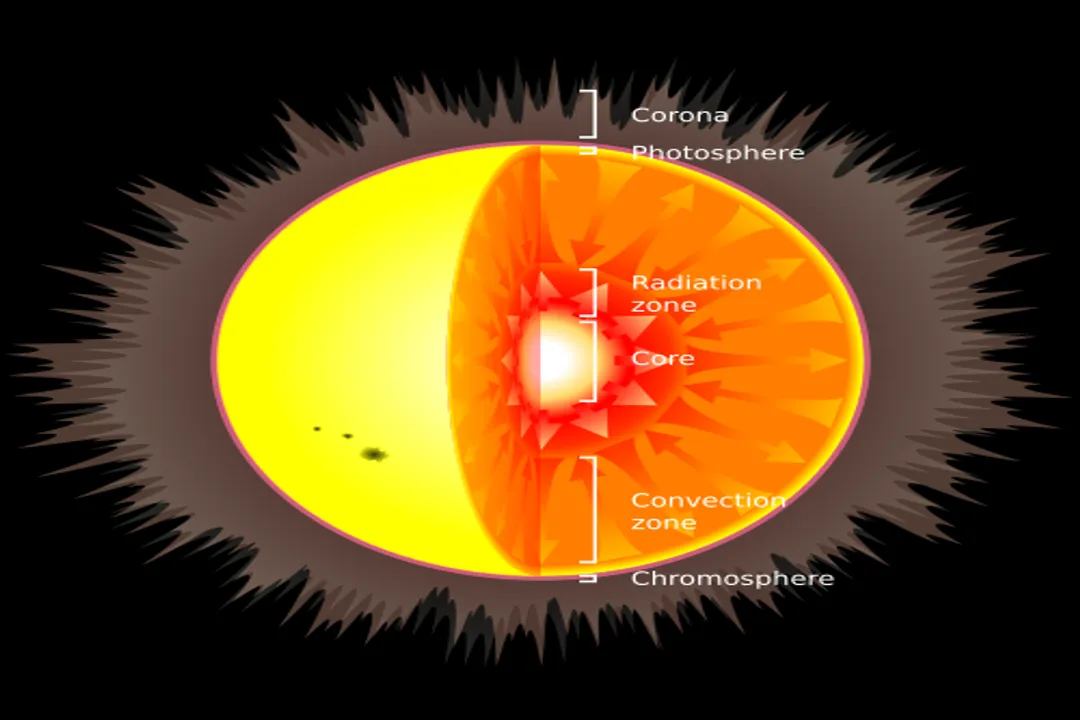
In stars much more massive than the Sun (often cited as above or ), the CNO cycle concentrates energy production intensely in the center, creating a very steep temperature gradient. To handle this intense heat flow, the core develops a convection zone. Convection is highly efficient because it involves the bulk movement of plasma—hot material rises, cool material sinks. This stirring action effectively mixes the helium "ash" away from the hydrogen fuel region, allowing the massive star to access a larger proportion of its total hydrogen supply before exiting the main sequence.
Contrast this with the Sun-like star, which has a radiative core where energy moves slowly via photons. Helium builds up in the core, which becomes increasingly inert, forcing the fusion process to shift to a shell around the ash core, a mechanism that is less efficient for bulk fuel use.
The very small, low-mass stars, known as red dwarfs (below about ), present the extreme opposite scenario. They are fully convective, meaning the stirring motion occurs throughout the entire star. This continuous mixing allows them to use virtually all their hydrogen as fuel, not just the central region. While their core fusion rate is very low (a "Smart Car" getting excellent mileage), the sheer availability of fuel across their entire volume grants them lifespans that can extend for trillions of years, far exceeding the current age of the universe.
If we were to map the average density of main sequence stars, we would find a curious result: more massive stars are often less dense on average than their smaller cousins. This is because while the mass increases, the radius increases even more dramatically, especially for the high-luminosity stars. For instance, the Sun has an average density of about [cite: 2, using Sun's as reference]. A star like Vega (Type A0V), which is , might have an average density significantly lower, as the volume swells rapidly to manage the immense core pressure required to sustain the CNO cycle. The core pressure in these massive objects is actually lower than in less massive, more contracted stars to prevent runaway fusion, with the overall structure scaling such that according to some approximations relating to the virial theorem.
# After the Main Sequence
The swift depletion of core hydrogen means that high-mass stars leap much more quickly into their post-main sequence lives, and these subsequent phases are far more violent.
For a star like the Sun, once hydrogen is exhausted in the core, it enters the red giant phase, burning helium into carbon. This phase is relatively long compared to the subsequent steps, but still short compared to the main sequence lifetime (e.g., the Sun’s helium burning is predicted to last about $130$ million years). The Sun will eventually puff off its outer layers as a planetary nebula, leaving behind a dense white dwarf.
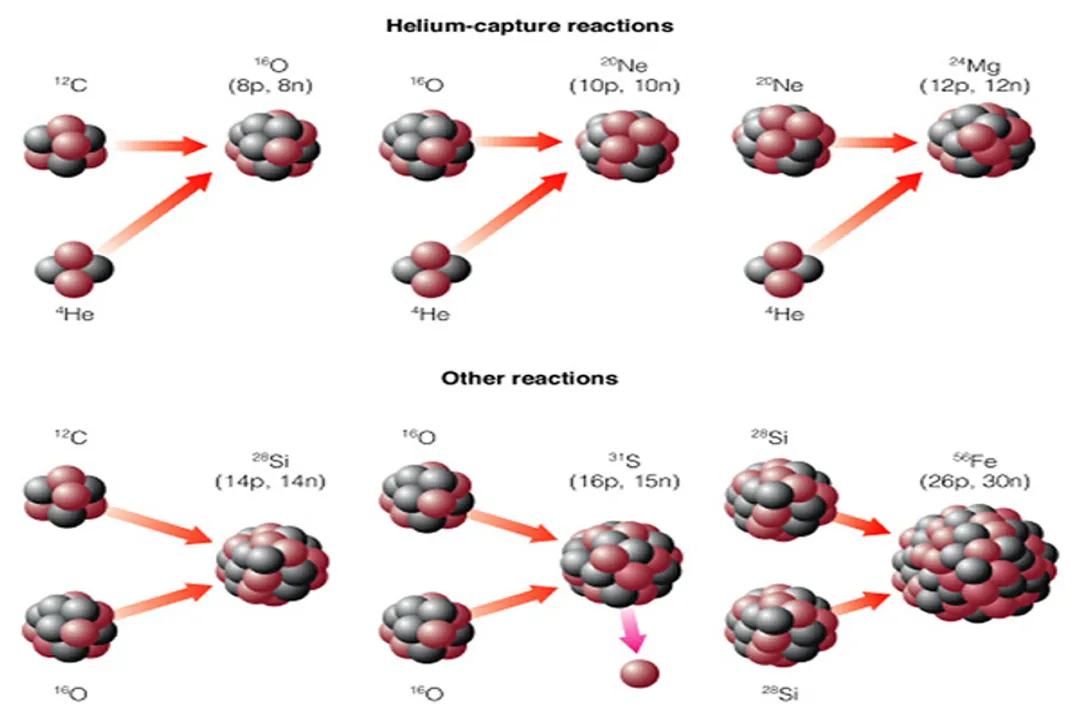
Massive stars experience a far more dramatic exit. When their core hydrogen is spent, they expand into red supergiants. Their cores, however, are hot enough to proceed through multiple, successive fusion stages—burning helium into carbon, carbon into neon, and so on, building up an "onion" structure of heavier elements. Each subsequent fusion stage is exponentially shorter than the last; a carbon-burning phase might last only a hundred years, while the preceding helium burn lasted hundreds of thousands of years. This rapid sequence ends when the core is converted to iron, as fusing iron consumes energy rather than releasing it. With the energy source gone, gravity wins instantly. The core collapses in a fraction of a second, triggering a supernova explosion that scatters newly synthesized heavy elements across the cosmos, leaving behind either a neutron star or, for the most massive progenitors, a black hole. The most massive stars may not even have time to expand fully into red supergiants before detonating, as their internal restructuring happens so quickly.
The lesson is clear: a star's mass is the single strongest predictor of its destiny and its lifespan. A slight increase in initial mass results in a massive increase in core temperature, which in turn powers a non-linear surge in fuel consumption, consigning the stellar giant to a brilliant but fleeting existence on the main sequence.
Related Questions
#Citations
eli5 why do high-mass stars live for a shorter period of time than low ...
Main sequence - Wikipedia
Do larger stars stay in the main sequence longer? | CK-12 Foundation
Why are main sequence stars more massive than the Sun less ...
The Lives of High Mass Stars - NMSU Astronomy
Stellar Evolution - | The Schools' Observatory
Post Main Sequence Stars - University of Oregon
Stars - Imagine the Universe! - NASA