According to $E=mc^2$, what happens to the mass when four protons form a helium nucleus?
Answer
The resulting helium nucleus is measurably lighter
When four hydrogen nuclei fuse into one helium nucleus, the resulting helium nucleus has a mass deficit ($\Delta m$), which is the mass precisely converted into radiant energy.
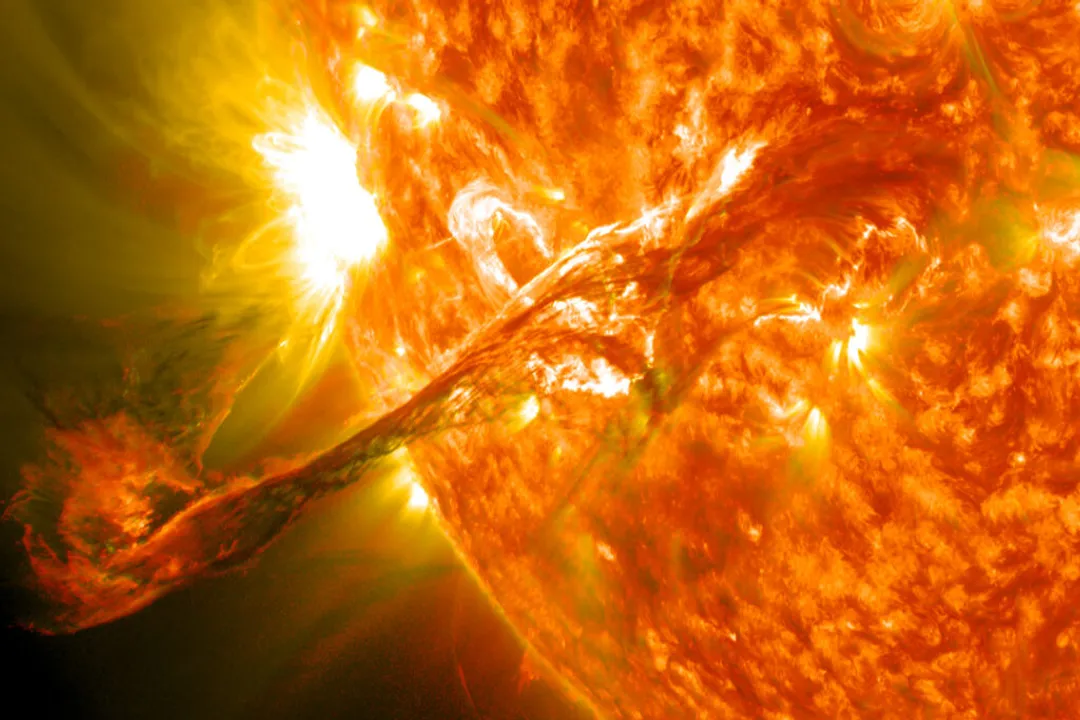
#Videos
How Do Stars Convert Hydrogen To Helium? - Physics Frontier
Related Questions
What is the fundamental cosmic transaction powering stars?What element composition dominated the universe following the Big Bang?What term describes the stable state where outward thermal pressure balances inward gravity in a star?What must colliding hydrogen nuclei overcome to initiate fusion within a star's core?Roughly how much greater is the energy released by hydrogen fusing into helium compared to forming water chemically?In stars with mass similar to the Sun, what is the primary energy generation mechanism?Which fusion pathway is characterized by its catalytic nature, using C, N, and O as intermediaries?Which fusion process exhibits extreme temperature sensitivity, with rates scaling proportional to $T^{16}$ to $T^{20}$?According to $E=mc^2$, what happens to the mass when four protons form a helium nucleus?What fusion process does a star like the Sun initiate after exhausting its core hydrogen fuel?