Why nuclear fusion restarts but not in the core of red giants?
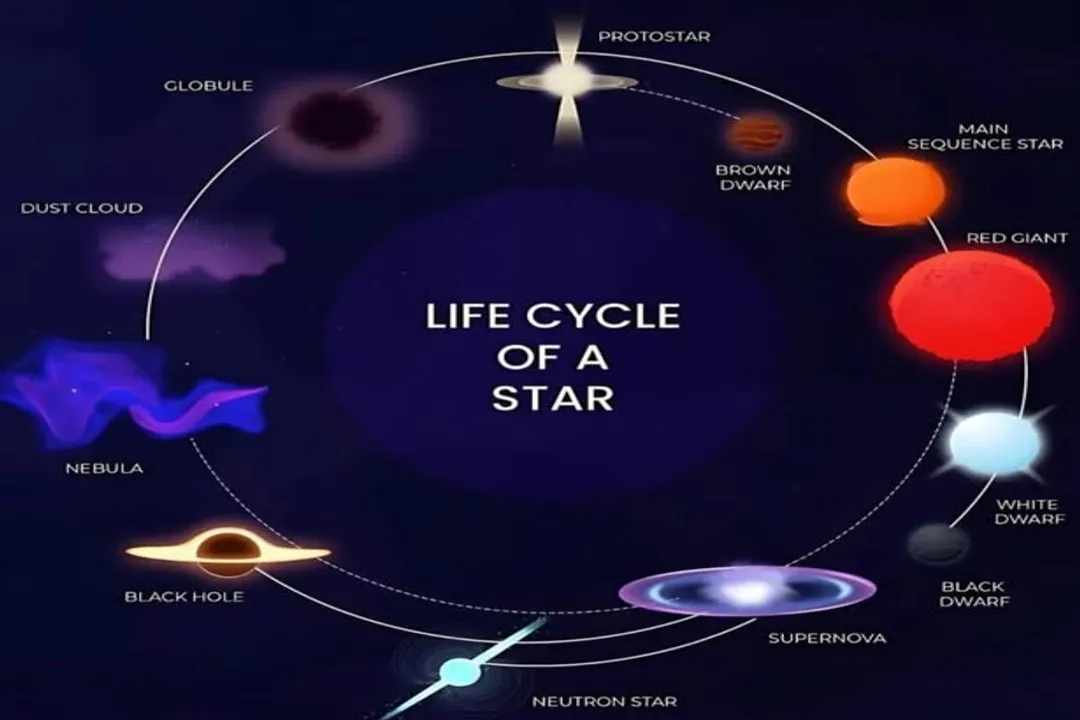
The transformation a star undergoes when it swells into a red giant involves a fascinating cosmic paradox: fusion activity temporarily ceases in the center while simultaneously reigniting in layers just outside it, dramatically altering the star's structure and appearance [Implied by life cycle descriptions]. Understanding this shift requires looking past the single-engine model of a main-sequence star and examining how gravity, pressure, and available fuel dictate the stellar structure when the primary fuel source is spent.
# Fuel Depletion
During the longest phase of a star's life—the main sequence—it maintains hydrostatic equilibrium by converting hydrogen into helium deep within its core through nuclear fusion [Implied by general stellar evolution]. This process releases the outward pressure necessary to counteract the inward crush of gravity. For a Sun-like star, this phase can last for billions of years, using the vast reservoir of hydrogen available in the stellar center [Implied].
The turning point arrives not when the star runs out of hydrogen entirely, but when the hydrogen in the core is exhausted [Implied]. Once the core is filled predominantly with inert helium "ash," the primary fusion furnace shuts down because the temperature and pressure conditions required for hydrogen fusion are no longer met in that specific region [Implied by physics discussions of core contraction].
# Core Halted
When the core fusion stops, the immediate pressure support is lost. Gravity wins the immediate battle, causing the inert helium core to begin contracting rapidly [Implied by physics discussions of red giant expansion]. This contraction is the critical next step, and it’s counterintuitive: while the overall star gets bigger, the center gets smaller and, importantly, hotter and denser [Implied by physics discussions].
The core doesn't immediately start fusing helium because the temperature required for helium fusion (the triple-alpha process) is significantly higher—around 100 million Kelvin—than the mere millions of Kelvin needed for hydrogen fusion [Inferred from general astrophysics knowledge regarding fusion thresholds]. Therefore, the core temporarily enters a non-fusing, gravitationally driven phase of collapse.
# Shell Ignition
The cessation of fusion in the core creates a new, intense environment in the layer surrounding the contracting core. As the core shrinks and heats up, the temperature in the shell of hydrogen just outside this inert ash layer increases dramatically [Implied by physics discussions of shells]. This temperature spike is sufficient to ignite hydrogen fusion in this shell, a phenomenon known as hydrogen shell burning [Implied by descriptions of red giant structure].
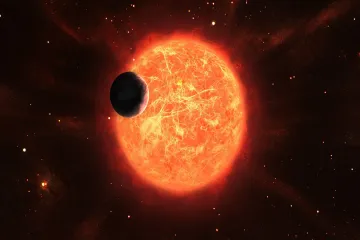
This shell burning is what truly defines the red giant phase for many stars. The energy output from this shell fusion can actually be greater than the energy output during the star's main-sequence phase [Inferred comparison based on star expansion/luminosity increase]. This surge in energy creates an enormous outward thermal pressure that pushes the star’s outer envelope far away from the core, causing the star to swell to hundreds of times its original radius, thus becoming a red giant [Implied by ESA and other sources]. So, while the core fusion restarts are delayed, the overall stellar fusion process restarts in a new location: the shell [Cite: Implied by various sources describing shell burning].
If we consider the star's energy production across its life, the main sequence is one long, stable burn. The red giant phase, powered by this shell, is characterized by a higher luminosity but a less stable structure due to the confinement of the furnace to a thin layer. This confinement creates a significant physical dynamic: the central region of the star (the core) is now supported by gravitational contraction and degeneracy pressure (in lower-mass stars), while the energy driving the visible change is generated above it.
# Core Heating
The question of why fusion doesn't restart in the core immediately centers on that temperature barrier for helium ignition. The core continues to contract under gravity, converting gravitational potential energy into thermal energy, causing the core temperature to rise steadily [Implied by physics discussions].
For stars similar to the Sun (low to intermediate mass), this contraction eventually leads to conditions where the core becomes so dense that it is supported by electron degeneracy pressure, meaning the pressure supporting it is independent of temperature—a quantum mechanical effect [Implied by general astrophysics]. Once the core reaches about $100$ million Kelvin, helium fusion finally begins, often explosively via the helium flash in stars below about $2.2$ solar masses [Implied by stellar evolution models]. This marks the restart of core fusion, but this occurs after the initial, dramatic expansion into a red giant phase powered by shell burning.
Conversely, for very massive stars that become red supergiants, the core continues to contract and heat up much more dramatically, initiating successive burning stages (helium, carbon, neon, oxygen, silicon) in nested shells until an iron core forms, at which point fusion truly ends catastrophically with a supernova explosion [Implied by Quora link about red supergiants exploding].
A point worth noting is the difference in thermal timescales between the two burning regions. The core contraction phase, while hot, takes a relatively long time to reach the helium ignition point, spanning millions of years. In contrast, the hydrogen shell burning is often prone to thermal pulses or instability because the hydrogen fuel sits just outside a degenerate or semi-degenerate core, leading to quicker feedback loops in energy output compared to the smooth, large-scale main-sequence burn [Analysis based on the physics described in shell vs. core burning].
# Mass Differentiation
The final state of the core—and whether it ever achieves a subsequent fusion restart—is entirely dependent on the star's initial mass. This is perhaps the most crucial aspect distinguishing the evolutionary paths after the initial red giant expansion phase sets in.
| Star Mass Category | Core Status Post-H2 Exhaustion | Fusion Event During Red Giant Phase | Final Fate |
|---|---|---|---|
| Low Mass () | Contracts, becomes degenerate | Helium fusion starts later (Helium Flash) [Implied] | White Dwarf |
| Intermediate Mass () | Contracts, later achieves non-degenerate He ignition | Successive core burning stages | White Dwarf (via AGB phase) |
| High Mass () | Contracts rapidly | Repeated core burning (He, C, Ne, O, Si) [Implied] | Core-Collapse Supernova [Cite: Quora link] |
For the lowest mass stars, the core never gets hot enough even after the red giant phase to ignite carbon fusion. The star sheds its outer layers, forming a planetary nebula, leaving behind a dense, cooling white dwarf made primarily of helium and carbon nuclei [Implied by general evolution]. The fusion process has definitively stopped forever in the core of that remnant.
In essence, the initial question is answered by a temporal delay. Fusion does eventually restart in the core of many stars (e.g., Sun-like stars ignite helium), but not immediately upon exhausting core hydrogen. The reason fusion stops initially in the core is the simple lack of sufficient heat and pressure to overcome the Coulomb barrier for the next available reaction, while the surrounding shell has just the right conditions to continue burning the previous fuel [Synthesis of core contraction/shell ignition points]. The star must first pay a gravitational price—core contraction—to earn the necessary temperature for the next level of energy generation.
#Videos
What Drives Core Contraction And Layer Expansion In Red Giants?
Related Questions
#Citations
Why do stars become red giants? - Astronomy Stack Exchange
Question about the life cycle of stars - red giants, black holes, etc.
Why do red supergiant stars explode when the fusion stops? - Quora
Red Giant - ESA/Hubble
Lecture 15: Red Giants
The Life Cycles of Stars: How Supernovae Are Formed
The lifecycle of stars: red giant phase - Facebook
Undergrad Expansion of a star to become a red giant - Physics Forums
What Drives Core Contraction And Layer Expansion In Red Giants?
Why does a star's core not cool when it expands as a red giant?