What marks the definitive end of fusion for the core of a low-mass star ($\lesssim 2.2 M_\odot$) after the red giant phase?
Answer
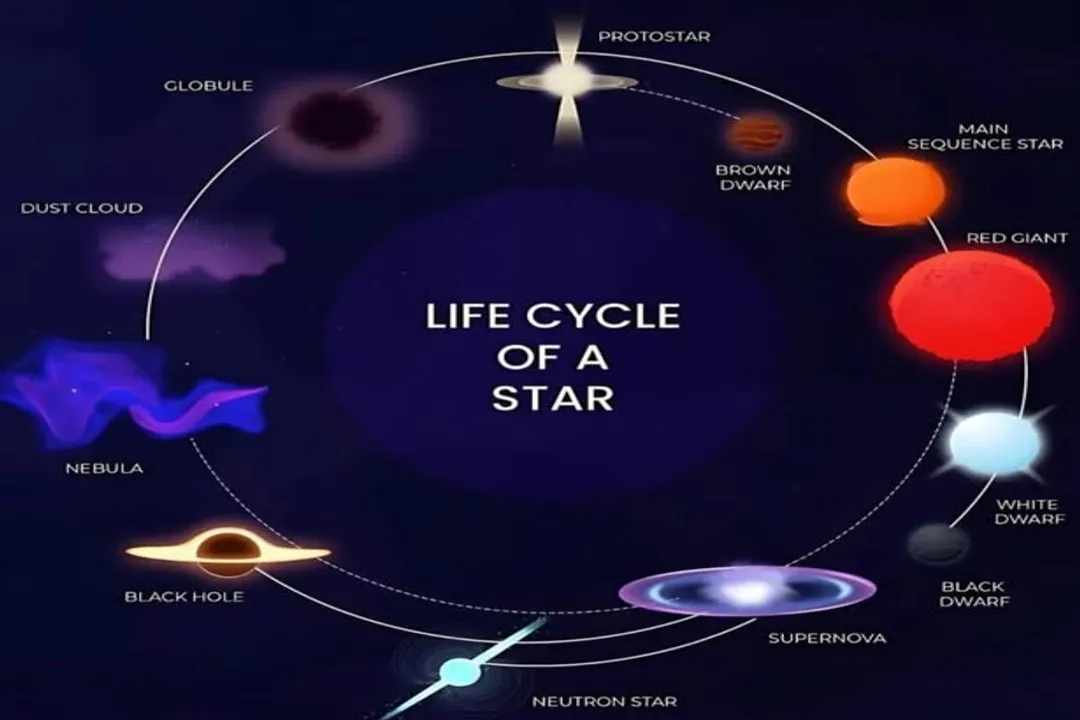
The core leaves behind a white dwarf made primarily of helium and carbon nuclei.
For low-mass stars, the core never reaches the necessary temperature for subsequent fusion stages like carbon fusion; fusion stops permanently, leaving a cooling white dwarf remnant.
#Videos
What Drives Core Contraction And Layer Expansion In Red Giants?
Related Questions
What causes the initial shutdown of fusion in the core when a Sun-like star enters the red giant phase?What is the phenomenon responsible for powering the dramatic expansion of a star into a red giant?How does the energy output during the hydrogen shell burning phase compare to the star's main-sequence phase?What state supports the inert helium core of a low-mass star while it contracts before helium ignition?Approximately what minimum temperature is required for helium fusion (the triple-alpha process) to begin in the core?What happens to the inert helium core immediately after core hydrogen fusion ceases?What marks the definitive end of fusion for the core of a low-mass star ($\lesssim 2.2 M_\odot$) after the red giant phase?How is the energy generation process characterized during the main sequence phase?For very massive stars, what event signifies the point where fusion truly ends catastrophically within the core?What is the primary physical mechanism causing the star's outer envelope to swell hundreds of times its original radius during the red giant phase?