Are younger stars blue or red?
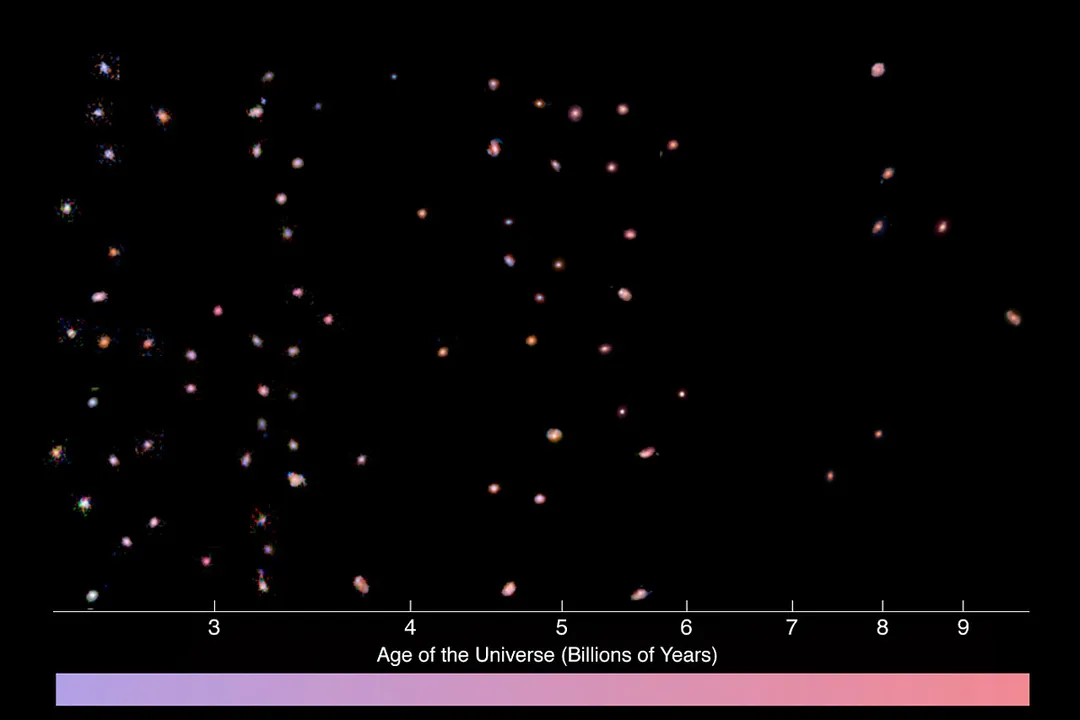
The color of a star provides astronomers with immediate, vital information about its physical state, particularly its surface temperature. When asking whether younger stars are blue or red, the most accurate answer is that the most massive young stars are intensely blue, while the less massive ones—like our own Sun—remain relatively unchanged in color throughout their long main-sequence lives. The hue we observe is fundamentally a direct result of the star's temperature; hotter objects emit light shifted toward the blue and ultraviolet ends of the spectrum, while cooler objects emit more light in the red and infrared regions. [8] This relationship is rooted in the physics of blackbody radiation, meaning that a star’s color acts as a highly reliable cosmic thermometer. [8][6]
# Color Temperature
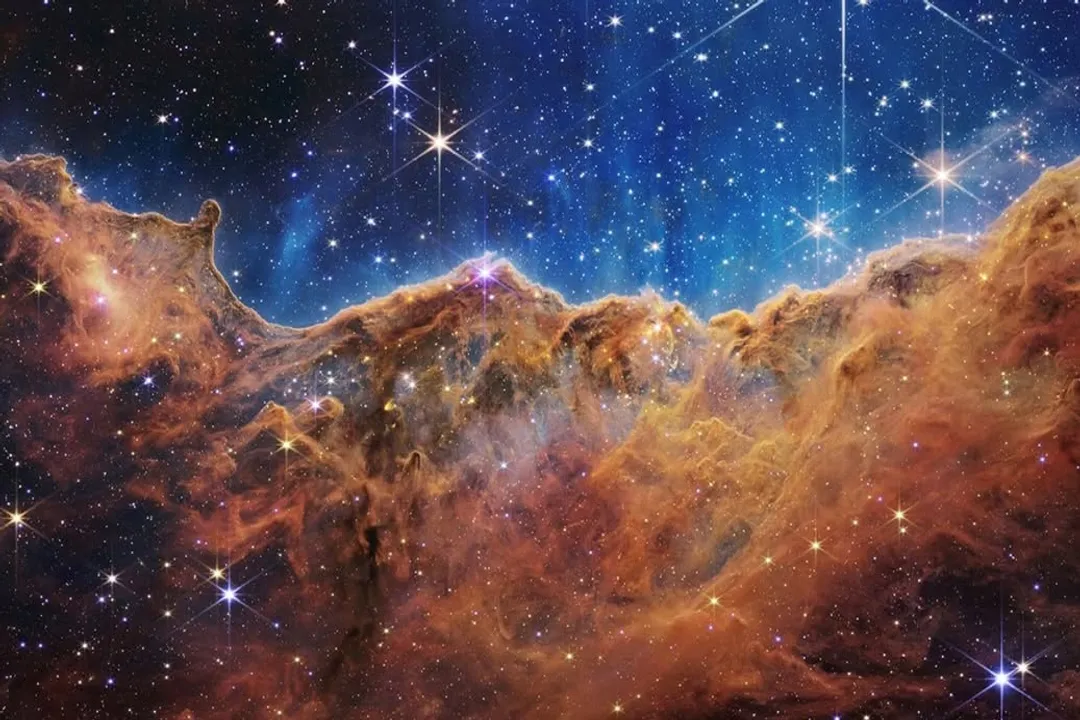
A star's surface temperature dictates its color, which is observable even from Earth. [6] Extremely hot stars possess surface temperatures high enough to emit most of their visible light in the blue end of the electromagnetic spectrum. Conversely, cooler stars appear orange or red because their peak light emission falls into the longer, redder wavelengths. [8] The classification of stellar temperature is well-established: O-type stars are the hottest and bluest, while M-type stars are the coolest and reddest. [6] This color-temperature correlation is one of the most fundamental observational tools in astrophysics, allowing researchers to immediately estimate a star’s thermal state simply by analyzing the light it sends across space. [8]
# Massive Youth
When astronomers discuss "young stars" being blue, they are almost exclusively referring to the very large, very massive stars that populate the hottest end of the Hertzsprung-Russell (H-R) diagram. [4] These colossal stars have extraordinary amounts of fuel available, but they must burn it at an astonishingly high rate to counteract their immense gravitational collapse. [4] This frantic pace of nuclear fusion pushes their surface temperatures into the thousands of Kelvin, resulting in a brilliant, dazzling blue appearance. [1][4] A prime example might be a star 15 to 20 times the mass of the Sun—these stars live fast and die young, often existing for only a few million years before exhausting their core hydrogen. [4] If an area of the sky, such as a newly formed stellar cluster, is rich in these brilliant blue objects, it confirms that the entire group is quite young, having formed perhaps only tens of millions of years ago. [3] The existence of these scorching blue giants is a temporary phase in a star cluster’s life cycle. [3]
Consider the sheer contrast in lifespans driven by mass. A star burning hot and blue at 30,000 Kelvin might only survive for 10 million years, whereas a low-mass red dwarf, burning coolly at perhaps 3,000 Kelvin, could remain stable on the main sequence for trillions of years. [4] Therefore, the blue color associated with youth is an indicator of a dramatic, brief existence driven by extreme mass, not a universal characteristic of all newborn stars. [4]
# Solar Hue
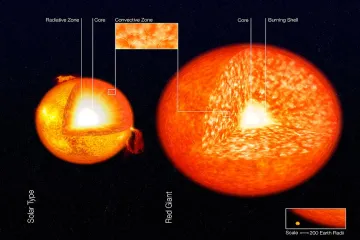
If the general rule were that all young stars are blue, one might expect our own Sun, which is currently middle-aged, to have been a vibrant blue giant in its infancy. This is not the case. The Sun is classified as a G-type main-sequence star, commonly called a yellow dwarf. [2] When the Sun formed approximately 4.6 billion years ago, it was already a yellow star, perhaps shining slightly more intensely or possessing a marginal shift toward the hotter, bluer end of the yellow spectrum, but it never achieved the deep, unmistakable blue of a massive O or B-type star. [2][4] The Sun’s relatively low mass dictates a moderate rate of fusion, resulting in a gentle evolution of color throughout its main sequence lifetime. [2] Stars like our Sun simply do not possess the necessary mass to reach the high temperatures required for a blue classification, meaning their color evolution is subtle rather than dramatic. [4]
# Cluster Dating
The association between blueness and youth is most clearly and reliably established when observing star clusters, which are groups of stars that formed around the same time from the same cloud of gas and dust. [3] Astronomers use a technique called "main-sequence turnoff" to date these groups. [3] In a young cluster, the most massive, hottest, blue stars are still actively fusing hydrogen and appear brightly on the main sequence of the H-R diagram. [3] However, as the cluster ages, these high-mass, blue stars quickly use up their fuel and evolve into red giants or explode as supernovae, leaving the cluster behind. [3] In an older cluster, the hottest, most luminous stars that have "turned off" the main sequence are less massive—perhaps A or F type stars that appear white or yellowish-white. [3] If a cluster still displays a significant population of incredibly hot, massive blue stars, it provides powerful observational evidence that the entire system is cosmically young. [1][3] The absence of these blue stars suggests the cluster has existed long enough for even its moderately massive members to complete their initial life phase. [3]
# Cooler Bodies
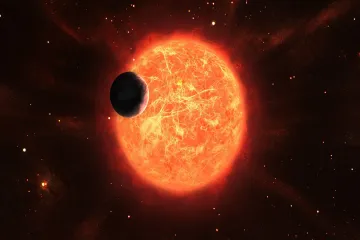
While massive young stars are blue, the vast majority of stars in the galaxy, including many that are quite old, are red or orange. [4] Red stars are generally defined by their lower surface temperatures, placing them on the cooler end of the stellar spectrum. [8] This red appearance is characteristic of lower-mass stars, such as red dwarfs, which burn their fuel extremely slowly and can persist for extraordinarily long timescales, potentially outliving the current age of the universe. [4] Red color is also the destiny of very high-mass stars later in their lives, after they have exhausted their core hydrogen and expanded into vast, cooler red giants. [4] Therefore, seeing a red star does not automatically indicate youth; it usually signals either a very long-lived, low-mass star or a massive star near the end of its evolutionary path. [4]
To put this into a simplified observational context, if you look at a stellar nursery where stars are actively forming, you expect to see brilliant blue light sources dominating the brightest detections because only the largest stars have had time to ignite and outshine their peers in that short window of time. [1] However, if you look at a globular cluster, a system known to be ancient, you will find almost no blue stars remaining; the brightest visible stars will be red giants that have evolved off the main sequence, while the low-mass red dwarfs, too dim to see easily, are the true survivors of that ancient population. [3] The color spectrum observed in any given star is thus a complex indicator, relying heavily on context—whether it is a solitary star or part of a young stellar gathering—to reveal its true age.
Related Questions
#Citations
The Colour of the Young Universe - Eso.org
I heard that young stars are blue. Does that mean our Sun was blue ...
Why are red clusters of stars much older than a cluster of mainly blue?
I heard that young stars are blue. Does that mean our Sun ... - Quora
New star systems are young and blue, not 'red and dead' - Futurity.org
Does the Color of a Star indicate its Age? - NASA ADS
Houston, we have a question! Think you know your stars? What ...
The colours of stars - British Astronomical Association
Stars | Causes of Color - Webexhibits