Assuming a constant rate of expansion, what relationship does a higher $H_0$ value suggest about the age of the universe?
Answer
It implies a younger age.
A faster expansion rate (higher $H_0$) means the universe took less time to reach its current size, suggesting a younger age when assuming constant expansion.
Related Questions
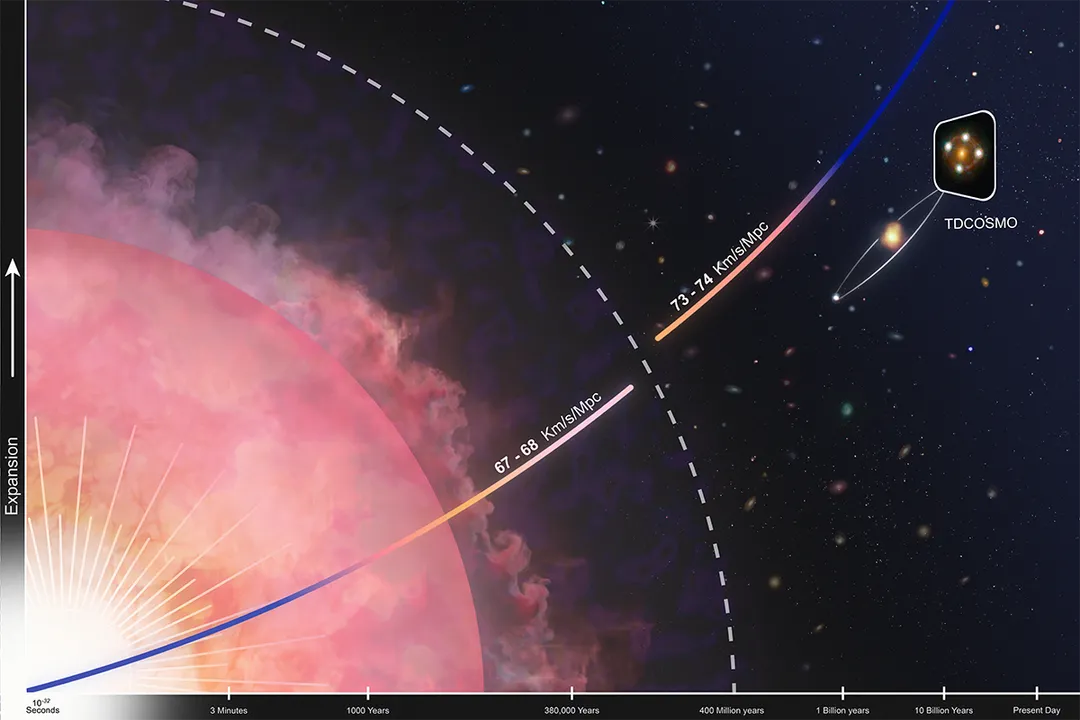
What is the fundamental quantity quantified by the Hubble constant ($H_0$)?In Hubble's Law, $v = H_0 d$, what does the term $v$ represent?Assuming a constant rate of expansion, what relationship does a higher $H_0$ value suggest about the age of the universe?What astronomical tools are typically used as 'standard candles' to determine cosmic distances necessary for calculating $H_0$?What is the typical $H_0$ value associated with measurements derived from the Early Universe (CMB analysis) within the $\Lambda$CDM model?What is the current major cosmological quandary related to conflicting $H_0$ measurements called?What physical parameter reflects the variation in the expansion rate over cosmic time?What primary component is relatively easy to measure via redshift spectroscopy, forming one half of the requirement for calculating distance using $H_0$?Which newer instrument has largely confirmed the higher local expansion rates, thus intensifying the Hubble Tension?If the Hubble Tension persists after further refinement, what does this suggest about our current understanding of the cosmos?