What does the Hubble constant tell us about the universe?
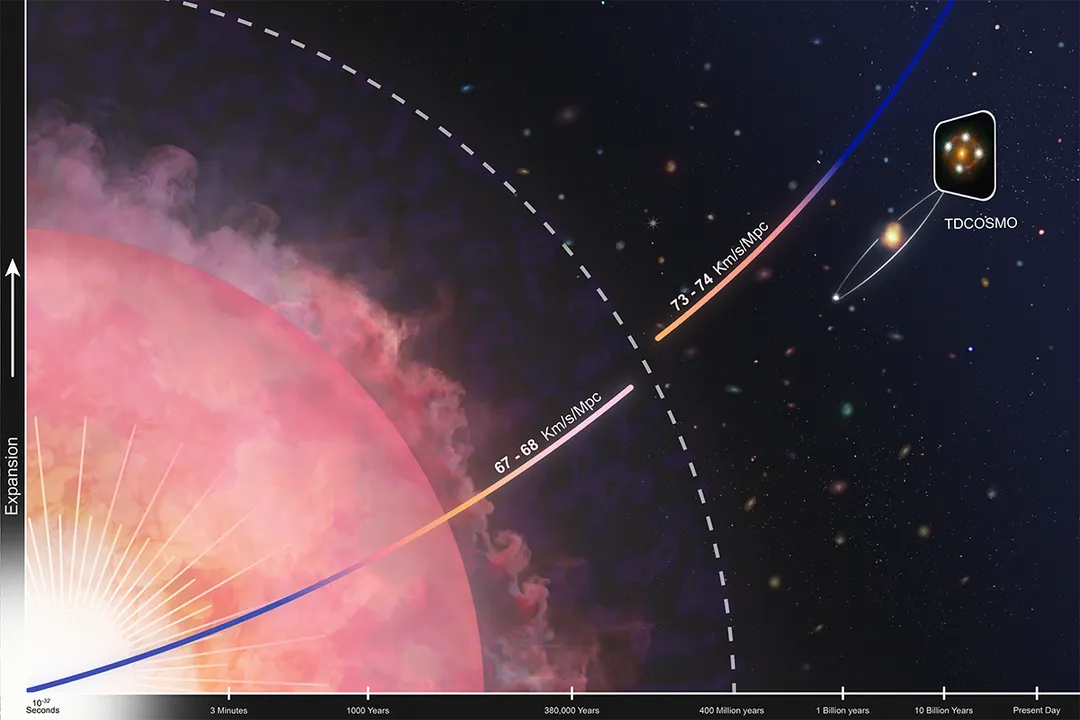
The Hubble constant, symbolized as , is one of the most fundamental numbers in cosmology, acting as the rate dial for the universe's expansion. It quantifies the observation, first formalized by Edwin Hubble in 1929, that galaxies are moving away from us, and the farther away they are, the faster they recede—a relationship encapsulated in the Hubble–Lemaître Law: velocity equals times distance (). This constant is expressed in units of kilometers per second per megaparsec (). More than just a speed measurement, dictates the scale, size, and approximate age of the cosmos. If one calculates the reciprocal of , known as the Hubble time, the result is a cosmic timescale that is very close to the currently accepted age of the universe, estimated to be around 13 to 14.4 billion years, assuming the expansion rate has been uniform.
# Historical Foundations
The idea that the universe is not static, but dynamically changing, has deep roots. While Edwin Hubble published the key observational evidence in 1929 by correlating galaxy redshifts with distance estimates derived using Cepheid variable stars, the underlying theory predates him. The concept of an expanding universe emerged from Albert Einstein’s general relativity equations, first derived by Alexander Friedmann in 1922. Georges Lemaître, the Belgian mathematician and physicist, independently derived this expansion law in 1927, though his initial paper in a French journal received less immediate attention than Hubble’s later, more comprehensive work. Hubble’s original estimate for was a surprisingly high , a figure skewed by then-unknown limitations in calibrating stellar distances. For decades, astronomical estimates oscillated wildly, famously pitting values near against those near until improved measurements began to converge around the turn of the century, settling expectations in the $65$ to range.
# Distance Rungs
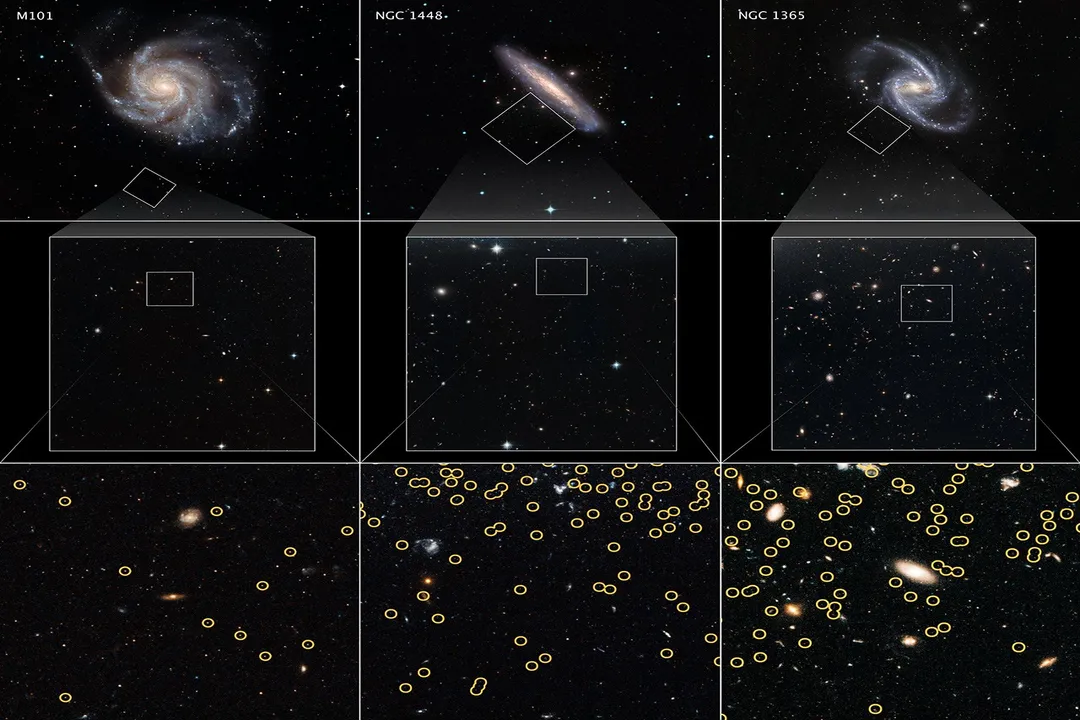
To measure the modern expansion rate, astronomers must accurately determine two things for distant galaxies: their recessional velocity (easily found via redshift) and their precise distance. This distance determination is accomplished by building what is often called a cosmic distance ladder.
The ladder relies on standardizable distance markers, or "standard candles," whose intrinsic luminosity is known, allowing astronomers to calculate their distance based on how dim they appear to us.
- The Base Rung (Geometric Anchors): The lowest rungs must be calibrated geometrically, such as using the parallax method (the apparent shift of a nearby star's position due to Earth’s orbit) for stars within the Milky Way, aided by data from the Gaia spacecraft. Other key geometric anchors include measuring the distance to the megamaser galaxy NGC 4258, where water molecules around a black hole emit light that allows for a direct, geometric distance calculation.
- The Intermediate Rung (Cepheids): These pulsating stars have a known relationship between their period and their true luminosity. Their distances are measured in nearby galaxies, and these measurements are then used to calibrate brighter yardsticks.
- The Top Rung (Type Ia Supernovae): These are the explosions of white dwarf stars that reach an almost identical peak brightness, making them visible across vast cosmic distances. By observing SN Ia in galaxies where Cepheids are also visible, astronomers can calibrate the supernova luminosity, allowing them to use these incredibly bright events to measure distances deep into the Hubble flow.
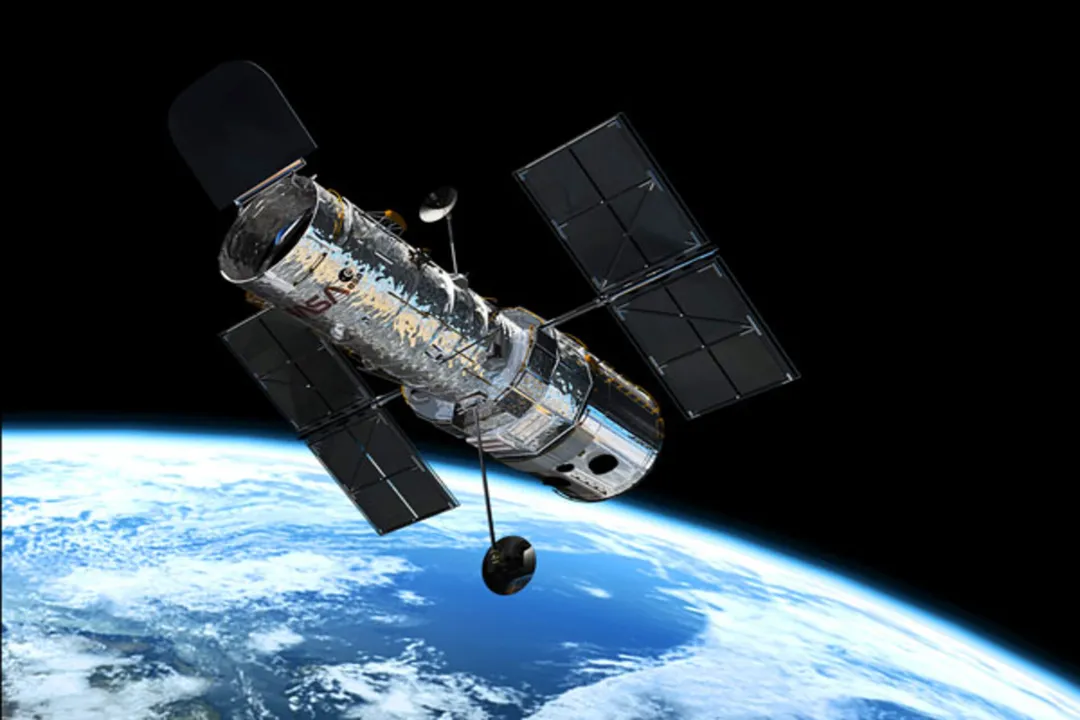
The SH0ES collaboration, led by Adam Riess, heavily relies on this Cepheid-calibrated supernova ladder using data from the Hubble Space Telescope (HST). Their latest high-precision work has repeatedly placed the late-universe value around .
It is worth noting that the reliance on this multi-step calibration introduces the risk of accumulating systematic errors at each stage. For instance, the SH0ES method calibrates Cepheids, which then calibrate SN Ia. A separate line of inquiry, utilizing the Tip of the Red Giant Branch (TRGB) as an intermediate standard candle instead of Cepheids—as demonstrated by the Carnegie-Chicago Hubble Program—also calibrates SN Ia. An interesting point arises when comparing these local methods: if the systematic errors were perfectly understood, the TRGB and Cepheid-based local measurements should yield the same . However, the slight variation between these two 'late universe' camps, with TRGB results sometimes falling closer to the lower CMB predictions, suggests that even within the local universe measurement system, nuances in calibrating the stellar populations remain.
# The Early Universe Perspective
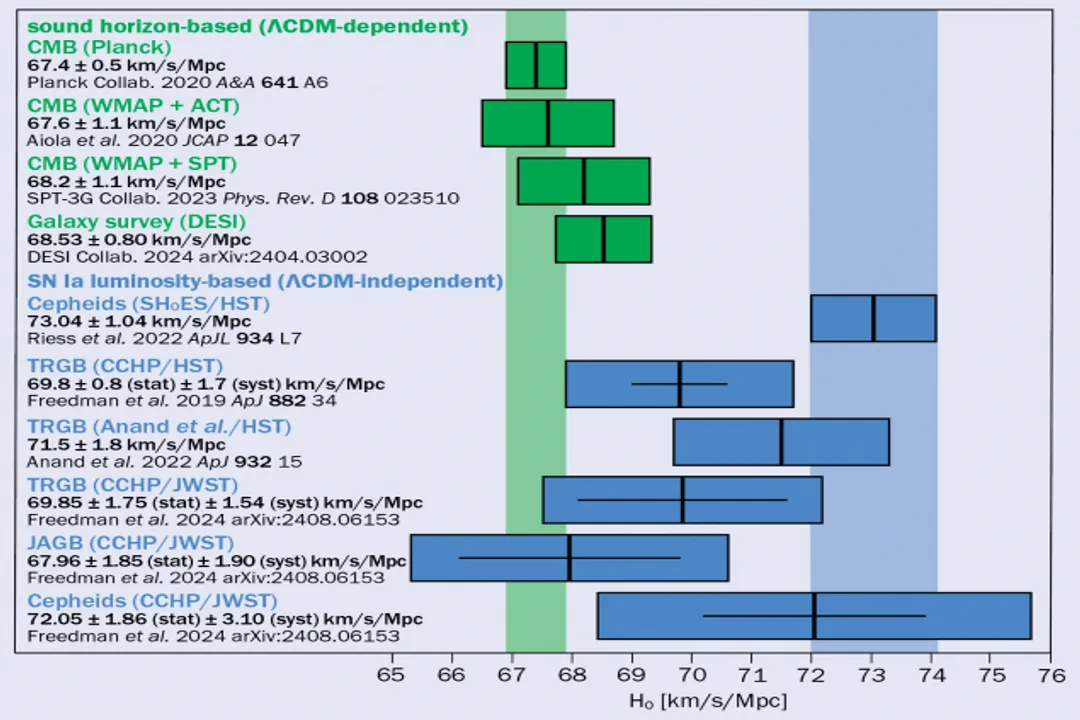
A completely independent way to determine the Hubble constant comes from looking at the universe when it was extremely young, roughly 380,000 years after the Big Bang. This approach uses the physics of the early universe, primarily relying on the Cosmic Microwave Background (CMB) radiation.
In this early epoch, the universe was a hot, dense plasma where photons and electrons scattered constantly. Quantum fluctuations in this primordial soup propagated as sound waves until the universe cooled enough for atoms to form (recombination), allowing photons to escape and create the CMB.
This process left two tell-tale imprints:
- The CMB Power Spectrum: Detailed analysis of the temperature fluctuations in the CMB—first mapped precisely by the WMAP satellite and later by the European Space Agency’s Planck mission—allows cosmologists to fit these observations to the standard cosmological model (CDM).
- Baryon Acoustic Oscillations (BAO): The physical scale imprinted by these sound waves in the early plasma is known as the sound horizon. Today, this same standard ruler is observable in the large-scale clustering patterns of galaxies across the sky.
By inputting the measured properties of the early universe (like baryon and dark matter density) into the CDM model, scientists predict what the expansion rate () should be today. The Planck mission’s results, which fit the CMB data with exquisite precision, converge on a value around . Even measurements based on BAOs, which bypass Planck’s direct CMB fit but still rely on the CDM model for the sound horizon calculation, agree closely with the CMB camp, such as the Dark Energy Spectroscopic Instrument (DESI) result of .
# The Cosmic Conflict
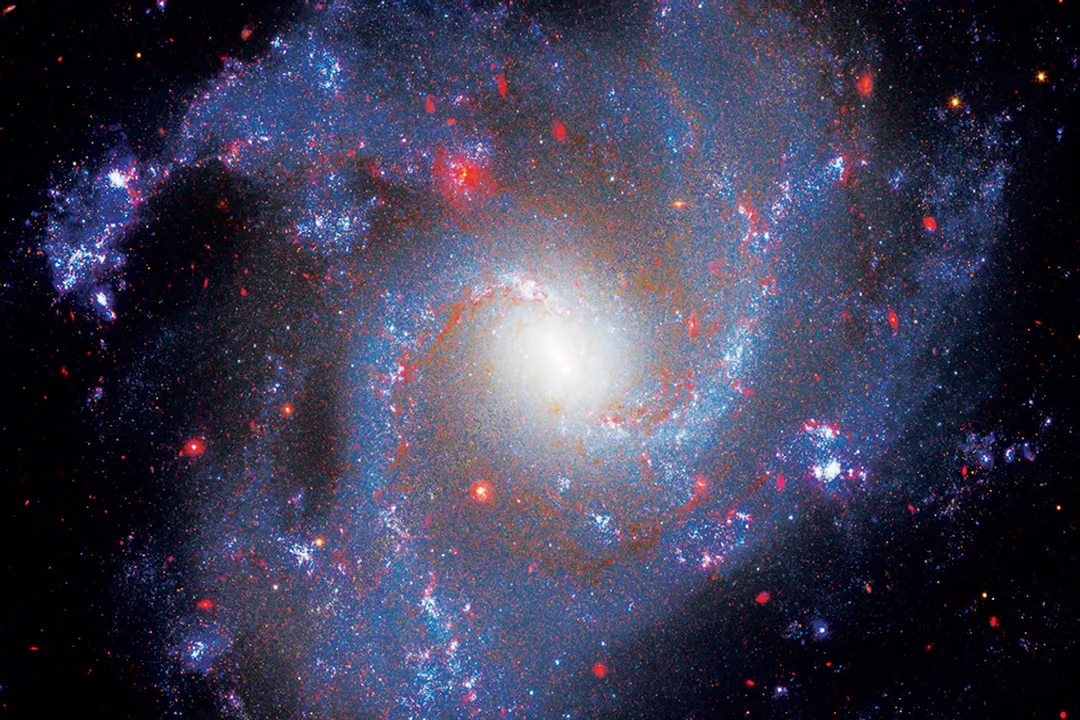
The core issue is the disagreement between these two precise camps: the late universe measurements clustering around and the early universe predictions clustering around .
The difference might seem minor in absolute terms, perhaps a difference of . To put this difference into perspective, consider the age calculation. If we take the higher SH0ES value of and calculate the Hubble time (, after unit conversion), it suggests a universe only about $13.4$ billion years old. If we use the Planck value of , the implied Hubble time is closer to $14.4$ billion years (using the value cited from the Planck analysis). This difference of over a billion years in the derived age of the universe, based on two well-established sets of measurements, is cosmologically significant. If the universe is indeed expanding faster now than predicted by its infancy, it implies the expansion rate has changed in a way that the standard CDM model—which assumes a specific balance between matter, radiation, and a cosmological constant for dark energy—does not account for. The statistical certainty of this mismatch is now greater than (five-sigma), which in physics is often considered the threshold for a discovery, strongly indicating this is not a random fluctuation.
# Independent Rulings
As the tension persisted, the scientific community sought wholly independent methods, specifically those that do not rely on the classic distance ladder or the Planck CMB measurements, to serve as tie-breakers.
# Time-Delay Cosmography
One compelling alternative involves time-delay cosmography, which leverages gravitational lensing by massive galaxies. When a distant source, like a quasar or a supernova, is lensed by a massive foreground galaxy, the light travels along multiple paths of slightly different lengths. If the source varies in brightness, the variation appears at different times in the different images. By measuring the time delay between these lensed images, and by precisely mapping the mass distribution of the intervening galaxy (often using spectroscopic measurements of its stars, as done with instruments like Keck’s KCWI), astronomers can calculate the absolute distance and thus constrain independently of the standard candles. Results from this technique, which have been refined using lensed quasars (H0LiCOW) and even a lensed supernova (SN Refsdal), have generally fallen closer to the higher, late-universe values of .
# Stellar Alternatives
Other methods focus on different types of standardizable stars to check the Cepheid calibration:
- Tip of the Red Giant Branch (TRGB): As mentioned, this uses the distinct peak luminosity of low-mass stars as they begin helium fusion. The Freedman team's result using TRGB was , which seemed to straddle the two camps, though it aligned slightly better with the lower CMB value initially.
- Megamasers: These are astrophysical masers in the accretion disks of supermassive black holes that provide a direct, geometric distance measurement that does not involve a multi-step calibration. Results from this project have generally supported the higher values.
# New Physics or New Mistakes
The consistent, high-precision results from both major camps, confirmed by independent techniques, force investigators to confront two possibilities.
The most conservative explanation is that a subtle, unknown systematic error persists in one set of measurements. For example, perhaps the Cepheids are being systematically underestimated in brightness, or perhaps the early universe model (CDM) is correct, but the sound horizon scale derived from it is subtly wrong due to physics we don't know about in the early universe. The fact that HST measurements have now been checked by the James Webb Space Telescope (JWST), which offers superior infrared resolution and less dust interference, has helped confirm the local Cepheid calibration, leading one collaboration to suggest systematic errors in the older HST Cepheid data are not the full story.
If systematic errors are ruled out, the implication is profound: the standard CDM model, which has explained so much of cosmology from inflation to the accelerating expansion driven by dark energy, may be incomplete. Resolving the tension would require “new physics,” perhaps:
- Early Dark Energy: A brief period where an additional energy component boosted the expansion rate before recombination, effectively shrinking the sound horizon size that the CMB measures today.
- Modified Gravity: Altering the laws of gravity at very large scales or in the early universe.
- New Particles: Introducing additional relativistic species in the early universe.
The next few years are critical. New data from ongoing surveys like DESI, upcoming releases from the Simons Observatory, and the continued recalibration efforts by JWST across all distance indicators will either reduce the statistical significance of the tension or confirm it as a landmark discovery that demands a revision of our fundamental cosmic model. The Hubble constant, which began as a simple way to measure expansion, now stands at the center of one of the deepest unresolved mysteries in modern science.
#Videos
Hubble Constant: An Expanding Universe - YouTube
Related Questions
#Citations
Hubble Constant and Tension - NASA Science
Hubble's law - Wikipedia
Hubble Constant: An Expanding Universe - YouTube
The Age of the Universe | ASTRO 801
Hubble constant | Definition, Value, Units, & Facts | Britannica
The Hubble tension - CERN Courier
NOIRLab Blog - How quickly is the Universe expanding?
Astronomers Sharpen the Universe's Expansion Rate, Deepening a ...