How do crater counts tell us the age of a surface?
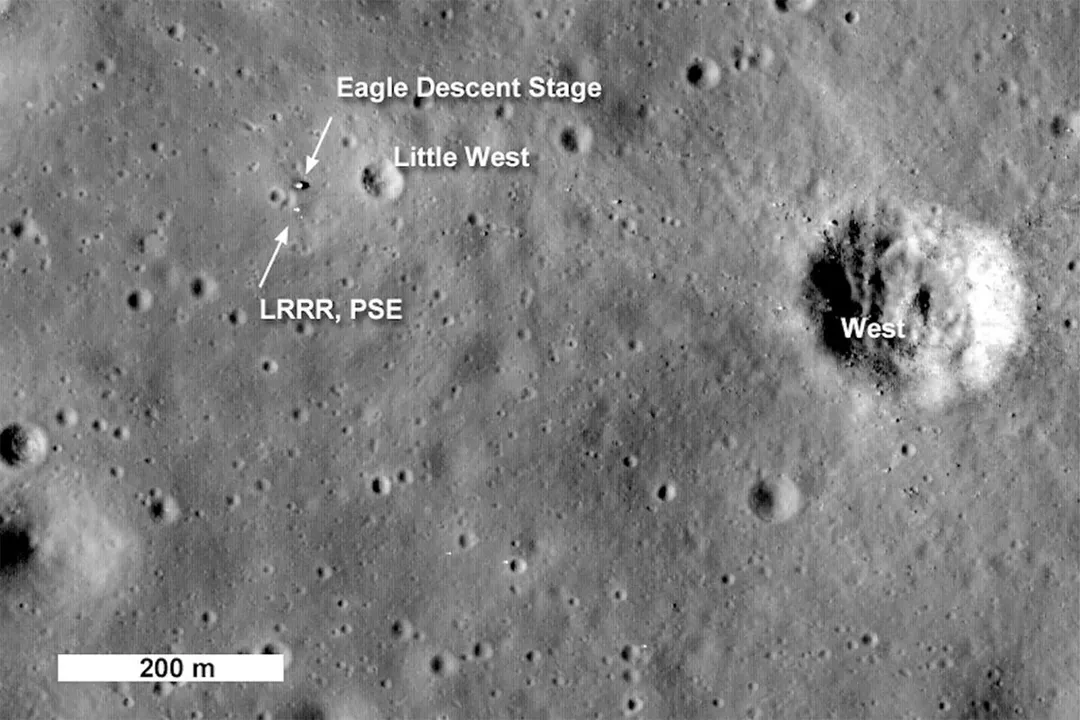
The simple appearance of a heavily cratered planetary landscape might seem chaotic, yet those overlapping circles and bowls hold one of the most fundamental keys to understanding the history of our solar system: time. By observing the density and state of impact craters on a world like the Moon or Mars, scientists can generate surprisingly accurate age estimates for the underlying rock surfaces that have been there since the earliest, most violent epochs of planetary formation. [8][5] This technique, known as crater counting, relies on the premise that surfaces exposed to space for longer periods will have accumulated a greater number of impact scars. [1]
# Impact Density
The core concept of dating a surface via craters is elegantly straightforward: if we assume a relatively consistent rate of incoming space debris—asteroids and comets—over time, then the number of impacts recorded on a region directly correlates with how long that region has remained undisturbed. [8][4] Imagine throwing paintballs at a pristine white wall. A wall left untouched for an hour will have significantly more splatters than one that was cleaned every five minutes. Planetary surfaces function similarly, though the "paintballs" are massive projectiles creating massive scars. [1]
The earliest era of solar system history, often called the Late Heavy Bombardment (LHB), was characterized by an intensely high impact flux. [5] During this period, billions of years ago, the gravitational dynamics within the young solar system stirred up a tremendous amount of debris, resulting in a barrage of impacts across all solid bodies, including Earth (though erosion has erased almost all evidence here). [8] Surfaces that formed or reformed after this period, such as the younger volcanic plains on the Moon, show far fewer craters because the general rate of impacts had already dropped dramatically. [1]
# Measuring Scars
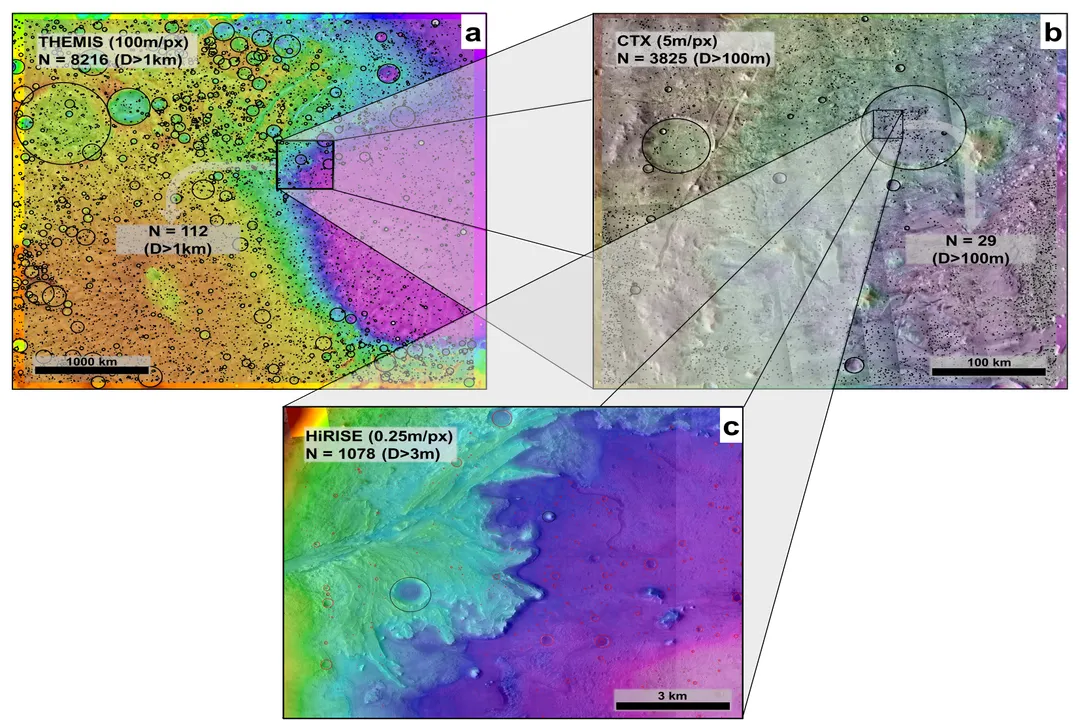
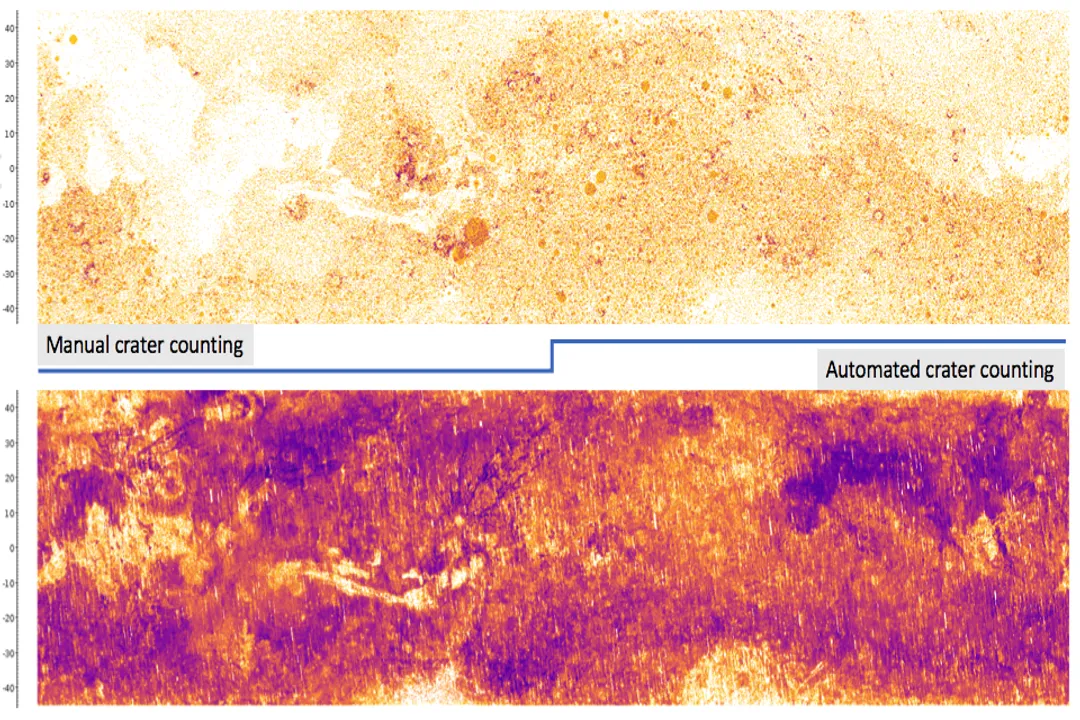
The actual process of applying crater counting requires meticulous measurement and definition. Researchers select a specific geographic area on the target body, such as a region of the Martian plains or a lunar mare, and systematically count every impact crater that falls within that boundary. [5][7] This count is usually normalized to a standard area, often expressed as craters per square kilometer, giving us the crater density. [1]
There is a critical distinction made between different sizes of craters during the counting process. Very small craters might be erased quickly by minor events or even space weathering effects that smooth out sharp features over relatively short timescales. [9] Conversely, counting only the largest craters—those several kilometers across—provides information on the oldest geological events that formed the terrain, as these massive impacts are rare and their features are long-lasting. [1][5] A surface might have thousands of small craters superimposed upon a few dozen large ones, providing a layered history of bombardment intensity. [9]
For instance, in a region like the southern highlands of the Moon, the density of craters is extremely high, indicating an ancient surface that has not seen significant resurfacing for perhaps four billion years. [8] In contrast, the vast, dark basaltic plains known as maria (seas) are clearly younger, exhibiting lower crater densities because they were formed later by volcanic flows that buried the older terrain, starting the "clock" over again for that specific area. [1][3]
# The Flux Problem
While counting craters is a measurement of relative time (Surface A has twice as many craters as Surface B, so Surface A is roughly twice as old if the impact rate was constant), the real goal is determining an absolute age in years. [4] This is where the single largest challenge in crater counting arises: the crater production rate, or flux, is not constant over time. [5][6]
The early solar system had a much higher rate of impacts than it does today. A surface that formed during the LHB accumulated craters much faster than a surface that formed one billion years ago. [1] Therefore, simply dividing the observed crater density by a modern, low impact rate would grossly overestimate the age of an ancient surface. To solve this, planetary scientists must create a crater production function, a curve that maps the expected impact rate over the solar system's history. [6]
This function is not derived simply from theory; it requires anchoring points—surfaces whose ages we do know independently. [4]
To illustrate the challenge, consider two different bodies, say Venus and the Moon, both surveyed by spacecraft. Venus is entirely covered in relatively young-looking terrain, suggesting a massive resurfacing event that reset the crater clock, but determining when that event happened relies entirely on calibrated flux models. [5] The Moon, however, provides those necessary anchors.
| Feature Type | Relative Cratering Density | Inferred Relative Age | Primary Resurfacing Mechanism |
|---|---|---|---|
| Lunar Southern Highlands | Very High (Saturated) | Oldest (Pre-LHB/LHB) | Impact Cratering |
| Lunar Maria Basins | Moderate | Intermediate (Post-LHB) | Volcanism |
| Martian Northern Plains | Very Low | Youngest | Tectonics/Erosion/Sedimentation |
| [5][8] |
# Calibration Methods
The ability to convert a crater count into a precise age hinges on radiometric dating of materials returned from the body in question. [4] Because the Apollo missions brought back lunar rocks, scientists have absolute, laboratory-verified ages for specific areas of the Moon. [8] These absolute dates are used to calibrate the crater production function for the Moon. For example, if scientists date a specific lava flow in a lunar mare to be $3.6$ billion years old, they then count the craters on that flow. This allows them to calculate the impact rate at that time ($3.6$ billion years ago), refining the production curve. [5][6]
This process is essential because the flux is thought to have dropped sharply after the LHB, stabilizing to a much lower, more consistent rate today. [1][9] A surface that accumulated all its craters during the LHB needs a very high production rate to calculate its age, while a surface that accumulated the same number of craters in the last billion years needs a very low production rate. [5]
Because Mars lacks returned samples, its crater production function must be transferred or scaled from the well-dated lunar curve. [6] This transfer introduces significant uncertainty. The impactor populations that hit Mars might have been slightly different from those that hit the Moon, or the relative efficiency of crater erosion might differ, meaning a Martian surface estimated to be $3.5$ billion years old based on lunar calibration might actually be $3.7$ or $3.3$ billion years old in reality. [6] This calibration step introduces what some researchers term a "systematic uncertainty" inherent in the dating of surfaces off-Earth. [6]

# Surface Modification Effects
A surface does not simply accumulate craters; it also erodes them. The measured crater density is a function of the cratering rate (how fast new ones form) minus the degradation rate (how fast old ones disappear). [9] This degradation rate is highly dependent on the environment of the world being studied. [5]
On the Moon, degradation is primarily driven by two processes:
- Micrometeorite Bombardment: Constant, tiny impacts over eons slowly grind down the rims and fill in the floors of older craters, making them less distinct until they are effectively erased. [9]
- Ejecta Blanketing: When a new, large impact occurs, the material thrown out (ejecta) can partially or completely bury older, existing craters nearby. [1]
On a geologically active world like Mars, the mechanisms are more dramatic. Volcanism can bury vast regions under new lava flows, completely erasing the record beneath them. [1] Wind erosion (aeolian processes) can sandblast crater rims smooth over eons, particularly in equatorial regions. [5] Water and ice action, if present, would be even more destructive. When a planetary geologist counts craters on Mars, they must first identify which areas have been chemically or physically altered recently, as these areas represent a time zero for that specific location. [5][9] For example, a relatively fresh-looking volcanic flow on Mars is dated by counting the craters on the flow, assuming the surrounding older terrain was present before the flow erupted.
The challenge of distinguishing between a truly ancient surface and a more recent surface that has simply experienced less degradation is an ongoing area of geological study. In regions where craters are so densely packed that nearly every point on the surface is covered by one crater, known as a saturation surface, further crater counting yields little new information about absolute age, as any new impact will simply obliterate an existing feature. [1] Understanding the transition into saturation helps constrain the age of the pre-saturation epoch. [9]
When analyzing very old terrains, researchers often focus on the large craters because they are the hardest to destroy. A $10$-kilometer-wide impact structure will likely survive billions of years of micrometeorite bombardment, whereas a $100$-meter one might be gone in a few hundred million years on the Moon. [1] This leads to a practical filtering step: determining which crater size population is statistically significant for the time period being investigated. If you are trying to date a surface from the Noachian period of Mars ($4.1$ to $3.7$ billion years ago), you are primarily interested in the larger craters, as smaller ones would have been erased by processes that were active even then. [5]
# The Value of Contextual Analysis
While the raw numbers are the foundation, true expertise in this field lies in contextual analysis—the subtle interplay between the count and the features themselves. A significant value is gained when we look not just at how many craters there are, but what they look like and where they overlap.
For example, when encountering a heavily cratered, ancient landscape, geologists look for superposition. If Crater A clearly sits on top of Crater B, Crater A must be younger than Crater B. [1] A systematic analysis of these overlaps can sometimes help date the major resurfacing events even in the absence of absolute dates. If a newly formed lava channel cuts across dozens of old craters, the age of that channel is constrained by the oldest crater it intersects and the newest one it buries. This layered approach allows for a relative chronology of events within a single region, regardless of the absolute date provided by the main flux model. [9] This internal consistency is what builds trust in the estimates derived from the primary counting method.
Another crucial contextual point involves the morphology of the craters. A fresh crater has a sharp rim, a deep bowl, and a distinct ejecta blanket. An ancient crater might have a shallow, subdued rim that is almost level with the surrounding terrain; its floor may be partially filled by subsequent smaller impacts or fine regolith. [9] The degree of this degradation, often quantified using metrics like central peak height or rim height, is another parameter used to refine age estimates, acting as a secondary check against the raw count density. It essentially measures the amount of time since the impact, independent of the number of impacts that have occurred. If two regions have the same crater density, but one region's craters are significantly more degraded, it implies that the degradation rate in the first region is higher, perhaps due to active geological processes not present in the second. [5]
# Comparative Ages
The power of crater counting becomes most apparent when applying the technique across the solar system, even with the inherent uncertainties of transferring flux models. By comparing the crater densities of similar-looking terrains on different worlds, we gain insights into their geological histories.
If we take the estimated ages derived from the calibrated lunar function and apply them to Mars, we can sketch out a timeline of Martian geological activity. [6] The ancient, heavily cratered southern highlands are estimated to be over $3.8$ billion years old, contemporary with the Moon's crust. [8] However, features like the Tharsis volcanic plateau and the vast outflow channels suggest extensive modification occurred between roughly $3.8$ and $3.0$ billion years ago, creating younger surfaces that are measurably less cratered. [5] The smooth plains of the northern lowlands appear much younger, potentially less than $1.5$ billion years old, suggesting that major resurfacing events, whether volcanic or sedimentary, ceased relatively recently in geological terms. [8]
This comparative approach highlights a key difference in planetary evolution. While the Moon effectively stopped evolving geologically shortly after the LHB, Mars continued to experience significant tectonic and volcanic activity for another billion years or more, constantly "wiping the slate clean" in various regions and delaying the accumulation of a full, ancient crater record. [5]
In summary, crater counting is less a simple headcount and more a sophisticated application of geochronology dependent on astrophysics, orbital mechanics, and materials science. [6] It requires researchers to manage complex variables: the known history of bombardment, the specific environment that dictates how quickly scars are erased, and the necessary calibration data from landed missions or sample returns. [4][8] The final age derived is an estimate, but it remains the most powerful tool we have for placing solid rock surfaces across the solar system onto a shared timeline. [5]
#Videos
How Planets Show Their Age: Impact Crater Analysis on Mars
Related Questions
#Citations
Crater counting - Wikipedia
How do crater counts tell us the age of a surface? Explain ... - Brainly
Chapter 7 Flashcards - Quizlet
Determining the age of surfaces on Mars
7.3 Dating Planetary Surfaces: Crater Counting (and Other Methods!)
Deriving Surface Ages on Mars Using Automated Crater Counting
Crater counting - Pawsey Supercomputing Research Centre
How scientists estimate the ages of planetary surfaces
How Planets Show Their Age: Impact Crater Analysis on Mars