What makes a crater a crater?
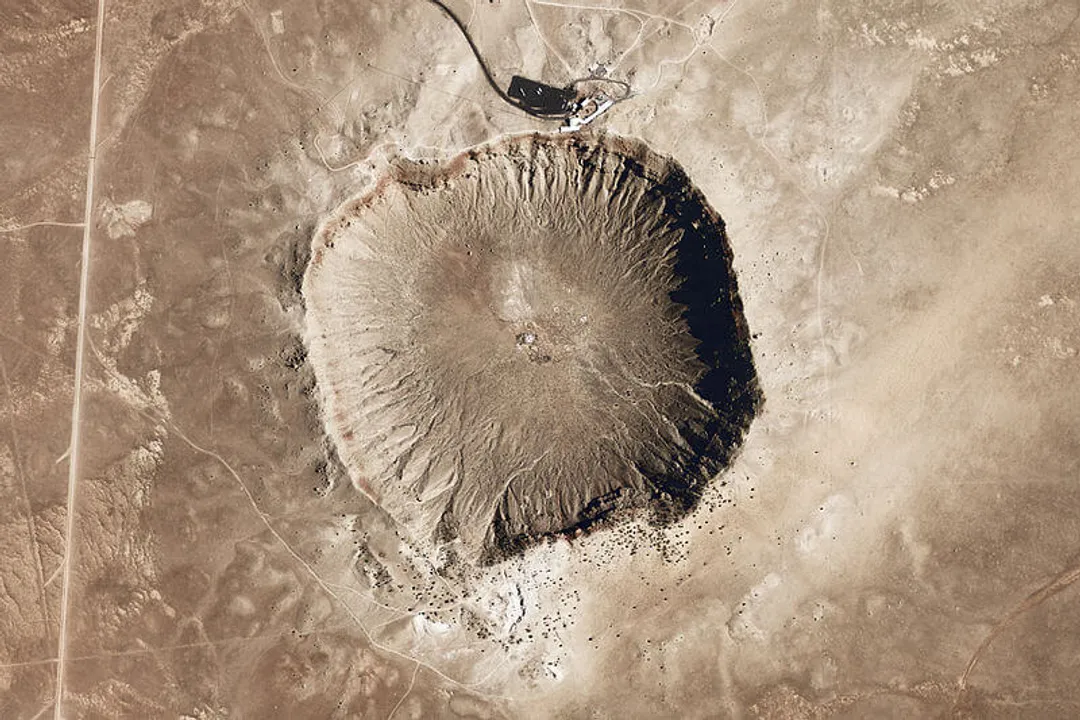
The circular depression we call a crater is far more than just a simple hole in the ground; it is the lasting scar of an extremely energetic collision, usually involving an asteroid or comet striking a planetary surface. [5][9] While volcanoes can create similar-looking features, the defining characteristic of a true impact crater lies in the mechanics of its creation: hypervelocity impact. [3][7] The resulting structure is a product of immense kinetic energy instantaneously converted into heat, shock waves, and excavation. [3] On Earth, these scars are often erased by erosion, tectonics, and sedimentation, but on airless bodies like the Moon, they provide a pristine geological history book. [10]
# Impact Mechanics
The key to forming an impact crater is speed—specifically, hypervelocity. [3] Objects entering a planet's atmosphere, like meteoroids, are traveling at speeds often exceeding 11 kilometers per second, or about 40,000 miles per hour. [3][8] At these incredible velocities, the kinetic energy carried by the impactor is the primary driver of crater formation, far outweighing the object's mass alone. [3] When this kinetic energy meets the target surface, it is instantly transferred, creating massive shock waves that travel through both the impactor and the target material. [3][8] This process vaporizes, melts, and compresses the material at the point of contact. [3]
A useful way to contextualize this energy release is to think not just about the object's size, but the speed at which it arrives. Even a relatively small object hitting at 20 km/s releases energy equivalent to a large nuclear weapon. [8] Because the impact happens so quickly, on the scale of seconds or less, the formation process is closer to an explosion than a simple dent or puncture. [8] This instantaneous release of energy is what differentiates an impact structure from slower geological processes like volcanic collapse. [1]
# Formation Stages
The creation of a recognizable impact crater involves three distinct, rapid phases: contact and compression, excavation, and modification. [7][9]
# Contact and Compression
This is the initial moment the impactor strikes the target body. [7] The immense shock wave begins propagating almost immediately, compressing and heating the rock beneath the point of contact. [3][9] The sheer force of the shock wave can cause the impactor itself to fragment and melt into a glassy material, often referred to as impact melt. [3]
# Excavation Phase
Following compression, the energy released forces material outward and upward, creating the transient crater. [7] This is the rapid emptying of the target material, blasting rocks and debris away from the impact site. [3][5] The ejected material, called ejecta, blankets the surrounding landscape. [1][5] The depth of this initial excavation is often related to the size of the impactor. [7]
# Modification Stage
Once the initial excavation stops, the crater structure begins to settle under gravity, which is the modification phase. [7] On bodies with substantial gravity, like Earth, the transient crater walls often become unstable and collapse inward. [1][7] This slumping creates terraces along the crater rim. [1] For larger impacts, the central floor may rebound upward, forming a central peak or a peak ring, features characteristic of complex craters. [1][7] On smaller bodies or for smaller craters, this stage may result in a simple bowl shape that remains relatively stable. [1]
# Crater Structure
The resulting structure varies dramatically based on the size of the impactor and the gravity of the body it strikes. [1] Craters are generally classified as simple or complex. [1][7]
# Simple Craters
For impacts that create craters less than about 2 to 4 kilometers in diameter on Earth, the resulting structure tends to be a bowl shape with a relatively smooth, continuous floor and steep walls. [1] These are called simple craters. [1] They usually lack the dramatic central uplift seen in their larger cousins. [7]
# Complex Craters
When the impact is energetic enough to create craters larger than this threshold—around 4 kilometers diameter on Earth—gravity begins to play a much larger role in modification. [1][7] These complex craters feature significant structural modifications. [1] These can include:
- Central Peaks: A mound of uplifted rock in the center, caused by the rebounding of the compressed target rock. [1][7]
- Terracing: Stair-step features along the inner walls formed as the transient crater walls collapse and slump inward. [1][7]
- Rims: These are often raised significantly above the surrounding terrain, with ejecta deposits spread around the outside. [1]
The scale of these features directly correlates with the energy of the impact. For instance, the central uplift in very large impact basins can reach several hundred kilometers across. [1]
# Size Classification
Crater size is generally measured by the diameter of the resulting structure, ranging from microscopic pits to basins hundreds of kilometers wide. [1] The relationship between the size of the impactor and the size of the resulting crater is not linear, but a complex function of energy, impact angle, and target material strength. [3]
One interesting observation across planetary science is the sheer scale of objects that have hit solid surfaces. While the vast majority of space debris entering Earth's atmosphere burns up harmlessly, the large objects that survive to impact the surface leave indelible marks. [5] On the Moon, where there is no atmosphere to burn up smaller projectiles and no geological activity to erase the evidence, the density of craters is much higher than on Earth, offering a clearer record of bombardment history. [10]
When we look at Earth-based data, the largest confirmed impact structures are massive, often exceeding 100 kilometers in diameter, yet finding them can be difficult due to geological masking. [1] A structure like the Sudbury Basin in Canada, which is a severely eroded impact structure, still preserves evidence of its violent origin, illustrating how resilient these formations can be even over billions of years. [10] It is a fascinating point that even if an object hits the ocean, which covers most of our planet, the resulting shock wave can fracture the seafloor and create a temporary, recognizable structure, though submerged ones are harder to confirm without specialized geophysical surveys. [9]

# Terrestrial Study
Studying impact craters on Earth provides crucial insights into planetary processes that are difficult to replicate or observe elsewhere. [10] Terrestrial craters offer a unique chance to examine in situ geology—we can drill cores, analyze shocked minerals, and study the immediate effects of hypervelocity impact in a location where we can observe long-term post-impact processes. [9][10]
For example, the presence of specific minerals that only form under extremely high pressure and temperature, such as coesite or stishovite (high-pressure polymorphs of quartz), is a definitive fingerprint that the rock experienced an impact shock rather than just volcanic heat. [10] This mineralogical evidence is key to distinguishing an impact crater from a caldera, which is a depression formed by the collapse of a magma chamber. [1] Where a caldera will show associated igneous rock layers formed by lava flows, an impact site will show evidence of brecciation (shattering of rock) and melt sheets created by instantaneous shock compression. [9]
One useful consideration for amateur geologists or field enthusiasts observing potential impact sites is looking for radial ejecta patterns or distinctive breccia deposits far from the central depression. If a depression is clearly associated with a massive, sudden event rather than slow volcanic buildup or tectonic faulting, and if high-pressure minerals are present, the case for it being an impact crater strengthens considerably. [9]
# Cosmic Record
The study of craters extends far beyond Earth; it is fundamental to understanding the entire Solar System. [10] Because bodies like the Moon, Mercury, and Mars lack significant atmosphere or plate tectonics, their surfaces act as time capsules, recording the history of bombardment over billions of years. [1][10]
The density of craters on a planetary surface is used by planetary scientists to estimate its age—a process called crater counting. [1] Areas with a high density of overlapping craters are generally considered older than smoother, less-pitted surfaces. [1] This technique allows scientists to build timelines for geological events on extraterrestrial bodies. [10] For instance, comparing the heavily cratered highlands of the Moon to the smoother maria allows us to date when massive lava flows flooded the basins. [10]
While most small impactors disintegrate in Earth's atmosphere, the relative scarcity of large impact craters on Earth compared to the Moon suggests that the Moon has experienced a much higher rate of impacts by objects large enough to create significant craters over the solar system's history, or that Earth's geological processes have simply erased its evidence more effectively. [10] The fact that we can see the Moon's surface peppered with features that mirror the impacts Earth must have experienced gives us a crucial reference point for understanding the bombardment history of our own world. [10] The study of these ancient scars helps us understand the environment of the early solar system and the processes that shaped all terrestrial planets. [10]
#Videos
CRATER - YouTube
Related Questions
#Citations
Crater - Wikipedia
Crater - National Geographic Education
Shaping the Planets: Impact Cratering - Lunar and Planetary Institute
CRATER - YouTube
What Is an Impact Crater? | NASA Space Place
Impact craters or meteor craters, how are they formed and why are ...
CRATER FORMATION - Crater Explorer
How Are Craters Formed? | Ask An Earth And Space Scientist
Why study impact craters? | AMNH