What is the Earth's reflective surface?
The phenomenon governing how much of the sun's energy bounces back into space versus how much is absorbed by our planet is central to understanding Earth's temperature regulation. This property, quantified as a measure of reflectivity, dictates the fate of incoming solar radiation across various surfaces, from the deepest oceans to the brightest glaciers. [1][6] It describes the fraction of solar radiation reflected from an object or surface back towards the source of illumination. [1]
# Surface Basics

This critical measure is formally known as albedo. [1][9] In its purest mathematical sense, albedo is a ratio, expressed as a value between 0 and 1, or as a percentage from 0% to 100%. [1] A value of 1 signifies a perfect reflector—a surface that bounces back every single photon it receives—while a value of 0 represents a perfect absorber, one that retains all incoming energy. [1] For the Earth as a whole, the average planetary albedo is estimated to be around 0.30, meaning that roughly 30% of the sunlight hitting the planet is immediately reflected back out to space. [6]
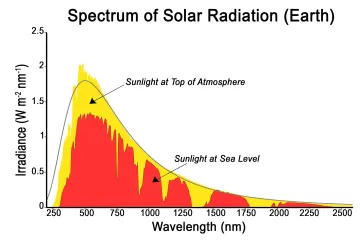
What makes this concept so vital is its direct link to thermal energy. Surfaces with high albedo, like fresh snow, keep things cool because they efficiently send solar energy away. [3][9] Conversely, surfaces that are dark or absorb light well, such as asphalt or deep water, have a low albedo and heat up significantly as they retain that energy. [3][9] This principle of reflection versus absorption is the fundamental mechanism controlling local and global energy balances. [5] It is also important to note that albedo measurements can be wavelength-dependent; a surface might reflect visible light differently than it reflects infrared radiation, an important detail when scientists model the Earth's total energy budget. [1]
# Reflectivity Values
Understanding the range of albedo values across different environments helps put the Earth's overall reflectivity into context. Different materials and surface conditions yield vastly different reflectivity numbers. [6][9]
Consider a few examples to illustrate the dramatic variance in how surfaces treat incoming sunlight:
| Surface Type | Typical Albedo (Approximate) | Energy Behavior |
|---|---|---|
| Fresh Snow | 0.80 to 0.90 (80% to 90% reflected) | Highly reflective, strongly cooling effect [6][7] |
| Dry Desert Sand | 0.30 to 0.40 (30% to 40% reflected) | Moderate reflection, warmer than snow [6][9] |
| Green Forest Canopy | 0.10 to 0.20 (10% to 20% reflected) | Highly absorptive, significantly warming effect [6] |
| Open Ocean Water | As low as 0.03 (3% reflected) | Extremely absorptive, retains most solar energy [7] |
A pristine, fresh snow cover is an excellent reflector, capable of bouncing back 80% to 90% of incoming sunlight. [6][7] In sharp contrast, dense, dark evergreen forests have a much lower albedo, absorbing 80% or more of the solar energy that strikes their needles. [6] The deep, dark surface of the open ocean absorbs almost all incident radiation, reflecting only about 3%. [7] This contrast—the difference between a bright, reflective surface and a dark, absorptive one—is what drives significant regional temperature differences. [5]
# Surface Dynamics
While the intrinsic material properties influence albedo, the immediate state of the Earth’s surface introduces a dynamic element that scientists must track continuously. [2] For instance, bare soil has a different albedo than that same soil when it is saturated with water, and the presence of vegetation dramatically changes the overall reflection signature compared to barren land. [2]
The measurement of these changing conditions, particularly the Land Surface Albedo (LSA), is achieved through sophisticated remote sensing techniques. [2][8] Satellites, such as those carrying the Moderate Resolution Imaging Spectroradiometer (MODIS), capture the reflected light across the globe, allowing researchers to create essential data products. [2] These LSA products are not just academic curiosities; they are critical inputs for predicting weather patterns, managing agricultural resources, and assessing hydrological cycles. [8] Monitoring LSA allows experts to quantify how changes in land use, like deforestation or urban sprawl, alter the reflectivity of a given area. [5]
When we consider local environments, these surface variations become even more pronounced. Imagine two neighboring areas: a vast field of dark, tilled soil versus a freshly paved, black asphalt parking lot. The parking lot, being darker and smoother, will absorb much more energy, creating a pocket of localized warmth—an effect often contributing to the urban heat island phenomenon. [3] This scale of localized heating, driven by surface color and composition, is the same physical mechanism operating on a planetary scale when discussing ice sheets. [3]
# Cryosphere Influence
Nowhere is the change in surface reflectivity more immediately impactful than in the polar regions, where water exists primarily as ice and snow. [7] The cryosphere—the frozen parts of the Earth—plays an outsized role in global energy balance precisely because of its high albedo. [7]
When sunlight hits the bright surface of sea ice or a vast snowfield, the majority of that energy is sent back into space, helping to keep the planet cool. [4][7] However, when that ice or snow melts, it exposes the darker surface beneath it—either open ocean water or bare land. [4][7] Open water has an albedo of only about 0.03, meaning it absorbs 97% of the incoming radiation, compared to the roughly 10% absorbed by reflective ice. [7]
This shift in reflectivity triggers a powerful cycle known as a positive feedback loop. [4] The absorption of more energy causes the exposed dark surface to warm up faster, which in turn melts more ice, exposing even more dark surface, leading to further warming and absorption. [4] This process is a major concern for climate scientists because the loss of highly reflective surfaces accelerates the rate of atmospheric and oceanic warming in those regions. [4][7] The consequences extend far beyond the poles, as these regions are crucial for regulating global heat distribution. [5]
# Climate Feedback
The Earth's overall albedo is not static; it is constantly shifting due to natural cycles and, increasingly, human activities. [4] The albedo effect is a key feedback mechanism in the climate system. [4] When surface properties change in a way that causes more warming—such as the ice melt cycle just described—it is termed a positive feedback. [4] If a change causes a cooling effect, it is a negative feedback.
For example, increased cloud cover can temporarily increase the Earth's overall albedo by reflecting more solar radiation away, potentially causing a slight cooling effect, though the mechanisms surrounding clouds are complex and involve both reflected light and trapped outgoing heat. [6] Conversely, as mentioned, the replacement of bright snow cover with dark vegetation or water represents a reduction in planetary albedo, contributing to overall warming trends. [4][6]
Thinking about this at a large scale is challenging. While a single glacier melting has a measurable impact, tracking the cumulative effect of countless small changes—a forest becoming farmland, a city expanding its dark rooftops, or a dust storm temporarily covering snow—requires the kind of precise, large-scale data that satellites provide. [2][8] The complexity lies in how these regional changes aggregate to influence the global energy budget, an area where modeling relies heavily on accurate albedo inputs. [2]
To put the scale of potential change into perspective, consider the difference between 10% absorption and 90% absorption of solar radiation over a massive area like the Greenland ice sheet. If we look at land use changes globally, the shift from natural landscapes to surfaces covered in dark, heat-trapping materials is a measurable, non-natural contribution to reduced planetary reflectivity. [5] While the planet’s overall reflectivity is heavily dictated by clouds and oceans, localized changes in land albedo are the direct result of terrestrial ecology and human development. [2][5]
# Local Action Reflection
While the sheer scale of global albedo management seems distant, understanding the underlying physics allows for tangible local decisions. The concept of albedo directly informs energy efficiency strategies in built environments. [3]
When selecting materials for roofing or paving in warmer climates, the choice has immediate thermal consequences for the immediate surroundings. Opting for a light-colored, highly reflective roof, sometimes termed a "cool roof," directly reduces the amount of solar energy absorbed by the building. [3] This reduction in absorbed heat translates directly into lower cooling demands, meaning less electricity is used to run air conditioning systems. [3] This is a practical application of the planetary principle: increasing local albedo leads to local cooling. If a significant portion of a city adopts lighter-colored surfaces, the collective effect can mitigate the urban heat island, offering a small, localized push against the overall warming trend driven by reduced global albedo. [3]
In essence, the Earth's reflective surface, its albedo, is a dynamic measurement that tells us how efficiently our planet is shedding incoming solar energy. It is a number that defines the line between a stable, cooler climate and one experiencing accelerated warming, a line constantly being redrawn by melting ice, growing forests, and the paving choices we make in our own neighborhoods. [4][5] Tracking these shifts remains a primary goal for Earth observation science. [2][8]
Related Questions
#Citations
Albedo - Wikipedia
Albedo - NASA Earthdata
Reflections on albedo: Why it matters - Global Heat Reduction Initiative
What is The Albedo Effect And How Does it Impact Global Warming?
Upon further reflection - Cary Institute of Ecosystem Studies
Earth's Albedo and Global Warming | PBS LearningMedia
Albedo effect - Norsk Polarinstitutt
VIIRS Land Surface Albedo (LSA) - NOAA OSPO
Albedo Effect | Restoring Earth's Energy Balance - MEER.org