What causes Earth’s magnetic field reversals?
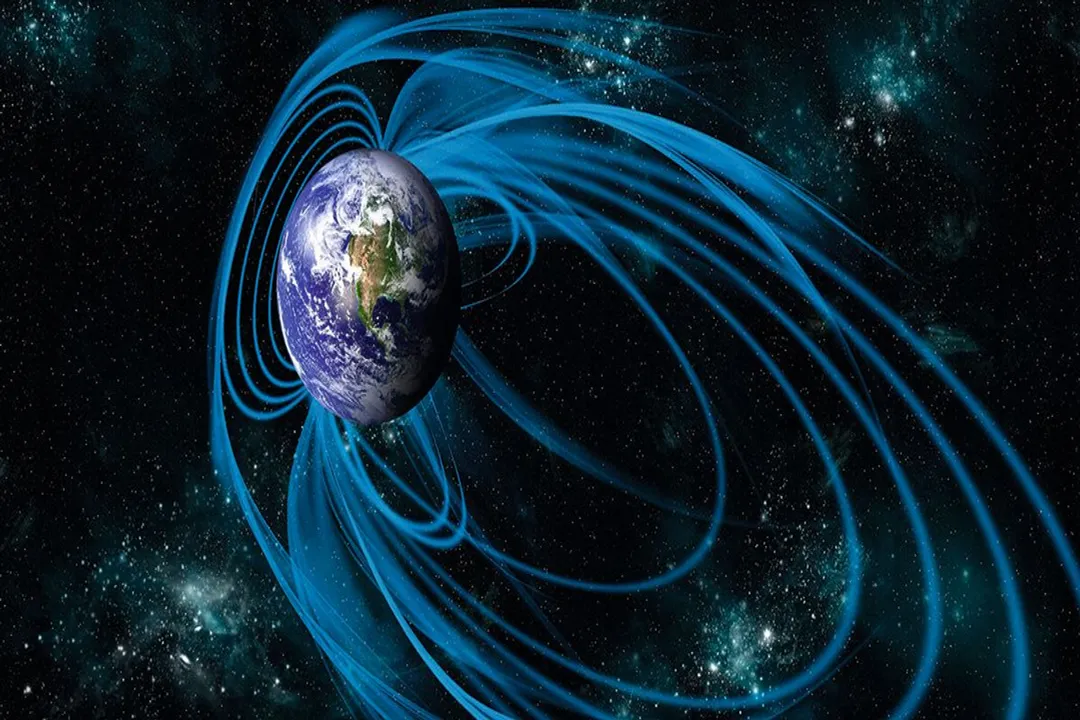
The Earth’s magnetic field, the invisible shield generated deep within our planet, is not a constant feature. Periodically, this field undergoes a dramatic event: a complete flip where the magnetic North and South poles swap their geographical locations. This phenomenon, known as a geomagnetic reversal, is a fundamental aspect of our planet’s long history, yet the precise mechanism driving these chaotic flip-flops remains a subject of intense study. The evidence for these ancient reversals is locked away in the geological record, primarily through the study of rocks that captured the planet's magnetic orientation as they formed.
# The Core Dynamo
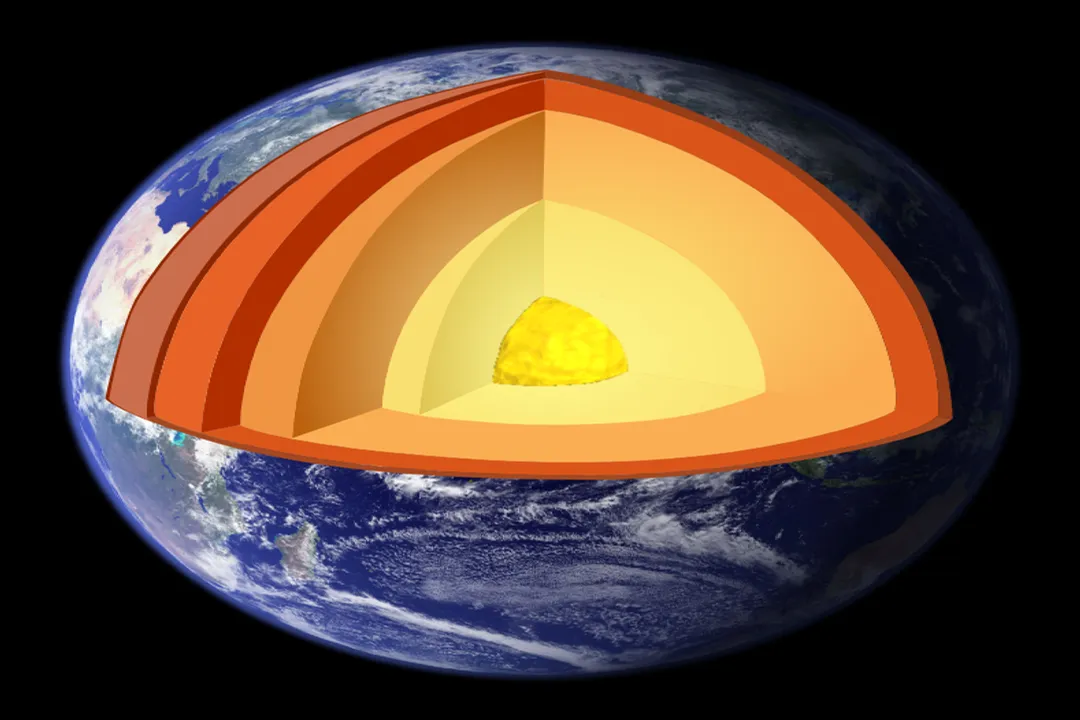
To understand why the poles reverse, one must first understand how the field is created. The Earth’s magnetic field is primarily generated by a process called the geodynamo, which occurs in the liquid outer core. This outer core is composed mainly of molten iron, and its motion is the engine of our planetary magnetism.
The movement in this conductive fluid is driven by convection—hot material rises, cools, and sinks—combined with the planet's rotation. This circulating, electrically conductive iron acts like a massive, naturally occurring electrical generator. The motion of the molten metal across pre-existing magnetic field lines generates electric currents, which, in turn, sustain and regenerate the magnetic field itself—a process known as advection. If this motion were smooth and organized, we would expect a very stable, simple dipole field, much like a bar magnet.
However, the flow within the outer core is far from laminar. It is described as turbulent and chaotic. This inherent turbulence means the system is naturally prone to instability. In computer simulations modeling the coupling between electromagnetism and fluid dynamics in the Earth’s interior, reversals frequently emerge spontaneously from these underlying dynamics. The chaotic nature of this fluid iron is the key factor that makes predicting these events currently impossible. The system essentially attempts to flip on its own due to the inherent instabilities of the churning, highly energized fluid.
# Reading the Past
We know that reversals have happened many times because the geological record preserves a signature of the ambient magnetic field at the time materials solidified. This field acts as a kind of tape recording embedded in the rock structure.
The primary source for this historical data comes from two main archives. First, volcanic rocks that cool through the Curie temperature preserve the magnetic field direction present at that moment. Second, sediments accumulate on the ocean floor, and the minute iron-rich minerals within them align with the field as they settle, trapping a magnetic record. Scientists famously used magnetic "stripes" on the ocean floor—symmetrical patterns of normal and reversed magnetism on either side of mid-ocean ridges—to provide the first compelling, large-scale proof of seafloor spreading, a concept crucial to plate tectonics theory.
Paleomagnetists have compiled the Geomagnetic Polarity Time Scale based on these records. This scale details periods of normal polarity (the current state) and reversed polarity, organized into units called chrons. The data shows that the field is not just flipping; it also experiences excursions, which are significant but shorter-lived changes in intensity that last from a few centuries up to tens of thousands of years, sometimes involving a temporary flip that quickly corrects itself, as seen in the Laschamps event about 41,500 years ago.
The existence of a field generating mechanism that alternates between two stable states (normal and reversed) is consistent with dynamo theory, which predicts no bias toward one polarity over the other. The history shows that the field has indeed been equally likely to be in either orientation over vast timescales.
# Irregularity and Pace
One of the most significant findings about geomagnetic reversals is their lack of periodicity. They are considered statistically random events.
For example, over the last 83 million years, there have been at least 183 reversals, averaging out to roughly one every 450,000 years. However, the rate has varied wildly across Earth's deep past. There were periods of frequent flipping, such as when 17 reversals occurred over a 3-million-year span around 42 million years ago. Conversely, there have been superchrons: extremely long intervals where no reversals occurred at all. The most famous is the Cretaceous Normal Superchron, which lasted an astonishing 37 million years, from about 120 to 83 million years ago.
Regarding the speed of the transition itself, general consensus places the duration of a full reversal between 1,000 and 10,000 years. While this is fast by geological standards, it is slow when compared to a human lifetime. During this transitional period, the field doesn't completely vanish, but it weakens dramatically, perhaps to 10% of its normal strength, and the simple dipole structure breaks down into a complex, multi-pole configuration. New research, however, suggests that the speed might be more variable than previously thought; some evidence points to a complete transition occurring in as little as 200 years, or even a few years in isolated instances within the broader transition. Furthermore, studies of ancient lava flows on Steens Mountain in Oregon suggest the magnetic field inside the core can shift at rates as high as 6 degrees per day, even if the overlying mantle material smooths out the signal we observe at the surface.
If we consider the current situation, the magnetic north pole has been wandering, recently accelerating toward Siberia. The field intensity has also decreased by about ten percent since the 1830s. Some propose this signals an impending reversal, but paleomagnetic data indicates the field is currently about twice as intense as its million-year average, suggesting it is far from the critically low intensity usually associated with a full flip.
The concept of a geological "speed limit" on change is often debated. While rapid changes in the core are modeled as possible, the physical resistance of the mantle—a semiconductor—likely acts as a filter, damping out variations that happen on timescales of less than a few months when observing the field at the surface.
# The Role of the Inner Core
The interaction between the fluid outer core and the solid inner core appears to be crucial in determining whether a field flip succeeds or fails. The generation of the field via convection happens in the liquid outer core. This fluid core seems to frequently attempt to reverse the field configuration. However, the solid inner core acts as an anchor or stabilizer.
Magnetic field lines generated in the outer core can diffuse, or spread, into the solid inner core. Since the inner core is solid, it cannot generate a field through advection, but it resists the "new" (reversed) field diffusing into it. The process resembles a tug-of-war: the outer core's flow tries to push a reversal through, but if the old field locked into the inner core has not completely diffused away, the attempt fails. This mechanism explains why reversals are relatively infrequent (on the order of hundreds of thousands of years) compared to the internal attempts at flux reversal, suggesting that perhaps only one in every ten attempts is successful in establishing a full reversal.

# Disruptions Versus Spontaneity
While the spontaneous nature derived from fluid dynamics models is the most widely accepted cause, an alternative hypothesis exists that suggests external or internal triggers initiate the instability.
Proponents of this trigger theory, such as Richard A. Muller, suggest that massive events might disrupt the core's organized flow enough to effectively "turn off" the dynamo temporarily. Potential triggers include large meteorite or comet impacts, or immense internal shifts like the arrival of large continental slabs carried down to the core-mantle boundary through subduction zones. In this scenario, when the dynamo recovers from the disruption, it randomly chooses to stabilize in either the original or the opposite polarity, meaning about half of these recoveries would result in a reversal.
However, the evidence for a correlation between reversals and major external events, like impact events that caused mass extinctions, is considered weak. For instance, no connection has been found between reversals and the Cretaceous–Paleogene extinction event. The chaotic nature of the dynamo itself, reflected in the randomness of the reversal pattern, strongly supports the idea that the process is self-contained.
# What Happens During the Stumble
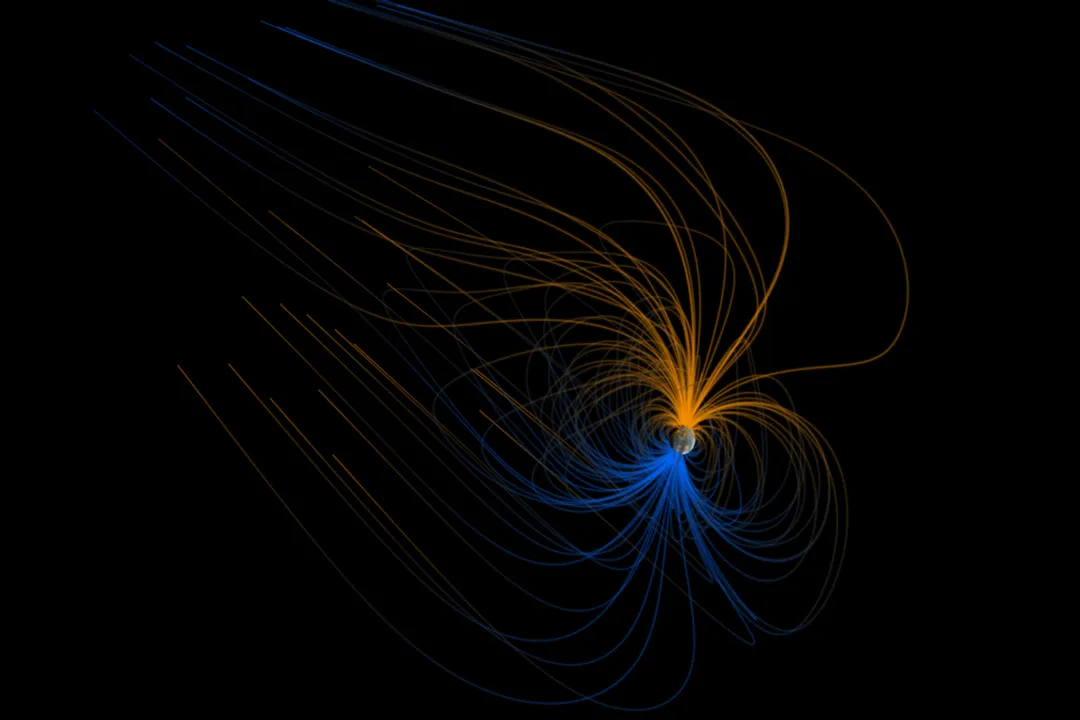
When the field enters the reversal process, the primary change noticed globally is a significant weakening of the main dipole component. The magnetic field doesn't drop to zero across the entire planet, but rather, the structure becomes jumbled, characterized by a complex, non-dipolar pattern where multiple North and South poles might temporarily exist in unexpected places as the field seeks its new orientation.
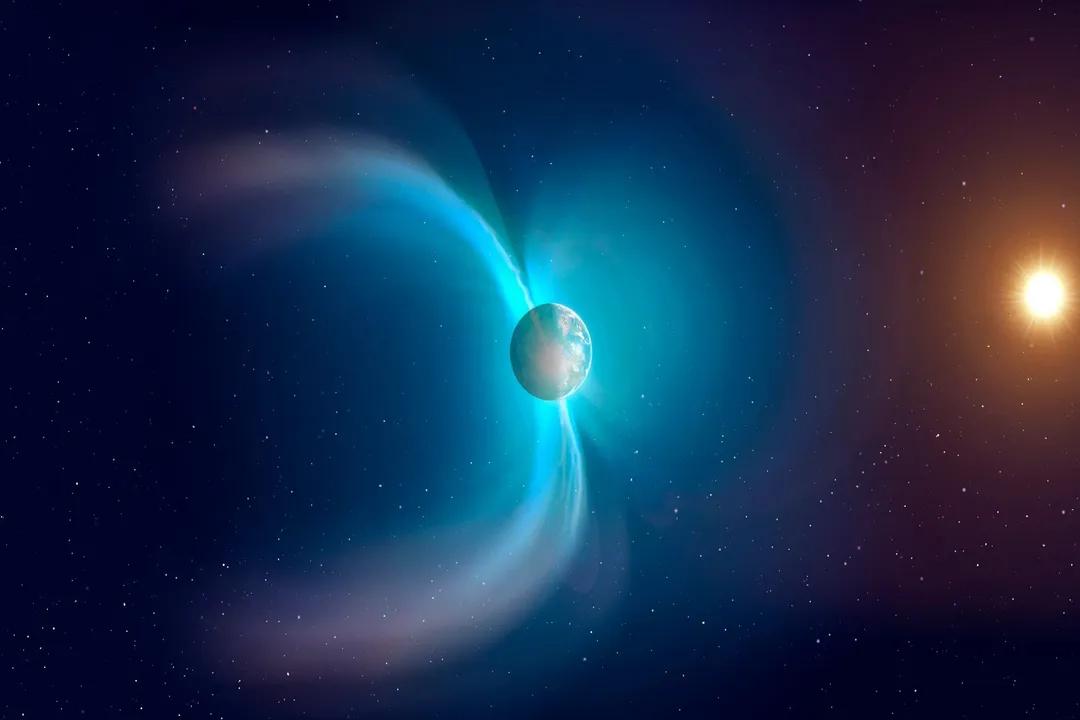
The magnetic shield—the magnetosphere—persists throughout this transition, though it is significantly reduced in strength. This weakening means that cosmic rays and charged particles from the Sun (solar wind) can penetrate closer to Earth than usual. During a reversal or excursion, studies of beryllium isotopes in ice cores suggest that the flux of cosmic rays reaching the atmosphere can increase significantly, sometimes by a factor of three or more, compared to normal periods.
A helpful way to visualize this instability is to think of the forces at play in the outer core. The chaotic flow of molten iron means localized regions of opposite magnetic flux are constantly forming at the core-mantle boundary. The overall field we measure is the sum of all these local fields. A reversal occurs when the large-scale, ordered field component is overcome by these growing, disorganized, reversed flux patches, such as the one currently centered under the South Atlantic, which is responsible for the South Atlantic Anomaly and the overall long-term global field decay. For the reversal to complete, the ordered component must essentially be replaced by the opposite ordered component, not just a temporary jumble.
# The Modern Risk Assessment
Given the geological evidence, several common concerns about reversals can be addressed with facts derived from long-term study.
First, mass extinctions are not correlated with magnetic reversals. Life has endured hundreds of flips over the last 160 million years, while major extinction events are far less frequent. The atmosphere itself, acting like a thick blanket, shields the surface from nearly all incoming radiation, even if the magnetic field is severely diminished.
Second, the reversal is not instantaneous, minimizing acute environmental shock to most life forms. The typical duration of one to ten thousand years allows for gradual adaptation in life forms, such as migratory species like birds and sea turtles that use the field for navigation.
The real concern for modern civilization stems not from the flip itself, but from the protracted period of reduced field intensity. Our current society relies heavily on technology susceptible to space weather and charged particle bombardment. A weaker magnetosphere allows increased particle penetration, which poses significant risks to:
- Satellites: Increased radiation can damage electronics in low Earth orbit.
- Power Grids: Rapid magnetic field variations, even during the transition, can induce currents detrimental to terrestrial power infrastructure.
- Communication Systems: Degradation of GPS and long-range radio communication due to ionization in the upper atmosphere.
It is interesting to consider that while the field has weakened by about 10% in the last two centuries—a measurable change—this fluctuation must be viewed in context. If we look at the historical fluctuation data, a 10% drop is relatively minor, comparable to natural secular variation over a period of a few thousand years. For instance, the field was nearly twice as strong in Roman times as it is now. This short-term, technologically relevant monitoring window (the last couple of centuries) is simply too narrow to align with the random, multi-hundred-thousand-year cycle of actual pole reversals. The current decrease in strength appears to be a normal fluctuation within the geodynamo's existing variability rather than the definitive precursor to a flip.
Ultimately, the cause of a geomagnetic reversal is the natural, chaotic, and self-sustaining turbulence within the Earth's liquid iron outer core. It is a dynamic system resisting the alignment of its own generated field, a struggle dictated by fluid physics and thermal evolution, playing out over random stretches of geological time. We monitor the signs of instability, but the timing remains firmly outside our ability to predict.
#Videos
Why Does the Earth's Magnetic Field Keep Flipping? - YouTube
Related Questions
#Citations
Geomagnetic reversal - Wikipedia
Flip Flop: Why Variations in Earth's Magnetic Field Aren't Causing ...
Why Does the Earth's Magnetic Field Keep Flipping? - YouTube
Why do Earth's magnetic poles flip? - Space
Reversals: Magnetic Flip - BGS Geomagnetism
ELI5: why the earth's magnetic fields reverses? : r/explainlikeimfive
Is it true that Earth's magnetic field occasionally reverses its polarity?
Earth's magnetic field is overdue a flip. Should we be worried?
Notes on What Causes Geomagnetic Reversal? - Unacademy