How do magnetic fields influence charged particles?

The interaction between magnetic fields and charged particles forms a cornerstone of electromagnetism, dictating everything from the stability of plasma to the operation of high-energy physics equipment. [2][7] Fundamentally, a magnetic field only exerts a force upon a charged particle if that particle is in motion. [5][9] A stationary charge, no matter how large its magnitude, will simply pass through a magnetic field completely unaffected. [5] This selectivity in interaction is a defining characteristic of magnetism, differentiating it sharply from the electric force, which acts on a charge regardless of its velocity. [9]
# The Force Equation

The specific influence exerted by a magnetic field on a moving charge is precisely described by the Lorentz force law. [2][9] This relationship is quantified by the vector cross product: , where is the resulting magnetic force, is the magnitude and sign of the charge, is the velocity of the particle, and is the magnetic field strength. [2]
The cross product nature of this equation is what determines the direction of the force. The resulting force vector () is always perpendicular to both the velocity vector () and the magnetic field vector (). [2][9] This perpendicular relationship has profound consequences for how the particle moves. [2]
A key takeaway from the cross product is the dependence on alignment. If a charged particle travels perfectly parallel to the magnetic field lines, or directly opposite (antiparallel), the angle between and is zero or 180 degrees, respectively. In these instances, the sine component of the cross product evaluates to zero, meaning the magnetic force exerted is zero. [2] This is a significant practical consideration when designing particle paths; one can deliberately align a magnetic field parallel to a beam path to avoid deflection entirely, even when the beam is moving at extremely high speeds. [2]
# Particle Trajectories

Since the magnetic force is always perpendicular to the velocity of the particle, it performs no work on the particle. [2] Work done requires a force component parallel to the displacement, but because the force is always perpendicular to the direction of motion, the particle's speed does not change, only its direction of travel. [2][9]
The resulting trajectory depends entirely on the initial angle between the particle's velocity and the magnetic field lines:
- Circular Motion: If the initial velocity vector is entirely perpendicular to a uniform magnetic field, the force acts as a centripetal force, continuously pulling the particle toward the center of a circle. The particle executes perfect circular motion. [2]
- Helical Motion: More commonly, a particle has components of velocity both parallel and perpendicular to the field. The perpendicular component dictates the circular path, while the parallel component keeps the particle moving along the field line direction. The combination of these two movements results in a helical or corkscrew-like path. [2]
The radius of this resulting circle or helix is directly proportional to the particle's momentum () and inversely proportional to the magnetic field strength () and the charge (). [2] This dependency is heavily exploited in physics experiments, allowing scientists to determine the momentum of unseen particles by simply measuring the radius of the curve they trace in a known magnetic field. [3]
# Charge Field Creation

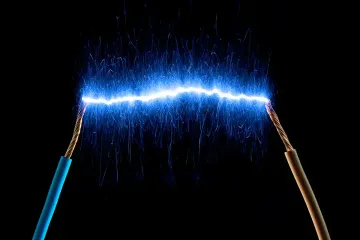
The relationship is not one-sided; moving charges are not only affected by magnetic fields, they are also the source of them. [5][6] Whenever electric charges are in motion—meaning an electric current flows—a magnetic field is generated in the space surrounding that current. [8] This concept is central to the creation of electromagnets. [6][8]
The characteristics of the field created depend on the nature of the current. For instance, in a wire, the magnetic field lines form concentric circles around the wire. [8] When dealing with permanent magnets, the magnetic field lines are conventionally drawn emerging from the North pole and entering the South pole. [8] Unlike electric field lines, which can start and end on individual charges, magnetic field lines always form closed loops; there are no isolated magnetic monopoles (isolated North or South poles) in classical physics. [8]
# Comparing Field Influences

To better appreciate the unique nature of magnetic influence, it helps to compare it directly with the influence of an electric field on the same moving charge.
| Characteristic | Electric Field () Force | Magnetic Field () Force |
|---|---|---|
| Dependence on Motion | Independent (acts on static or moving charges) | Dependent (acts only on moving charges) |
| Direction of Force | Parallel or antiparallel to field lines | Perpendicular to both and field lines |
| Work Done | Can perform work, changing particle kinetic energy | Performs no work, speed remains constant |
| Governing Law | Coulomb's Law (or ) | Lorentz Force () |
This fundamental difference—the magnetic force being directional-dependent and non-work-doing—is vital for understanding many technological applications. [2][9] It allows engineers to manipulate the path of high-speed particles without imparting extra energy, something an electric field could not do as cleanly. [3]

# Accelerator Magnets
The controlled manipulation of charged particles via magnetic fields is the operating principle behind particle accelerators, devices used to study the fundamental nature of matter. [3] In these environments, particles like protons or electrons are accelerated to near the speed of light and guided through long vacuum chambers. [3]
Magnets are the primary tools for beam control in these machines. Different types of magnets serve distinct focusing and steering functions:
- Dipole Magnets: These magnets create a relatively uniform magnetic field across a specific region. [3] Their main job is to bend the path of the charged particle beam, keeping it circulating within the circular structure of a synchrotron or synchrotron storage ring. [3] The force they apply continuously changes the direction of the momentum vector, forcing the particle into a curve. [2]
- Quadrupole Magnets: Where dipoles steer, quadrupoles focus. [3] A quadrupole magnet has four poles arranged such that the magnetic field gradient is linear, creating a focusing or defocusing effect in one plane while focusing or defocusing in the perpendicular plane. [3] By alternating focusing and defocusing quadrupole magnets (a FODO lattice), physicists can keep the particle beam tightly constrained, preventing it from spreading out and hitting the walls of the vacuum pipe. [3]
The precision required in these applications is staggering. A slight misalignment or error in the magnetic field strength in a large collider can cause a beam of particles traveling near the speed of light to deviate just enough to strike the beam pipe, resulting in a costly shutdown. [3] This dependence shows that controlling motion via magnetic fields is as much an engineering challenge as it is a physics principle. [2]
# Field Manipulation Insight
Considering the practical application in accelerators, we can observe an interesting consequence of the Lorentz force when dealing with extremely high velocities. As a particle’s speed approaches the speed of light (), relativistic effects mean that the relationship between the magnetic force and the particle's kinetic energy becomes more complex than the simple cross product suggests. [2] While the magnetic force itself still does no work, the necessary magnetic field strength () required to maintain a given radius of curvature () must increase dramatically if the velocity () increases, due to the increasing relativistic mass (momentum) of the particle. [3] To bend the path of a particle that is already moving at , the magnets must generate far stronger fields than those needed to bend a slow-moving particle to the same radius. [3] This necessity drives the development of superconducting magnets capable of generating fields many times stronger than standard laboratory magnets. [3]
Ultimately, the influence of a magnetic field on a charged particle is a rule set by geometry and motion. It is a selective force, present only when there is movement, and it redirects that movement without spending energy, making it the perfect mechanism for guiding and controlling the subatomic world in our most advanced scientific instruments. [2][4][5]
Related Questions
#Citations
Can someone explain to me why a charged particle moving through ...
Motion Of Charged Particles In Magnetic Fields Lorentz Force
The power of attraction: magnets in particle accelerators - Newsroom
Understanding the Impact of Magnetic Fields on Charged Particles
PHYSICS BASICS
How do moving charges produce magnetic fields?
How do electromagnetic fields guide the motion of charged particles?
Creation of Magnetic Fields - NDE-Ed.org
Force on a Moving Charge in a Magnetic Field - Lumen Learning