How does the greenhouse effect warm Earth?

The presence of certain gases in our atmosphere naturally warms the Earth, a phenomenon we call the greenhouse effect. This process is fundamental to habitability; without it, our planet would be a frozen wasteland with an average temperature hovering around (). Thanks to this atmospheric blanket, the global average temperature is maintained near (), representing a warming of about () compared to what it would be otherwise. While the term draws an analogy to a glass structure that traps warm air, the physical mechanism in the atmosphere is distinct, relying not on blocking convection but on restricting the planet's ability to radiate heat back into space.
# Solar Energy Incoming

The entire process is driven by energy originating from the Sun. This incoming solar radiation, or sunlight, is mostly in the form of visible light, with smaller components of ultraviolet (UV) and near-infrared energy. This is referred to as shortwave radiation.
When this sunlight reaches Earth, the planet's energy budget dictates how that energy is partitioned. Clouds and the Earth’s surface reflect about 30% of this incoming radiation straight back out to space. Another fraction, roughly 20%, is absorbed by the atmosphere, with most of that being UV energy. The remaining half is absorbed by the Earth’s surface, which subsequently warms up. In the context of energy flow, about 48% of incoming solar energy heats the surface directly, while 23% is absorbed by the atmosphere.
# Earth Radiates Heat Outward
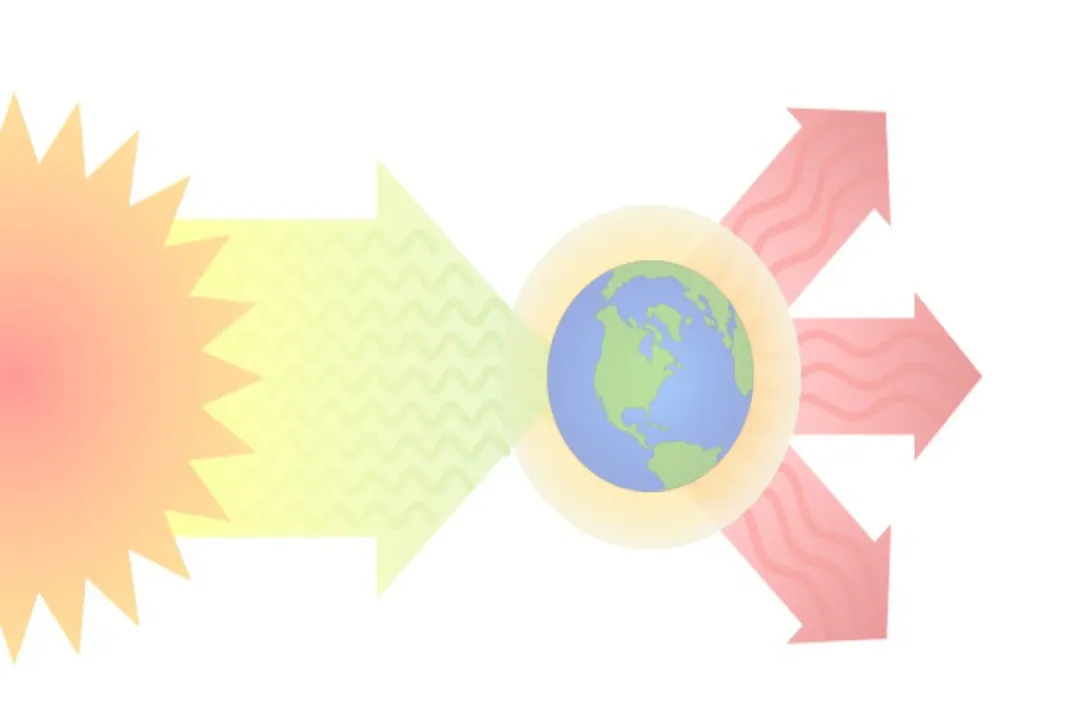
Once the Earth’s surface absorbs solar energy, it warms up and re-emits that energy, but in a different form. Because the Earth is significantly cooler than the Sun, it radiates much weaker energy with longer wavelengths, specifically in the infrared range. This outgoing energy is also known as longwave radiation or terrestrial radiation.
If the atmosphere contained no gases capable of interacting with this energy, the majority of this infrared radiation would pass unimpeded through the atmosphere and escape directly into space, causing the planet to cool rapidly. The difference between the energy absorbed and the energy escaping to space determines whether the planet warms or cools; a planet tends toward a state of radiative equilibrium where incoming and outgoing energy balance.

# The Molecular Trap
The warming mechanism hinges on the composition of the atmosphere. The vast majority of the atmosphere—over 99.5% of dry air—is made up of nitrogen (), oxygen (), and argon (). These dominant gases are symmetrical molecules that are largely transparent to both incoming sunlight and outgoing infrared radiation; they do not absorb longwave energy and therefore have almost no warming effect.
The critical players are the Greenhouse Gases (GHGs). These are the minor "trace" gases that comprise only about 0.43% of the atmosphere, with water vapor being the most abundant among them (ranging from 0% to 3% regionally). These molecules are structured differently—they contain three or more atoms (like and ), which allows them to absorb longwave infrared radiation. When a GHG molecule absorbs an infrared photon, the energy causes the bonds between the atoms to bend and stretch, making the molecule vibrate. This vibration effectively traps the energy that would have otherwise left for space.
This process is not simply a matter of re-emitting the same photon. Because the molecule experiences billions of collisions per second with surrounding gas molecules, any energy gained from absorbing a photon is rapidly redistributed as kinetic energy—heat—through these collisions, warming the immediate air parcel.
Furthermore, GHGs absorb light within specific wavelength ranges, known as spectral lines or bands. Carbon dioxide, for instance, has a particularly crucial absorption peak around . This specific range of longwave radiation emitted by the Earth is the very light that has the easiest time escaping the atmosphere if unimpeded. By blocking this specific window, GHGs significantly reduce the rate of planetary cooling.
# Altitude and Cooling Efficiency
The atmosphere acts as a series of layers, and the temperature structure of these layers is key to understanding the trapping effect. Near the surface, air is dense, and greenhouse gases are highly effective at absorbing outgoing infrared radiation. The atmosphere near the ground is thus mostly opaque to longwave radiation traveling upward.
However, the temperature of the atmosphere decreases with altitude in the lowest layer, the troposphere—a change known as the lapse rate. Because the atmosphere gets colder higher up, the gases at those greater heights emit less thermal radiation upward toward space than the warmer surface below is emitting. Instead of viewing heat escaping directly from the surface, it is more accurate to see the outgoing longwave radiation that finally reaches space as being emitted from a higher, effectively coupled layer of the atmosphere. The difference in temperature between the warm surface and this cooler emission altitude is the physical manifestation of the greenhouse effect, quantified as a temperature change ().
When the concentration of GHGs increases, the atmosphere becomes even more opaque at lower levels. This forces the effective altitude from which radiation can escape to space to rise higher, where the air is even colder. If the emission altitude rises to a point where the air is colder, the total energy radiated to space decreases for the same surface temperature, leading to the Enhanced Greenhouse Effect and planetary warming.
It is important to note that while the blanket analogy suggests trapping of already created warm air, the physics is about blocking the escape of energy through radiation. Non-radiative cooling processes like evaporation and convection still occur, but the radiative cooling component is what gets curtailed by the increase in GHGs.

# The Players and Their Persistence
The warming potential and longevity of GHGs vary widely. Water vapor is the most abundant and largest overall contributor to the natural effect, though human emissions of it are relatively small. For the enhanced warming, the gases whose concentrations humans control are most relevant.
- Carbon Dioxide (): The most significant contributor to the enhanced effect. is released through burning organic matter and fossil fuels like coal, oil, and natural gas. A critical feature of is its long atmospheric lifetime; it can remain in the atmosphere for up to . This longevity means that carbon released today piles up much faster than natural processes can remove it. Atmospheric levels are currently higher than at any point in the past .
- Methane (): Methane is a far more potent warmer than when measured over shorter timeframes—it is about more potent over a period. However, it has a much shorter atmospheric lifespan, typically breaking down in about . Sources include natural wetlands, but human activity contributes significantly through fossil fuel extraction, waste in landfills, and agriculture (like cattle digestion).
- Nitrous Oxide (): This gas is approximately more potent than over . Its human-caused rise is largely linked to the use of fertilizers in agriculture.
- Fluorinated Gases: These are entirely human-made (e.g., hydrofluorocarbons, sulfur hexafluoride ()) and are exceptionally powerful, with global warming potential ranging up to that of over .
The fact that remains for centuries means that human emissions are effectively setting a long-term thermostat for the planet, even if we rapidly cut emissions today.
# The Criticality of Lifespan in Climate Forcing
The difference in molecular lifespan is a crucial aspect of climate dynamics that warrants closer examination. Methane's decade-long life means its warming influence is intense but relatively short-lived; once emissions cease, the concentration drops relatively quickly as atmospheric chemistry works to remove it. In contrast, 's stability—its reluctance to react with the oxidative environment of the atmosphere—means the carbon added by burning ancient fossil fuels stays in the system for millennia. This suggests that managing isn't just about reducing the rate of warming today, but about reversing a long-term imbalance caused by persistent historical additions. Even if we achieved net-zero emissions, the accumulated already in the air would continue to trap heat, necessitating active removal strategies—like carbon capture or large-scale reforestation—to return to a pre-industrial energy balance.
# Measuring the Imbalance
Scientists use detailed measurements to quantify the actual heating occurring. The Earth's Energy Imbalance (EEI) measures the difference between the power of incoming solar radiation absorbed by Earth and the power of outgoing longwave radiation emitted to space. A positive EEI means the planet is accumulating thermal energy and warming. As of , this imbalance was about , but newer data suggests the trend has since grown to about twice that rate.
The natural greenhouse effect can be measured as a flux change (): the amount of thermal radiation leaving the surface minus what actually reaches space. Based on measurements, this flux difference is about , meaning that of the thermal radiation leaving the surface fails to reach space.
When we focus solely on the surface energy budget—how much heat is directed back down versus up—it can lead to conceptual errors. If we only considered the downward radiation warming the surface, one might incorrectly conclude that if the air near the surface is already opaque, adding more does nothing. However, the key mechanism is what happens at the Top-of-Atmosphere (TOA). Increasing reduces the longwave radiation flux that escapes to space at the TOA, creating the imbalance that forces the entire system to heat up until the energy flows match again. The surface temperature must rise higher than the planet's theoretical effective temperature (the temperature if there were no gases trapping IR) to radiate enough energy back out to balance the absorbed sunlight.

# Global Contexts of Warming
The effectiveness of GHGs is not solely dependent on their concentration; atmospheric pressure also plays a role through a process called pressure broadening. Higher pressure causes molecules to collide more frequently, broadening the range of wavelengths a gas can absorb.
This principle helps explain the differences observed across the solar system:
- Venus: Possesses an extremely powerful greenhouse effect ( of or ) because its atmosphere is and consists of about 97% . In this high-pressure, -dominated environment, absorption occurs over a broad continuum of wavelengths, not just specific bands.
- Mars: Experiences only a small greenhouse effect ( of about or ). Despite having about more than Earth, its atmosphere is extremely thin (), which limits the trapping efficiency of each molecule.
# Adapting the Analogy for Clarity
While the greenhouse analogy serves as a useful starting point for understanding heat retention, it is important to distinguish it from the atmospheric reality. A simple glass greenhouse works primarily by creating a physical barrier that stops warm air from rising and mixing with the colder ambient air—a process called convection. In the Earth's atmosphere, however, the primary gases () do not block infrared radiation; they are transparent to it, allowing energy transfer via air movement (convection) and radiation. Greenhouse gases directly interfere with the radiative path by absorbing the upward-bound infrared waves. If we think of the atmosphere as a jacket instead of a greenhouse, the jacket doesn't stop your body heat from radiating away; it simply slows the rate at which that radiated heat is lost to the colder environment. Greenhouse gases act similarly by reducing the speed at which the Earth can shed its longwave energy to space.
The critical point is that as we add these specific heat-absorbing molecules, we are tuning the planet's radiative efficiency. We are not just trapping heat that has already radiated; we are preventing the infrared energy from ever leaving the surface-troposphere system efficiently in the first place. This forces the entire system to elevate its temperature until the diminished outgoing radiation flow can finally match the constant stream of incoming solar energy. This ongoing effort by the Earth to find a new, warmer equilibrium defines the warming trend we observe.
Related Questions
#Citations
What Is the Greenhouse Effect?
Greenhouse effect
How do greenhouse gases actually warm the planet?
How do greenhouse gases trap heat in the atmosphere?
Exploring the greenhouse effect | Ag Decision Maker
Why Do Greenhouse Gases Warm the Planet?
Basics of the Carbon Cycle and the Greenhouse Effect
Understanding the Greenhouse Effect | Changing Climate