How did Edwin Hubble help Albert Einstein?
The relationship between Edwin Hubble, the pioneering American astronomer, and Albert Einstein, the architect of relativity, is one of physics’ most fascinating dramas—a case where empirical observation forced a titan of theory to reconsider his own creation. Hubble did not just observe the cosmos; his meticulous measurements provided the necessary, undeniable evidence that steered Einstein away from a conceptual error and toward a more accurate, dynamic picture of reality as described by General Relativity. [4][6]
# Establishing Scale
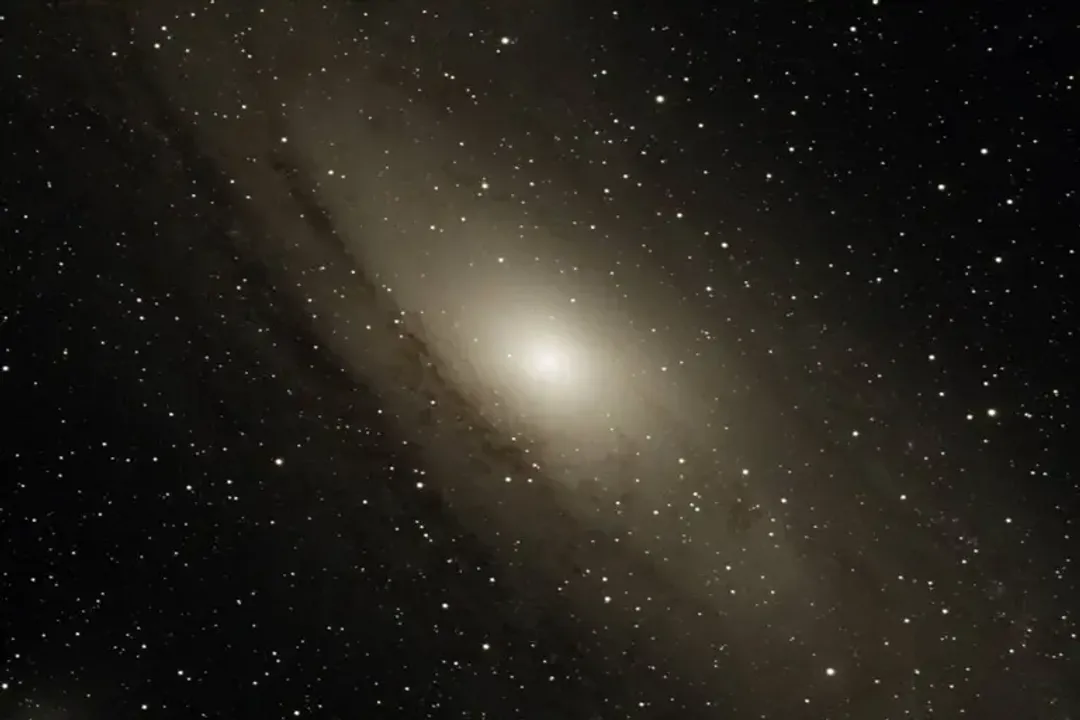
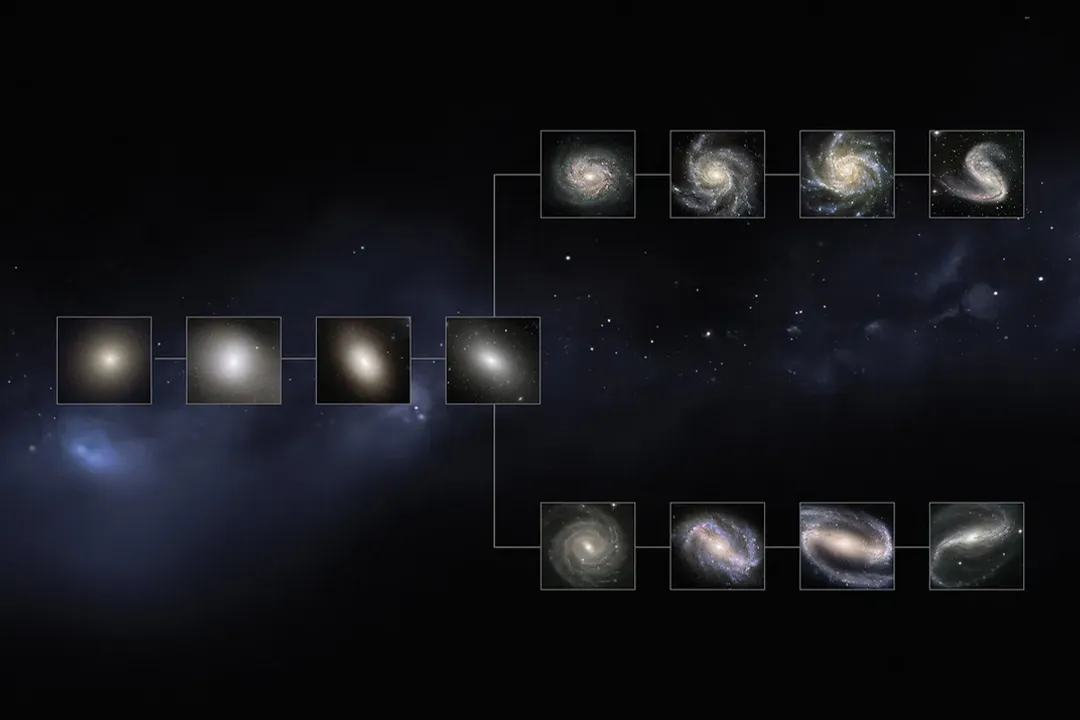
Before Hubble could influence Einstein's cosmological view, he first had to establish the true size of the universe. In the early 20th century, many astronomers believed the Milky Way galaxy encompassed everything observable. [2] The "spiral nebulae," fuzzy patches of light visible in telescopes, were largely thought to be gas clouds within our own galaxy. [2][5] Edwin Hubble, working at the Mount Wilson Observatory, changed this forever using the powerful 100-inch Hooker Telescope. [2][5]
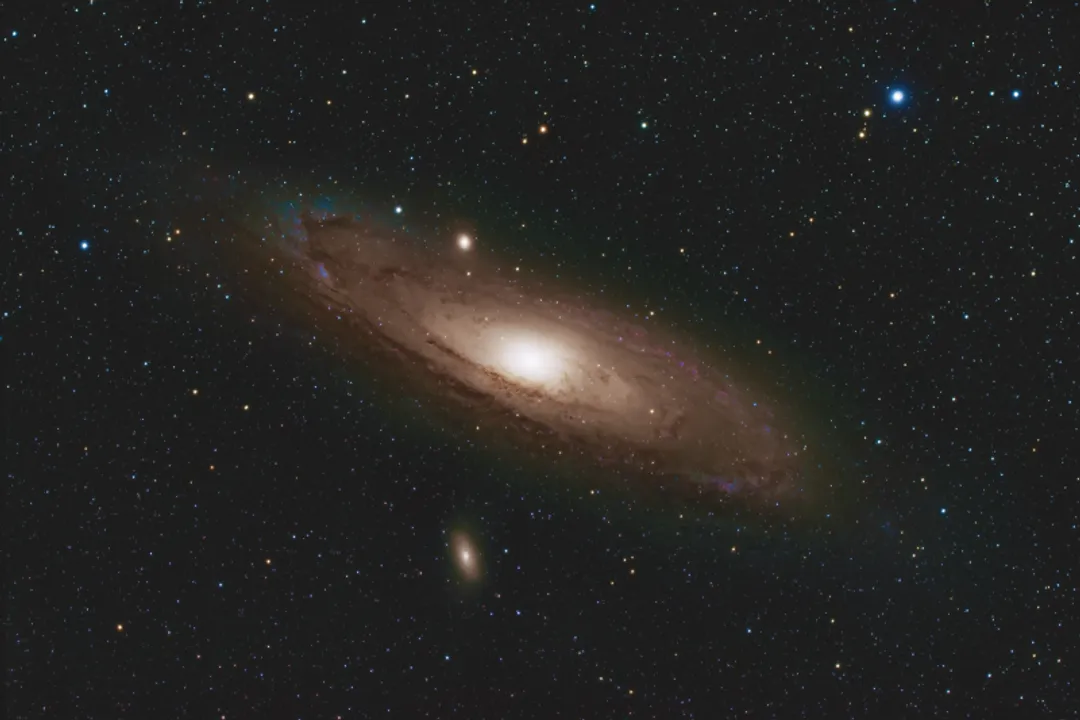
His critical tool for measuring vast distances was the Cepheid variable star. [2] These stars pulse rhythmically, and Henrietta Swan Leavitt had previously established that the period of their pulsation is directly related to their true luminosity. [2] By measuring the observed brightness and knowing the intrinsic brightness of a Cepheid in a spiral nebula, Hubble could calculate its distance. [2] In $1924$, Hubble identified Cepheids in the Andromeda Nebula, definitively proving it was an object far outside the confines of the Milky Way—it was, in fact, another massive galaxy. [1][5] This discovery single-handedly expanded the known universe by an order of magnitude. [2] Understanding the scale of these galaxies was the essential prerequisite for tackling the universe's overall structure and motion.
# Measuring Movement
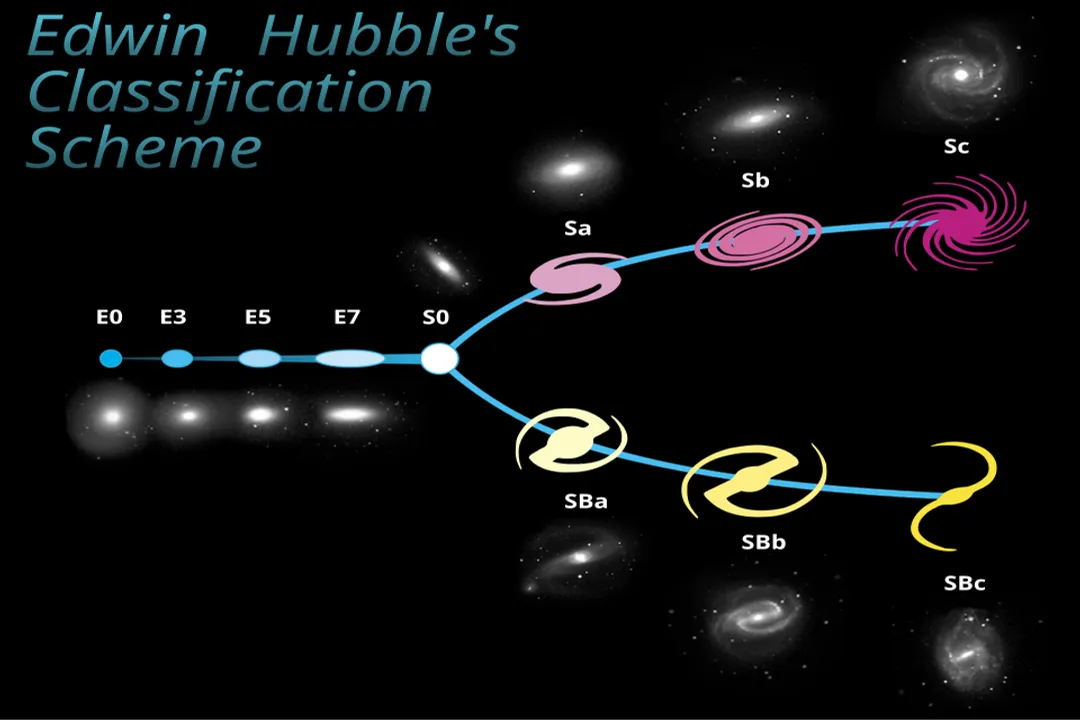
Once the distances to other galaxies were established, Hubble began measuring their spectral shifts. [6] Along with his assistant Milton Humason, he observed that the light from nearly all these distant galaxies was redshifted. [6][8] In astronomy, redshift indicates that an object is moving away from the observer, with the degree of shift corresponding to the speed of recession. [8]
This led to Hubble’s momentous discovery in $1929$: the velocity at which a galaxy recedes is proportional to its distance from us. [1][6][8] This relationship, now known as Hubble’s Law, provided the first observational proof that the universe was not static; it was expanding. [6][8] The implication was profound: the fabric of spacetime itself was stretching, carrying galaxies along with it. [8]
The observational precision required to make this link is often overlooked. To confirm this relationship, Hubble needed to correlate distance measurements (derived from Cepheids, which are tricky to spot across cosmic voids) with velocity measurements (derived from spectral lines) across dozens of galaxies. [2] This required years of patient, difficult observation, turning a theoretical possibility into a concrete physical reality. It is a subtle point that while redshift implies motion, it does not inherently imply expansion unless the distance component of Hubble’s Law is also accurately measured, something only Hubble managed at the time. [2]
# Einstein's Static Predicament
To appreciate how Hubble helped Einstein, one must understand the theoretical predicament Einstein was in before Hubble's data arrived. When Einstein formulated his General Theory of Relativity in $1915$, his equations described a universe that was inherently dynamic—it should either be expanding or contracting under the influence of gravity. [4] However, at the time, the prevailing scientific and philosophical consensus, shared by Einstein, was that the universe was eternal and static. [4][5]
To reconcile his dynamic equations with the static universe he believed in, Einstein introduced a mathematical term known as the Cosmological Constant (). [4][5] This constant acted as a repulsive, anti-gravitational force, perfectly balancing the attractive force of gravity to hold the universe motionless. [4] Einstein later famously referred to this addition as his "biggest blunder". [4][5]
This preference for a static universe, despite the mathematical implications of his own theory, represents a fascinating intersection of physics and personal philosophy. [4] Einstein, like many of his contemporaries, sought a universe that was timeless and unchanging. [4]
# The Empirical Correction
Hubble’s findings delivered the empirical shock that corrected this theoretical compromise. [4] When Hubble announced in $1929$ that the universe was expanding, the need for Einstein’s balancing act—the cosmological constant—vanished. [4][6][8] The observations supported the original, unadulterated predictions of General Relativity: a universe in motion. [4][8]
In this sense, Edwin Hubble helped Albert Einstein by providing the observational anchor that confirmed the core of General Relativity while invalidating Einstein’s ad hoc modification designed to preserve a static view. [4] Hubble’s data forced Einstein to accept that his theory predicted a far more dramatic reality than he had initially allowed for. [5] This validation of the dynamic nature of spacetime is arguably one of the most profound consequences of Hubble’s astronomical work.
If we look at the mathematics, Einstein’s original field equations describe the relationship between spacetime curvature () and the energy/matter content (). [4] When was included, the equation became . [4] Hubble’s discovery showed that the universe naturally behaves according to the first equation (dynamic, no ) rather than the second (static, with ). [4][8] This is a clear instance where observational data provided a superior edit to a foundational theory.
It is interesting to reflect on the philosophical weight of this moment. Einstein was accepting that a universe expanding forever—or perhaps destined to contract later, depending on the density of matter—was the actual state of affairs, rather than the more aesthetically pleasing, unchanging cosmos he had initially favored. [4] Hubble provided the evidence that proved the universe was, in fact, evolving, a concept crucial for understanding its past and future. [6]
# A Return to
The story doesn't end with the cosmological constant being abandoned. While Hubble's work showed the universe was expanding and Einstein discarded , modern cosmology has reintroduced the concept under a new guise. [4] Observations beginning in the late $1990$s revealed that the expansion of the universe is actually accelerating. [4]
To account for this acceleration, cosmologists have brought back a term functionally equivalent to Einstein's cosmological constant, now generally attributed to the energy of empty space, known as dark energy. [4] Thus, Hubble’s initial work paved the way for establishing the dynamic nature of the universe, and subsequently, his successors confirmed that the dynamics required reintroducing the very term Einstein regretted adding. [4] This creates a remarkable loop where an initial error correction, prompted by Hubble, was later necessitated again by new, even more profound measurements of cosmic dynamics.
# Human Connection
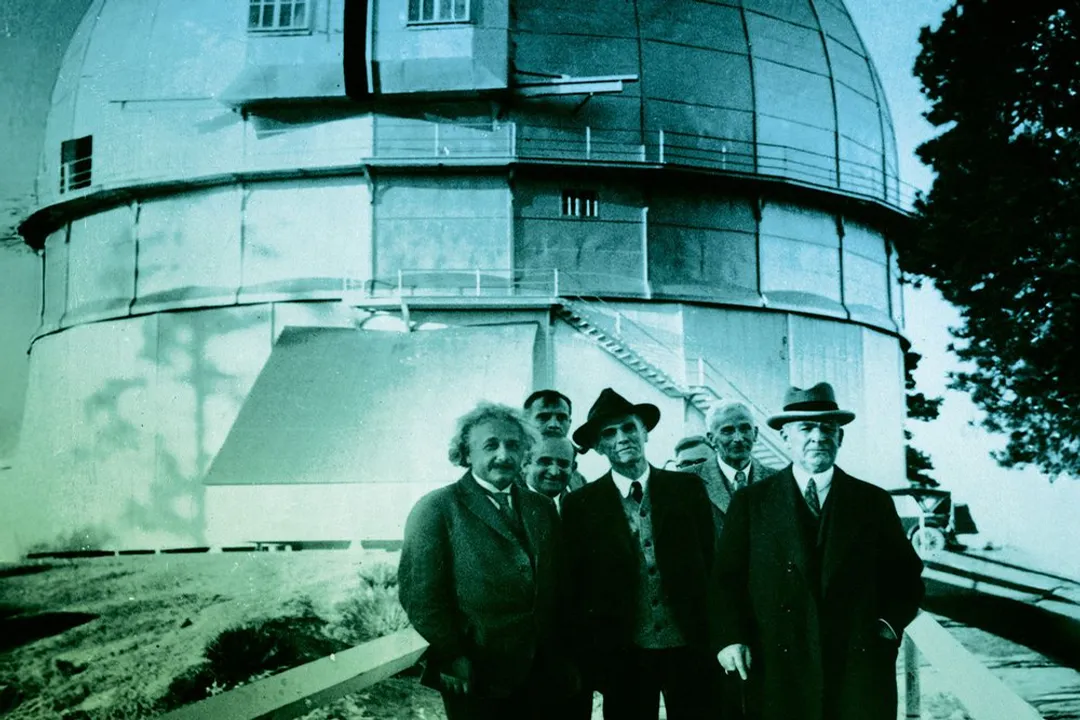
While the impact was largely through scientific data, the two men did meet. It is recorded that Einstein and his wife visited the Mount Wilson Observatory, where Hubble conducted his groundbreaking work. [9] Though the specifics of their conversations remain less documented than the science, the proximity of the two intellectual giants—one finalizing the theory of relativity and the other mapping the structure of reality beyond our galaxy—speaks volumes about the era. [9] It suggests a direct channel, however informal, between the theoretical foundations being laid in physics and the empirical results emerging from astronomy.
Hubble's contribution, therefore, was multifaceted. First, he mapped the physical architecture, proving that our galaxy was just one island in a vast archipelago of galaxies. [2] Second, he measured the movement of those islands, establishing the universe was expanding. [6][8] Third, and most crucially for Einstein, his expansion data provided the empirical proof that forced the theoretical framework of General Relativity to embrace its inherent dynamic nature, discarding the artificial static constraint Einstein had imposed upon it. [4] Hubble helped Einstein realize the true, moving universe his own equations had foretold.
The shift from a static, eternal cosmos to a dynamic, evolving one is perhaps the greatest conceptual gift Hubble gave to Einstein’s legacy, securing General Relativity as the framework for modern cosmology by validating its most radical prediction. This entire shift, from thinking the universe was static to knowing it was expanding, required a transition from viewing the cosmos as a fixed stage to seeing it as an active participant in its own development. [6]
Related Questions
#Citations
Edwin Hubble - Wikipedia
Who Is the Man Who Discovered the Universe? | Smithsonian Voices
Case Files: Edwin Hubble | The Franklin Institute
Einstein and his so-called biggest blunder - Physics Stack Exchange
This Month in Astronomical History: Remembering Edwin Hubble
Carnegie Science celebrates Edwin Hubble's discovery of the ...
How did he even find it out?! : r/sciencememes - Reddit
Edwin Hubble born today and the expanding universe - EarthSky