What thing did Albert Einstein invent?

The query of what Albert Einstein invented often leads to a surprising answer because the world remembers him primarily as a physicist whose power lay in dismantling and rebuilding our understanding of the universe, rather than as a garage inventor tinkering with physical mechanisms. While he formulated theories that underpin nearly all modern physics and technology, the tangible inventions associated with his name are far less numerous than his published papers. [2][8] His legacy is rooted in profound conceptual breakthroughs—discoveries that unlocked new ways of seeing reality—which subsequently inspired countless practical inventions by others. [1][9]
# Theory Dominance

The vast majority of Einstein’s fame stems from his intellectual contributions, which reshaped classical mechanics. These were not things built in a workshop, but mathematical descriptions of nature's laws. [2] His work introduced revolutionary concepts regarding space, time, mass, and energy. [8]
The Special Theory of Relativity, published in 1905, fundamentally altered concepts of time and space, asserting that the speed of light in a vacuum is constant for all observers, regardless of the motion of the light source or observer. [2][8] This same seminal year, often called his Annus Mirabilis, saw the publication of his work on the photoelectric effect and the famous mass-energy equivalence formula, . [2][8] This equation elegantly shows that mass and energy are interchangeable, a concept central to understanding nuclear power and particle physics. [2]
Later, in 1915, Einstein completed the General Theory of Relativity, which posits that gravity is not a force but a curvature of spacetime caused by mass and energy. [2][8] This framework remains the most accurate description of gravity we currently possess. Consider the immense conceptual leap required here: understanding General Relativity demands accepting that the very fabric of the cosmos is malleable, bending around objects like a bowling ball placed on a stretched rubber sheet. This is a far cry from inventing a better mousetrap; the difficulty lies in visualizing a reality where time runs differently depending on your altitude or velocity. [2] If you were to compare his theoretical output to a tangible invention, the theory of relativity is like designing the blueprints for the entire universe, whereas a traditional invention is like designing one of the lightbulbs inside the house.
# Light's Dual Nature
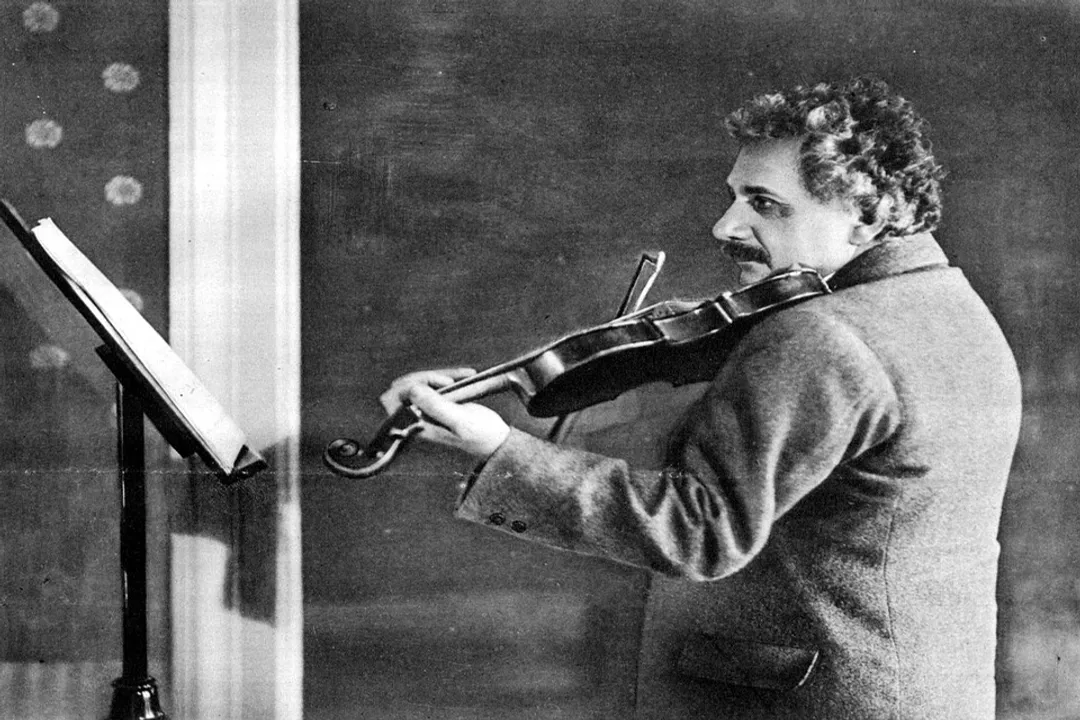
One of Einstein’s most consequential theoretical achievements, which actually secured him the 1921 Nobel Prize in Physics, concerned light. [2][8] This achievement centered on explaining the photoelectric effect. [2][9] While many people associate his Nobel Prize with relativity, it was specifically awarded for his explanation of how light can knock electrons free from a material's surface when shone upon it. [2][8]
Einstein proposed that light is not just a continuous wave, as was commonly held, but also consists of discrete packets of energy he called quanta (later known as photons). [2][9] This idea supported the quantum theory being developed at the time and established the concept of wave-particle duality for light. [2] This is an area where discovery directly paved the way for invention. The understanding that light energy comes in these defined packets is foundational to modern electronics, including digital cameras and sensors. [9]
# Patented Devices
Despite his fame resting on abstract physics, Einstein did hold patents, proving he engaged in applied problem-solving alongside theoretical exploration. [1][4] The most frequently cited tangible invention associated with him is a design for an absorption refrigerator. [1][4]
Einstein, along with his former student Leo Szilard, patented this device around 1926. [1][4] They were motivated by reports of leaked toxic refrigerants in domestic units and aimed to create a safer, self-regulating cooling system that used no moving parts or external power sources during operation. [1][4] The design relied on a liquid absorber and a heat source, often employing ammonia and water or hydrazine hydrate and water as the working fluids. [1] While absorption refrigerators exist today—used often in RVs or off-grid situations—they were a direct product of this mid-1920s patent collaboration. [1][4]
It is essential to note that these patents reflect a practical application of his intellect, but they do not define his historical significance compared to the theories of relativity. [1]
# Technology Echoes
Einstein’s theoretical insights, though abstract at the time of their formulation, proved to be the necessary precursor for several technologies we rely on every day. The leap from pure theory to applied technology is often mediated by decades of engineering refinement, but the bedrock was laid by his physics. [9]
One direct technological descendant of his Nobel Prize-winning work on the photoelectric effect is the laser. [9] The concept of stimulated emission—the process that allows a laser to produce coherent light—was theoretically described by Einstein in 1917. [9] This mechanism, tied to how energy levels in atoms transition, is a direct outgrowth of the quantum understanding he established. [9]
Another monumental modern application that mandates the use of his work is the Global Positioning System (GPS). [9] For GPS satellites to provide accurate location data, their onboard clocks must be precisely synchronized with clocks on Earth. [9] Because the satellites are moving at high speeds (requiring Special Relativity corrections) and are in a weaker gravitational field than the surface (requiring General Relativity corrections), engineers must factor in Einstein’s equations to avoid accumulating positioning errors that could render the system useless within minutes. [9] This practical necessity underscores a key difference between his life’s work and that of a typical inventor: his "inventions" govern the accuracy of global navigation.
To better grasp the dichotomy in his output, one might consider this comparison:
| Category | Einstein's Primary Contribution | Example | Direct Impact |
|---|---|---|---|
| Theory | Mathematical Description of Physical Law | General Relativity | Understanding Gravity, Cosmology |
| Discovery | Explanation of Physical Phenomenon | Photoelectric Effect | Basis for Quantum Mechanics/Lasers |
| Invention | Patented Mechanical/Applied Device | Absorption Refrigerator | Safe Home Cooling Systems |
This highlights that while he invented a refrigerator design, his discovery concerning light led to the development of the technology of lasers, which is a much broader and more significant technological footprint. [9]
# Life Context
Understanding Einstein's primary focus—theoretical physics—also requires appreciating his professional environment. He spent much of his early career working in patent offices, which might seem like an ironic prelude to his later career, but it gave him time to contemplate physics problems independently. [6][10] He worked in the Swiss patent office in Bern for several years starting in 1902. [10] His ability to think through complex problems without immediate experimental verification was a defining characteristic of his genius. [6]
He was not a man who built prototypes for every idea; rather, he sought to establish the fundamental mathematical truths governing the cosmos. [2][8] While others focused on refining existing machines, Einstein focused on refining the rules by which matter and energy operate. [2] His later work focused heavily on a unified field theory, attempting to marry electromagnetism with gravity, a pursuit that occupied him until his death, even though a complete solution remained elusive. [2][8] His enduring fame is a testament to the fact that sometimes, the most world-changing "invention" is a new way of thinking about what already exists. [6]
Related Questions
#Citations
What Did Albert Einstein Invent? - Science | HowStuffWorks
Albert Einstein - Wikipedia
How Albert Einstein's inventions shaped everyday technology
What did Albert Einstein invent? Here's what made him famous.
What exactly is it that makes Albert Einstein so important ... - Reddit
Albert Einstein's Early Life and Inventions in Physics - Facebook
What did Einstein first discover? - Quora
Albert Einstein - BYJU'S
4 Everyday Items Einstein Helped Create | National Geographic
Albert Einstein's Inventions: Lesson for Kids - Video - Study.com