What did Edwin Hubble know for?
The early 20th century saw one of the most profound shifts in humanity's understanding of its place in the cosmos, a revolution largely spearheaded by the meticulous observational work of Edwin Hubble. He is, without question, known for fundamentally redefining the scale of the universe, proving that the fuzzy patches of light observed through telescopes were not mere gas clouds within our own galaxy, but entire island universes far beyond the Milky Way. [2][6][8] This revelation alone would secure his legacy, yet his contributions did not end there; he also provided the first compelling evidence that the entirety of this vast, newfound cosmos is in motion, actively expanding. [2][3][8][9]
# Early Work

Hubble’s professional path involved significant interruptions, including service in World War I where he achieved the rank of Major. [5] Before dedicating himself to astronomy, he had an interesting academic background, having attended Oxford University as a Rhodes Scholar. [1][2][5] Upon returning to the United States, he began his astronomical career, eventually taking a position at the Mount Wilson Observatory in California. [5][7] This observatory housed the formidable 100-inch Hooker telescope, a technological marvel of its time, which became the instrument through which Hubble would make his most consequential observations. [3][7]
# Spiral Nebulae

For decades, astronomers engaged in what was famously termed the "Great Debate." The central question revolved around the nature of the spiral nebulae: were these objects relatively nearby stellar nurseries within the Milky Way, or were they, as some suspected, incredibly distant, independent star systems? [4] Hubble took on this challenge, not with philosophical argument, but with empirical data. [4]
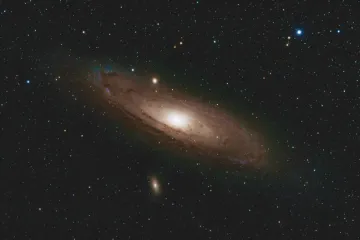
His key breakthrough relied on identifying and measuring the distance to these nebulae. To do this, he needed to find standard candles—stars whose intrinsic brightness was known. Hubble successfully identified Cepheid variable stars within the Andromeda Nebula (M31). [4][5][7] By observing how long these stars took to cycle between maximum and minimum brightness, he could accurately determine their true luminosity, and subsequently, their distance from Earth. [4][7]
In 1923, this method allowed him to calculate that the Andromeda Nebula was far outside the boundaries of the Milky Way. [5] This single act demolished the existing model of a universe confined to our own galaxy. It was a dramatic scaling-up of reality. Before Hubble, the known universe effectively ended at the borders of the Milky Way, which was estimated to be perhaps 100,000 light-years across. [1] After his findings, the universe instantly became orders of magnitude larger, populated by countless other galaxies. [6][8] Thinking about that conceptual leap is staggering; one might consider that the sheer volume of space suddenly known to contain stars expanded by a factor greater than a million in an instant, simply by recognizing that M31 was not an anomaly but another true galaxy like our own. [1] This confirmed the extragalactic nature of these nebulae. [8][9]
# Classification System
Hubble’s work was not limited to establishing distance; he also sought to categorize the new population of objects he was discovering. Alongside Milton Humason and others, he began examining the forms of these external galaxies. [1]
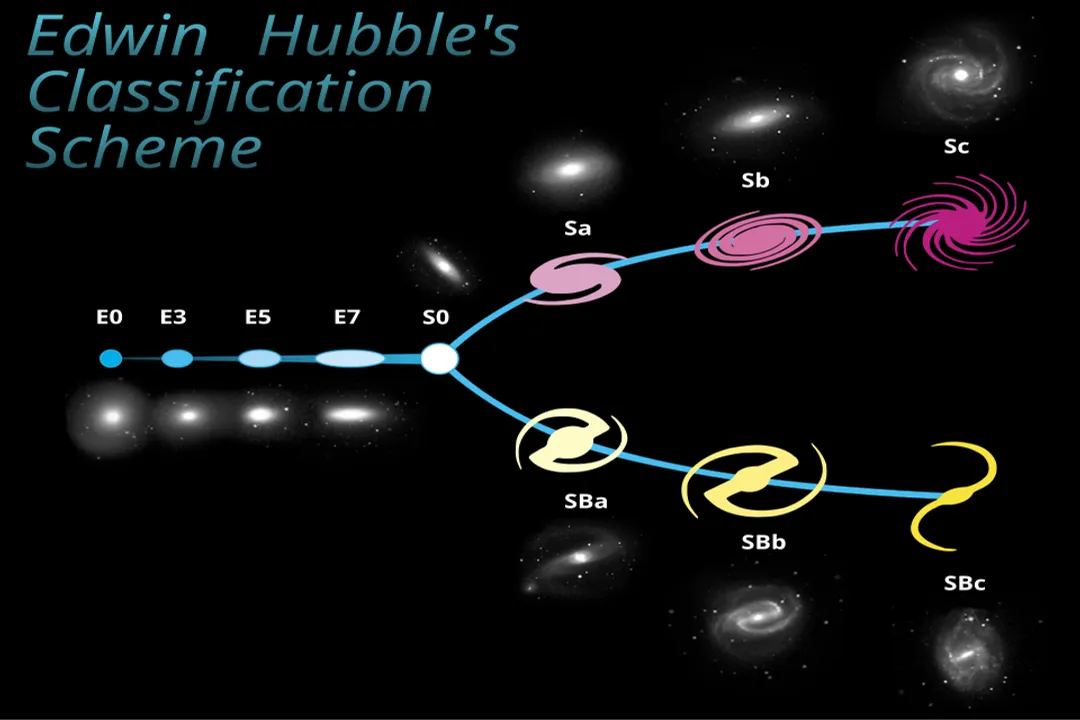
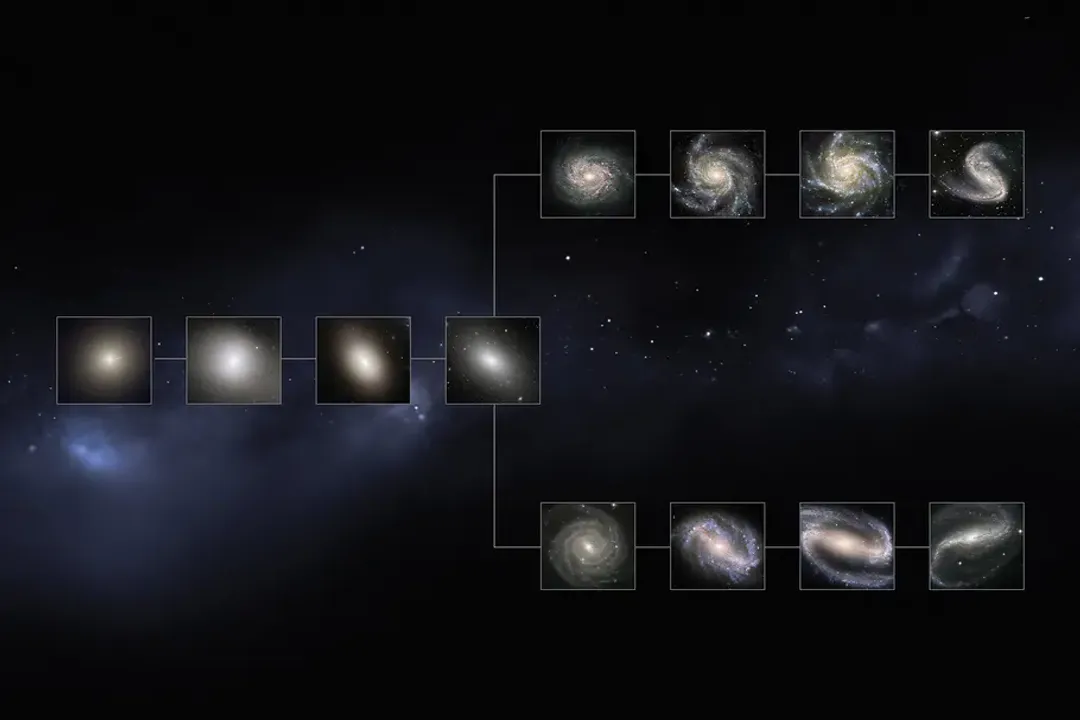
This effort resulted in the development of the Hubble sequence, often visualized as the "Hubble tuning fork diagram". [1] This system provided a morphological classification for galaxies based on their visual appearance. [8] The categories he established were:
- Elliptical Galaxies (E): Ranging from E0 (nearly spherical) to E7 (highly elongated). [1]
- Spiral Galaxies (S): Characterized by a central bulge and spiral arms, sometimes further subdivided based on whether the arms emanate from a central bar structure (SB). [1]
- Lenticular Galaxies (S0): Galaxies that possess a disk and bulge like spirals but lack defined spiral arms. [1]
While modern astronomy has refined this classification—for instance, adding irregular galaxies—the Hubble sequence remains a foundational tool in galactic astronomy. [1] The discipline required to systematically examine and categorize hundreds of these new systems underscores the sheer depth of Hubble's expertise in observational astronomy. [7] It is a testament to good methodology that the structure he devised based on visual light patterns remains useful today, even as we understand the underlying physics of stellar population and dynamics more deeply.
# Expanding Cosmos
Once Hubble had established that numerous galaxies existed beyond the Milky Way, his subsequent investigation turned to their movement. Working with data collected by Vesto Slipher, who had previously measured the spectral shifts of these nebulae, Hubble found a critical correlation. [4]
The spectral lines emitted by light from these distant galaxies were systematically shifted toward the red end of the spectrum—a phenomenon known as redshift. [4] In the context of the Doppler effect, redshift indicates that the object is moving away from the observer. [9]
Hubble’s monumental finding, published in 1929, was that the velocity with which a galaxy is receding is directly proportional to its distance from us. [3][8] In simpler terms: the farther away a galaxy is, the faster it is moving away. [9] This relationship is now known as Hubble’s Law. [1]
This observation was not just a list of motions; it implied a dynamic, evolving universe. It strongly suggested that the universe itself—the very fabric of space and time—is expanding. [2][3] This realization, derived from painstaking observation at Mount Wilson, served as a crucial observational pillar for the Big Bang theory that would later develop. [4] It's fascinating to consider how Hubble’s methodical work contrasted with the more theoretical battles of the Great Debate. Where others debated classification in theory, Hubble used the power of the world's largest telescope, combined with the physical principle of Cepheid variables, to produce irrefutable distance measurements, thereby resolving the debate and simultaneously opening the door to cosmology as we know it today. [4][7]
# Legacy and Recognition
Edwin Hubble’s discoveries reshaped cosmology, fundamentally changing how we view existence and scale. [6] He was honored by having the Hubble Space Telescope (HST) named after him upon its launch in 1990. [6] This telescope continues to perform observations that build directly upon his foundation, investigating the farthest reaches of space and time. [6]
While his scientific achievements are paramount, his career also involved military service and academic pursuits. [5] He received numerous accolades during his lifetime for his work, which transitioned astronomy from a study primarily focused on our local stellar neighborhood into the vast, dynamic field of extragalactic astronomy. [2] His methodical approach, focusing on instrumental capability (the 100-inch telescope) and measurable physical phenomena (Cepheid variables), stands as a model for scientific progress when facing deeply entrenched scientific paradigms. [7]
| Achievement | Key Tool / Method | Implication |
|---|---|---|
| Proving Nebulae are Galaxies | Cepheid Variables in M31 | Universe is much larger than the Milky Way [1][6] |
| Galaxy Classification | Visual Morphology | Established the Hubble Sequence (E, S, SB, S0) [1][8] |
| Measuring Cosmic Velocity | Redshift analysis | Discovery of the expansion of the universe (Hubble's Law) [3][9] |
His findings provided the observational backbone for modern cosmology, establishing that the universe is not static and infinite in the old sense, but dynamic and, as far as we can measure, growing larger every moment. [2][3]
Related Questions
#Citations
Edwin Hubble - Wikipedia
Edwin Hubble | Biography, Discoveries, Education, & Facts | Britannica
Carnegie Science celebrates Edwin Hubble's discovery of the ...
This Month in Physics History | American Physical Society
A Science Odyssey: People and Discoveries: Edwin Hubble - PBS
Edwin P. Hubble - New Mexico Museum of Space History
Edwin Powell Hubble - The man who discovered the cosmos
Who is the Man That Discovered the Universe?
Case Files: Edwin Hubble | The Franklin Institute