How do they know that dark matter exists?
The universe, for all its blazing stars and sweeping nebulae, is dominated by something we cannot see. It is a substance that has mass, exerts gravity, and fundamentally shapes the cosmos, yet it refuses to interact with light in any recognizable way. This invisible component, dubbed dark matter, is estimated to make up about 85% of all the mass in the cosmos, meaning the familiar atoms that make up stars, planets, and us account for less than 5% of the universe’s total mass-energy content, with dark energy accounting for the rest. To simply state that something making up the vast majority of mass is "invisible" sounds like science fiction, yet the evidence for its existence is built upon multiple, independent lines of astronomical observation, each one pointing back to the same conclusion: there must be five times more unseen mass than visible mass in the universe.
# Early Whispers
The necessity of an unseen gravitational component wasn't a modern epiphany; the idea has roots stretching back nearly a century, stemming from simple observations of motion. Swiss astrophysicist Fritz Zwicky was one of the first to formally grapple with this disparity in the early 1930s while studying the Coma Cluster of galaxies. Zwicky used the velocities of galaxies within the cluster, derived from shifts in their emitted light, to estimate the total gravitational mass required to keep the cluster bound together. He then compared this dynamical mass estimate to one derived from the cluster’s total observable light output. The result was staggering: the required mass was hundreds of times greater than what was visible. Zwicky called this necessary, invisible material dunkle Materie, or dark matter, though his initial magnitude estimate was later refined.
While Zwicky planted the seed, the concept remained on the fringe until the 1970s, when American astronomer Vera Rubin and her colleague Kent Ford provided the smoking gun with unprecedented precision.
# Galactic Rotation
The most accessible piece of evidence comes from watching how spiral galaxies spin. If a galaxy’s mass were concentrated only where we see the bright stars—densely packed at the center and fading toward the edges—we could apply a rule very similar to Kepler’s laws governing our solar system. In our solar system, planets farther from the Sun orbit more slowly because the gravitational pull weakens with distance. By analogy, stars far out in the sparse, outer regions of a spiral galaxy should orbit much slower than those nearer the core.
Using advanced spectrographs, Rubin and Ford measured the rotational velocities of stars in edge-on spiral galaxies with much greater accuracy than before. They discovered something revolutionary: the rotation curves did not drop off. Instead, the stars in the outer fringes were orbiting just as fast, or nearly as fast, as the stars closer to the bright center. This flatness implies that the gravitational force must remain nearly constant, even where the luminous matter density plummets.
The only way to resolve this massive contradiction—fast-moving outer stars held in place by sufficient gravity—is to conclude that the visible stars and gas are embedded within an enormous, spherical, non-luminous halo of dark matter. This invisible material must extend far beyond the visible disk of the galaxy, providing the extra gravitational scaffolding required to keep the entire structure from tearing itself apart like an overloaded merry-go-round.
# Cluster Dynamics

The gravitational arguments aren't limited to single galaxies; they are even more pronounced when looking at entire clusters. Galaxy clusters are crucial testing grounds because their mass can be estimated in several independent ways: by measuring the velocity dispersion of member galaxies, by analyzing the X-rays emitted by superheated gas trapped within the cluster, and by using gravitational lensing. Across these three distinct measurements, astronomers consistently find that dark matter outweighs the visible, luminous matter by a ratio of roughly 5 to 1.
It is an established principle in physics that ordinary matter interacts strongly with radiation and can collide electromagnetically. If the extra mass holding these clusters together were just ordinary, non-luminous baryonic matter—like cold gas clouds or dim stellar remnants—it would still interact via electromagnetism. This leads us to the most compelling single piece of observational evidence: the Bullet Cluster.
# The Separation Event
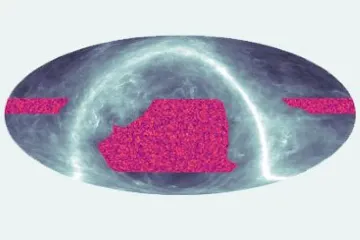
The Bullet Cluster is the result of a titanic, high-speed collision between two galaxy clusters, observed about 3.8 billion light-years away. This event provided a rare opportunity to see how dark matter behaves versus normal matter during a violent interaction.
When the two clusters slammed into each other, the hot, diffuse gas clouds—composed of normal, baryonic matter—from each cluster collided, interacting electromagnetically. This collision caused the gas to slow down, heat up (which we see as pink X-ray emission via the Chandra X-ray Observatory), and settle near the center of the collision site.
Crucially, when astronomers mapped the total mass distribution using gravitational lensing, they found that the bulk of the mass (mapped in blue) was not where the pink gas was located. Instead, the mass followed the path of the individual galaxies, which, being mostly empty space, passed through one another with little interaction, just as expected for collisionless dark matter. This cleanly separates the gravitational mass component from the ordinary, visible matter component. Modified gravity theories like MOND struggle to explain this spatial separation, as they generally predict that the gravitational mass should remain clustered with the visible matter (the gas). The Bullet Cluster observation powerfully suggests that the majority of mass in the universe is made of something that primarily interacts only through gravity, much like the proposed Weakly Interacting Massive Particle (WIMP).
# Light Bending
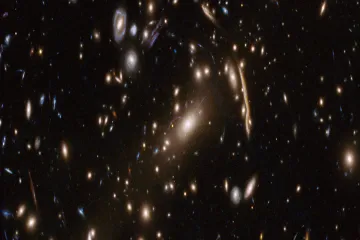
The concept of using gravity to "see" the invisible is deeply rooted in Einstein’s General Relativity, which describes gravity as the warping of spacetime by mass. Imagine a massive object acting like a cosmic magnifying glass—a phenomenon called gravitational lensing. Light from a distant source (like a galaxy or quasar) traveling past a massive foreground object (like a cluster) has its path bent, distorting the source's image into arcs or multiple images.
The degree to which light bends depends only on the total mass present, not on what that mass is made of. By measuring the degree of distortion—whether it's the strong arcs or the subtle, statistical shearing of background galaxies—astronomers can precisely calculate the mass distribution in the foreground cluster. When they compare this total mass map to the distribution of visible stars and X-ray gas, the overwhelming gravitational effect proves that the mass budget is dominated by non-luminous matter.
# Early Universe Echo
Perhaps the most fundamental evidence comes from looking back to the universe’s infancy, approximately 380,000 years after the Big Bang, when the Cosmic Microwave Background (CMB) was released. At this time, the universe was a dense, hot plasma of protons and electrons scattering photons everywhere, making it opaque. When the universe cooled enough for the first neutral atoms to form, this light was suddenly released, bathing the cosmos in uniform radiation.
The CMB isn't perfectly uniform; it contains tiny temperature fluctuations—anisotropies—that represent the seeds of all future structure. The specific pattern of these acoustic peaks in the CMB’s angular power spectrum depends critically on the precise ratio of baryonic matter to dark matter present in the early universe.
If the universe contained only ordinary matter, the early radiation pressure would have smoothed out density fluctuations before they could grow large enough to form the massive structures we see today. However, because dark matter does not interact with this radiation, its density perturbations could start collapsing gravitationally much earlier. It formed deep gravitational potential wells—scaffolding—into which ordinary matter later fell once the universe became transparent. When cosmologists input the required amount of dark matter into the Lambda-CDM model—the standard cosmological model—the resulting theoretical CMB power spectrum matches the ultra-precise data from Planck and WMAP satellites almost perfectly. Competing models, such as those that try to modify gravity instead of invoking dark matter particles, simply fail to reproduce this specific, detailed pattern of peaks.
This structural requirement highlights an important distinction: the evidence demands Cold Dark Matter (CDM). If the dark matter particles were moving too fast (hot dark matter, like known neutrinos), their free-streaming would have washed out the small-scale density fluctuations necessary for the earliest, smallest structures, like dwarf galaxies, to form in the first place. The fact that we observe a cosmic web dominated by structures that started small confirms that most dark matter must be slow-moving or "cold".
# Candidate Landscape
Given the overwhelming gravitational proof that something unseen exists, the scientific community has shifted focus to what that something is. The consensus is that it must be a new type of non-baryonic particle, as ordinary baryonic matter (even in the form of non-luminous brown dwarfs or rogue planets, known as MACHOs) is largely ruled out by nucleosynthesis constraints and microlensing surveys.
The two historically favored particle candidates are:
- WIMPs (Weakly Interacting Massive Particles): These are hypothetical heavy, slow-moving particles that interact via gravity and possibly the weak nuclear force. While they were a prime explanation, large direct-detection experiments deep underground have yet to find them, casting doubt on the simplest WIMP models.
- Axions: These are hypothesized ultralight particles, initially proposed to solve a separate problem in particle physics (the strong CP problem). Axions are seeing a rise in popularity as WIMP searches falter.
Beyond these, researchers are also exploring complex hidden sectors of particles that interact only with themselves, or other exotic possibilities like Primordial Black Holes (PBHs). What is fascinating is that the failure of one candidate, like WIMPs, doesn't invalidate the dark matter hypothesis; it merely forces physicists to pivot their experimental focus toward the next most likely particle characteristics, a process that has driven significant advances in detector technology.
# Incomplete Picture
It is true that the "dark matter" concept originated as a parameter to make existing gravity equations (like those derived from General Relativity) fit observations where they fell short at galactic scales. Critics often suggest that dark matter is an ad hoc fix, or that perhaps General Relativity itself breaks down at these vast distances, requiring a modification like MOND.
However, the counter-argument against pure modified gravity is the sheer consistency of the evidence. A theory that modifies gravity might be tweaked to explain galaxy rotation curves, but it has struggled to simultaneously account for the dynamics of the Bullet Cluster and the precise pattern of the CMB acoustic peaks. If gravity itself were the only issue, one would expect the correction needed to be consistent across all scales—from a few galaxies to the entire observable universe—but no single modified gravity theory has managed that feat yet. Thus, the current scientific majority holds that the presence of an unseen mass component, dark matter, provides a much cleaner and more consistent explanation for the totality of observations under the well-tested framework of General Relativity.
The quest to know what dark matter is remains one of the most significant challenges in science, balancing massive underground detectors seeking particle collisions with sophisticated space telescopes mapping gravitational distortions across billions of light-years. We might not know the particle's name yet, but the evidence proving its gravitational presence is written across the entire history and structure of the cosmos.
#Videos
How Do We Know Dark Matter Exists? - YouTube
Related Questions
#Citations
If dark matter is 'invisible,' how do we know it exists? | Space
Is dark matter proven to exist, or is it still speculative? : r/cosmology
Dark Matter - NASA Science
Dark matter - Wikipedia
What Is Dark Matter, and Where Is it Hiding? - Caltech Magazine
How Do Scientists Know Dark Matter Exists?
How Do We Know Dark Matter Exists? - YouTube
DOE Explains...Dark Matter - Department of Energy