What defines dark matter in cosmology?
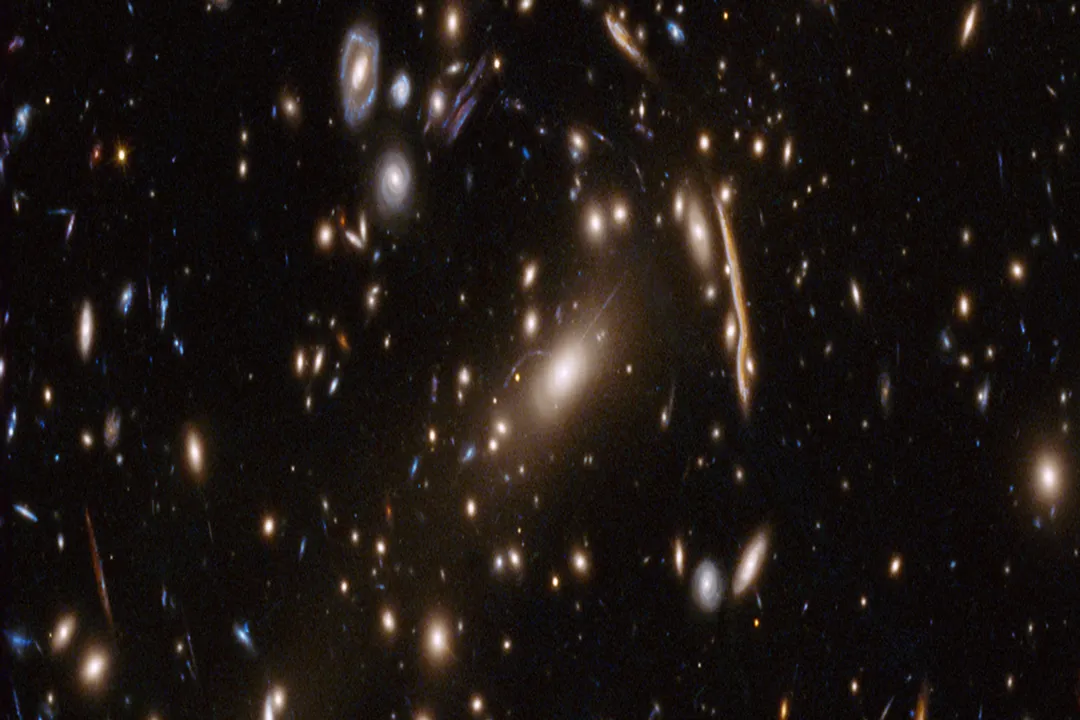
The universe, as we observe it through visible light, is merely the illuminated portion of a much grander, largely invisible structure. When cosmologists weigh the cosmos—accounting for stars, gas, dust, and everything that interacts with the electromagnetic force—they find a significant, gaping hole in the ledger. This missing gravitational influence defines what we call dark matter; it is the enigmatic scaffolding upon which the visible universe is built, accounting for approximately 85% of the total matter in the universe. [1][6][7]
This substance does not emit, absorb, or reflect light or any other form of electromagnetic radiation, making it fundamentally different from the ordinary atomic matter—the baryons—that make up planets, people, and stars. [5][7] Its presence is inferred purely through its gravitational interactions with the things we can see. [1][5] The concept is a crucial pillar of the standard cosmological model, Lambda-CDM, without which our observations of cosmic structure and motion simply do not align with the laws of gravity as described by Einstein. [8]
# Seeing Shadows

The evidence for dark matter is not a single smoking gun but a collection of strong, independent lines of observational proof that converge on the same conclusion: there is far more mass present than meets the eye. [1][7]
# Galactic Dynamics
One of the earliest and most compelling pieces of evidence comes from the rotation of galaxies. If a galaxy were composed only of the stars and gas we detect, stars far from the galactic center should orbit slower than those closer in, much like outer planets in our solar system orbit the Sun more slowly than inner planets. [7] However, observations, pioneered in the $1970$s by Vera Rubin, showed that stars in the outer regions of spiral galaxies orbit at roughly the same speed as those nearer the core. [7] This implies that a massive, invisible halo of material must envelop the visible disk, providing the extra gravitational pull required to keep these outer stars moving so quickly. [1][5] This unseen mass component is the dark matter halo. [3]
# Cosmic Structure
Dark matter also plays the critical role of the cosmic architect. In the very early universe, matter needed to clump together under gravity to form the seeds of galaxies and galaxy clusters we see today. [8] Ordinary matter, however, was strongly coupled to radiation until about $380,000$ years after the Big Bang. This radiation pressure prevented baryonic matter from collapsing effectively into these dense structures. [8] Dark matter, being non-interacting electromagnetically, could begin clumping much earlier, forming gravitational potential wells that acted as nurseries. [8] Once the universe cooled enough for neutral atoms to form, the ordinary matter fell into these pre-existing dark matter scaffolds, allowing structure formation to proceed at the rate we observe. [1][8]
# Bending Light
Another powerful indicator is gravitational lensing. Mass warps the fabric of spacetime, and this warping bends the path of light passing nearby. [1] Massive objects, such as galaxy clusters, act as natural lenses, magnifying and distorting the light from even more distant background galaxies. [7] By meticulously mapping how severely the background light is distorted, scientists can calculate the total mass of the foreground cluster, including the invisible component. [1][7] Consistently, these lensing measurements reveal far more mass than can be accounted for by the visible stars and hot gas alone, perfectly matching the mass requirements inferred from galactic rotation curves. [1][7] The Bullet Cluster provides an almost laboratory-like demonstration, where the bulk of the mass (dark matter) has passed cleanly through the collision, while the hot, X-ray-emitting gas (baryonic matter) has lagged behind due to electromagnetic interaction. [1]
To put this into perspective, consider the cosmic inventory: the energy density of the universe is composed of roughly $68%$ dark energy, $27%$ dark matter, and only about $5%$ ordinary baryonic matter. [4][6] It is a staggering thought that everything we have ever directly touched, seen, or measured with chemistry or particle physics constitutes less than one-twentieth of the mass-energy content of reality. This sheer dominance of the unseen suggests that our current physical theories describing matter are profoundly incomplete when applied to the universe at large. [2]
# What It Is Not
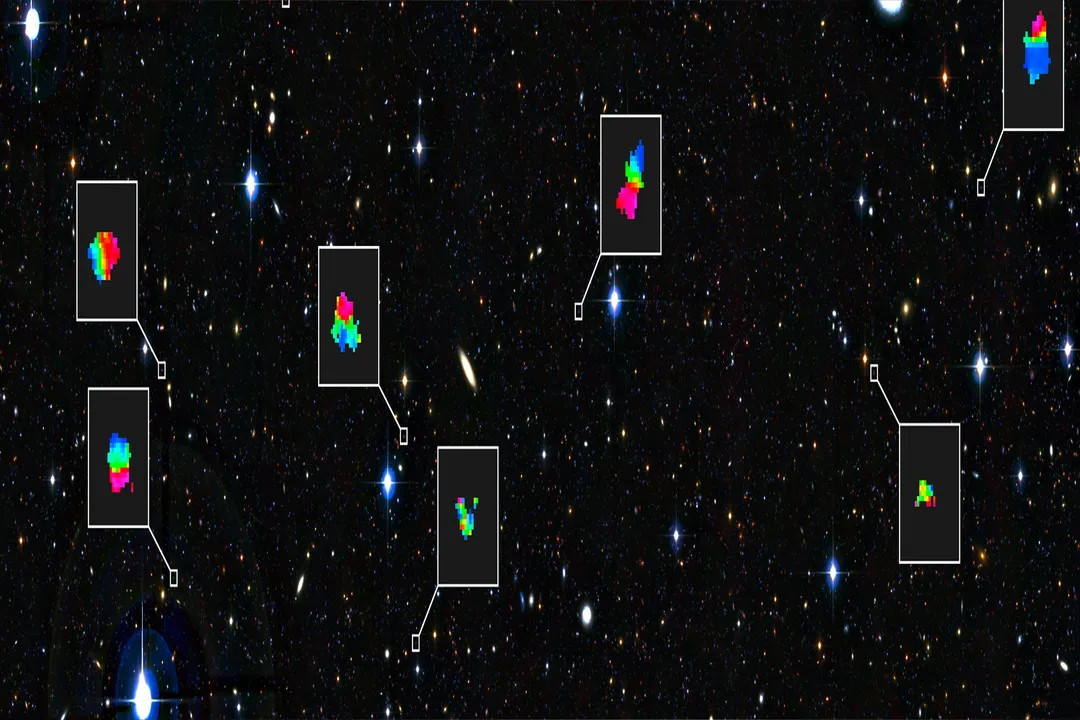
Defining dark matter often starts by ruling out what it cannot be. This process is essential for narrowing down the vast landscape of theoretical possibilities. [3]
# Not Just Dim Stars
Initially, scientists considered that dark matter might just be ordinary matter that is hard to see—things like faint brown dwarfs, rogue planets, or vast clouds of cold gas, collectively termed Massive Compact Halo Objects (MACHOs). [5] However, extensive searches looking for the tell-tale microlensing signatures of MACHOs passing in front of distant stars have largely ruled out these objects as accounting for the majority of the required mass. [5] The consensus now firmly points toward a new, exotic type of particle, as the amount of baryonic matter that could hide in these forms is limited by constraints derived from primordial nucleosynthesis (the creation of light elements in the early universe). [8]
# Distinct from Dark Energy
It is common for the terms "dark matter" and "dark energy" to be confused, perhaps because they both contain the word "dark" and dominate the cosmic inventory. [2] However, they are fundamentally different phenomena operating on different scales and having opposite effects. [4][6]
| Feature | Dark Matter | Dark Energy |
|---|---|---|
| Effect | Attractive gravitational force; clumps matter together. [4] | Repulsive pressure; drives the accelerating expansion of the universe. [4][6] |
| Distribution | Clumps into halos around galaxies and clusters. [1][3] | Uniformly distributed throughout space. [6] |
| Cosmic Fraction | Approximately $27%$ of the total mass-energy. [4][6] | Approximately $68%$ of the total mass-energy. [4][6] |
Dark matter works to hold structures together, creating the web of the cosmos, while dark energy works to push all structures apart over vast distances. [6] One is a gravitational glue, the other is an anti-gravity push. [4]
# Particle Candidates
Since dark matter is non-baryonic and interacts primarily through gravity, the search has focused on hypothetical, as-yet-undiscovered elementary particles. [3][5] These candidates must be "cold," meaning they move relatively slowly compared to the speed of light, which is necessary to allow for the formation of the small-scale structures we observe in the universe. [8]
# Weakly Interacting Massive Particles (WIMPs)
For a long time, the leading theoretical candidate has been the WIMP. [3] These are hypothesized particles that would have mass and interact via gravity and possibly the weak nuclear force, but not the electromagnetic or strong nuclear forces. [5] If WIMPs exist, they should be streaming through the Earth—and through you—constantly. [5] Experiments deep underground, shielded from cosmic rays, are designed to detect the incredibly rare instance where a WIMP might bump into an atomic nucleus in the detector material, causing a tiny recoil signal. [5]
# Axions
Another prominent theoretical contender is the axion. [3] These are much lighter than WIMPs and were originally hypothesized to solve a separate problem in particle physics related to the strong nuclear force. [3] Axions would interact even more weakly than WIMPs, making them far more challenging to detect. Experiments searching for axions typically look for their theoretical ability to convert into photons (light particles) in the presence of a strong magnetic field. [3]
In considering the properties required, it's insightful to realize that the mass range for these potential dark matter particles spans an incredible gulf, from particles far lighter than a neutrino (like axions) up to particles hundreds or even thousands of times heavier than a proton (like many WIMP models). [3] This vast parameter space is why experiments are so varied, ranging from direct detection detectors to massive underground colliders. [5]
# The Hunt for Detection
The goal of experimental cosmology and particle physics is to move dark matter from the realm of inference to confirmed observation. [3] This search is generally divided into three avenues: direct detection, indirect detection, and production.
# Direct Searches
As mentioned, direct detection experiments aim to catch a WIMP striking a nucleus on Earth. [5] These setups require extreme sensitivity and isolation. They are often placed deep underground in former mines or tunnels to use the surrounding rock as natural shielding against interference from normal cosmic rays. [5] The hope is to see a rare, faint flash of light or a tiny vibration that signals a dark matter particle interaction. [5]
# Indirect Signals
Indirect detection looks for the products created if two dark matter particles do interact with each other in dense regions of the universe, like the center of the Milky Way or dwarf satellite galaxies. [1] If dark matter particles collide, they might annihilate or decay into standard model particles, such as gamma rays or neutrinos, which we can detect with telescopes. [1] Telescopes designed for high-energy gamma rays scan the sky, looking for an excess of these signals coming from areas where dark matter density is expected to be highest. [1]
# Particle Production
The third approach involves recreating the conditions of the early universe using powerful accelerators, such as the Large Hadron Collider (LHC) at CERN. [5] Physicists smash known particles together at near light speed, hoping that the immense energy involved might occasionally produce a dark matter particle. [5] Since dark matter would pass through the detector unnoticed, scientists look for "missing energy" in the collision debris—energy that must have been carried away by an undetectable, non-interacting particle. [5]
If we were to map the required gravitational mass to the visible mass in a cluster like Coma, we'd find that the dark matter contribution must be roughly six times greater than the visible matter contribution. [7] This ratio remains remarkably consistent across different scales and epochs, lending great confidence to the overall dark matter hypothesis, even though the particle identity remains elusive. [8]
The very fact that dark matter provides the gravitational foundation for all large-scale structure suggests that its properties—its "coldness" and non-interaction with light—are fundamental necessities for the universe to have evolved into its current state. [8] It is the invisible support beam that prevents the entire cosmic edifice from collapsing into a featureless soup or dispersing too quickly to form galaxies. [1] The ongoing effort to pinpoint the nature of this substance represents one of the most profound quests in modern science, bridging the gap between the largest scales of cosmology and the smallest scales of particle physics. [3][5] While the evidence for its existence is overwhelming, the identity of the particle remains perhaps the most significant outstanding mystery in our current understanding of the physical world. [2]
#Videos
Dark Matter Explained | Cosmology 101 Episode 7 - YouTube
Related Questions
#Citations
Dark Matter - NASA Science
What exactly is Dark Energy and Dark Matter? : r/cosmology - Reddit
Dark Matter | Kavli Institute for Particle Astrophysics and Cosmology ...
Dark Energy and Dark Matter | Center for Astrophysics | Harvard ...
Dark matter | CERN
Cosmology and Dark Matter | ELT - Eso.org
Dark Matter - ESA/Hubble
Dark Matter, Cosmological
Dark Matter Explained | Cosmology 101 Episode 7 - YouTube