Do completely dark dark matter halos exist?
The idea that dark matter forms invisible scaffolding around galaxies is a cornerstone of modern cosmology, yet the specific nature of these massive, spherical structures continues to provoke deep questions. One of the most fascinating debates centers on whether halos can exist entirely devoid of luminous matter—structures known colloquially as "dark dark matter halos." While our telescopes search for stars and gas, these theoretical entities suggest that the gravitational skeleton of the universe might be far more common in its barren form than in its decorated, galaxy-hosting state. [1][6]
# Why Halos Form
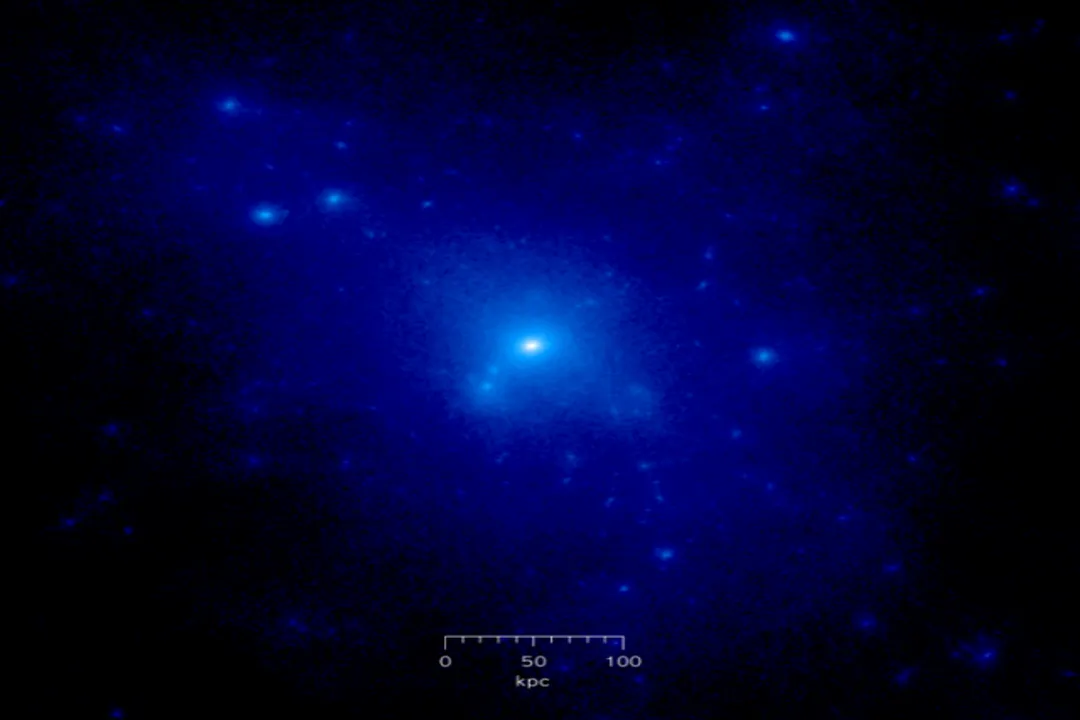
To understand the possibility of a completely dark halo, we must first grasp why these structures exist in the first place. Dark matter, which accounts for the vast majority of the mass in the cosmos, is defined by its reluctance to interact with light or itself through forces other than gravity. [2] Unlike normal, or baryonic, matter—which includes the atoms that make up stars, planets, and ourselves—dark matter particles do not collide, clump via electromagnetic forces, or settle into the flat, spinning disks we observe as spiral galaxies. [2]
When the early universe began to cool and collapse under gravity, the baryonic material, being subject to pressure and radiation, was slower to accumulate at the centers of potential wells. Dark matter, however, fell directly into these deepest gravitational pockets unimpeded, forming vast, diffuse, roughly spherical structures. [2][9]
These resulting halos act as the gravitational wells into which ordinary matter eventually sinks. The visible galaxy, therefore, resides at the very center of a much larger, invisible envelope of dark matter. [9] Cosmologists often model the density of these halos using specific mathematical shapes, such as the Navarro-Frenk-White (NFW) profile, which describes how density increases dramatically toward the center. [9]
# Barren Structures
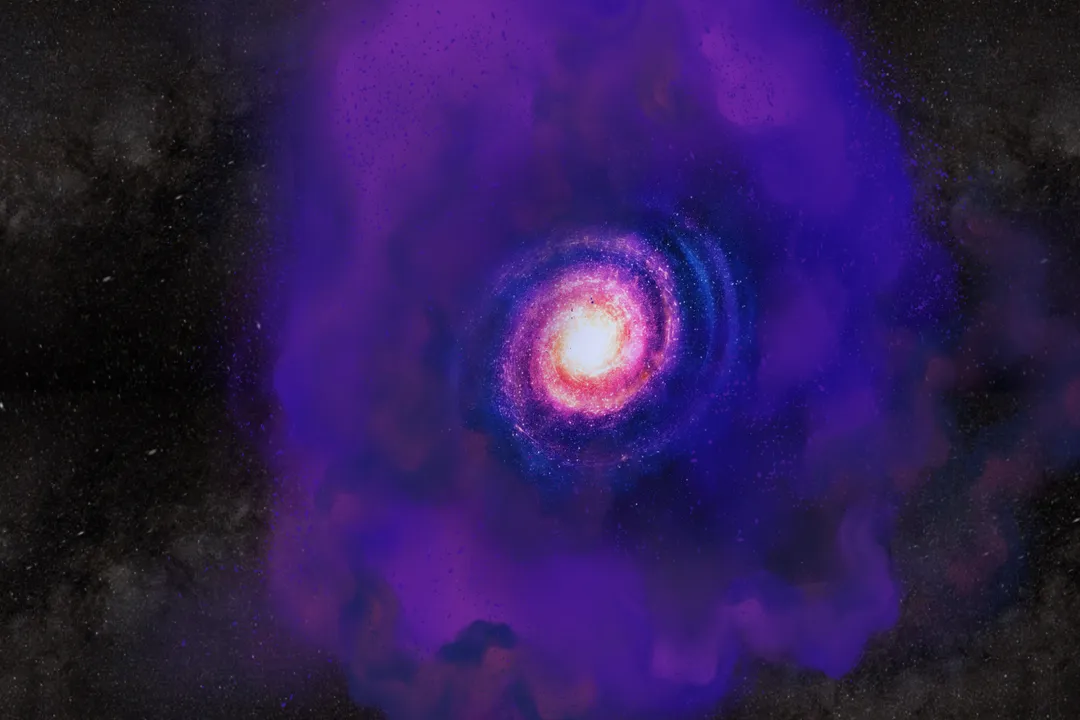
The existence of a dark dark matter halo hinges on a simple question: Must every gravitational well eventually collect enough normal matter to spark star formation? The consensus among many simulations suggests the answer is no. [4]
The term "dark galaxy" is often used to describe a structure where dark matter significantly outweighs the observable baryonic mass. [6] A completely dark dark matter halo takes this one step further, representing a halo where the baryonic fraction is so low, or the environment so hostile, that no stars have ever managed to ignite. [4]
Simulations exploring the formation of structure in the universe suggest that halos form across an enormous range of masses. While the massive halos surrounding galaxies like the Milky Way are certainly well-populated with stars, there is a lower mass limit below which the required conditions for sustained star birth may simply not be met. [1] If the total mass of the halo is too small, the amount of gas that falls in might be insufficient, or it might be rapidly ejected by early supernova feedback or tidal stripping from passing structures, leaving behind a gravitational remnant with no visible tracers. [1][4]
# Minimum Size Limits
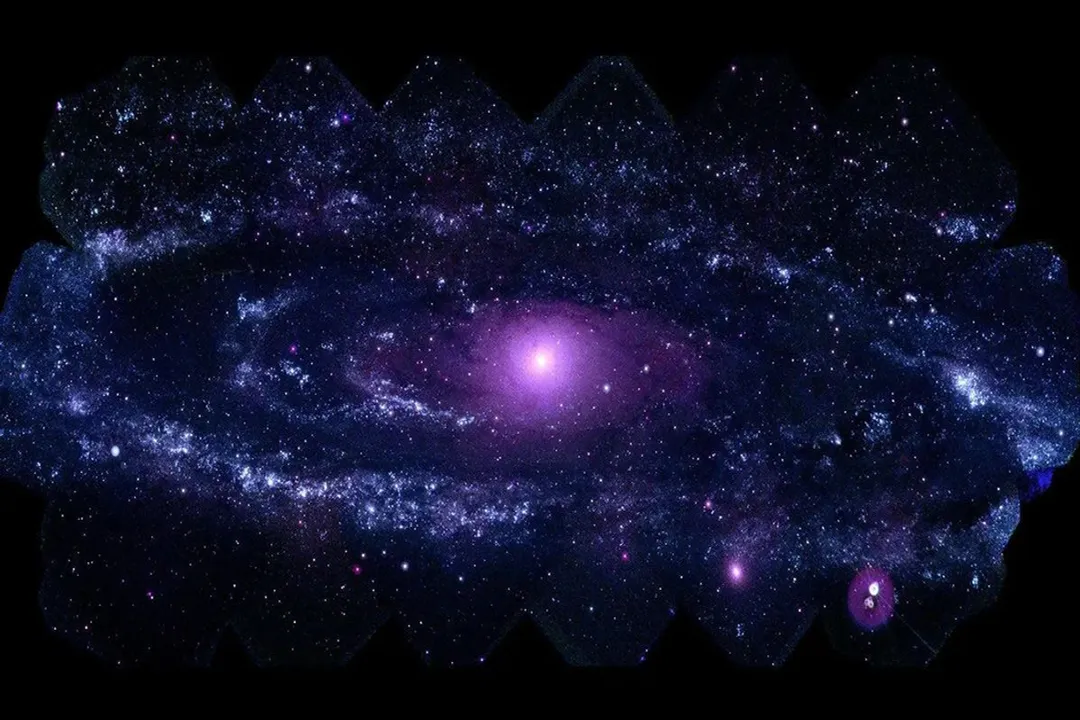
Research into the smallest possible structures capable of hosting stars helps define the boundary where "dark galaxy" becomes "completely dark halo." Evidence suggests that stars can form in halos considerably smaller than previously assumed. [8] Some models indicate that stars might form even in halos with masses as low as ten million times the mass of our Sun. [8]
This minimum size is crucial. If the threshold for star formation is indeed very low, then truly barren halos might only exist at the very bottom end of the mass spectrum, or perhaps in regions where the initial density fluctuations were too weak to pull in the necessary gas in the first place. [1]
One intriguing prediction from cosmological simulations is that these dark dark matter halos might not be uniformly filled. Instead, some models have suggested configurations where the dark matter distribution itself could resemble a "hollow cosmic Easter egg". [3] While this analogy often refers to unusual density distributions within galaxy-hosting halos, it speaks to the inherent complexity and variety in how dark matter aggregates. If a halo were to form under unusual accretion histories, it might maintain a strong outer gravitational profile while remaining virtually empty in its core, effectively creating a void where light-emitting matter fails to settle. [3]
# Searching the Void
The fundamental challenge in confirming the existence of a dark dark matter halo is, naturally, its invisibility. We cannot point a telescope at something that emits no light across the electromagnetic spectrum. [6] Detection must therefore rely on indirect gravitational signatures.
One potential avenue involves looking for microlensing effects. If a completely dark halo were to pass directly between Earth and a distant star, the halo’s mass would bend the star's light, causing a temporary brightening—a phenomenon known as gravitational microlensing. [6] Detecting a microlensing event caused by an object the mass of a small galaxy, but which emits no light, would provide strong evidence for these barren structures.
Another area of investigation involves searching the immediate vicinity of known galaxies. If a small, nearby dark halo passed close to the Milky Way, it might subtly perturb the orbits of distant, faint stellar streams or globular clusters orbiting our own galaxy. [2] The effect would be minute, requiring extremely precise astrometry over long periods, but it offers a way to map the presence of unseen mass near our galactic neighborhood. [2]
If we consider the scale of the problem, we must remember that the visible universe is likely just the luminous froth sitting atop the massive, unseen gravitational sea. An analytical comparison of simulations suggests that for every galaxy we observe, there may be dozens, perhaps hundreds, of smaller halos that simply never reached the critical mass or thermal conditions required to ignite fusion. [1][4] Think of it this way: If you model a vast cosmic web of filaments and knots, the knots where galaxies form are the exception, not the rule; the vast majority of the mass resides in knots that never sparked into life. [4]
# Implications for Structure
The confirmation or refutation of widespread dark dark matter halos has significant implications for our understanding of galaxy formation efficiency. If these barren halos are common, it suggests that the process of drawing in and retaining baryonic gas is surprisingly difficult, even when a substantial gravitational pull (the dark matter halo) is present. [4] It implies that the initial conditions—the slight overdensities present moments after the Big Bang—must be extremely finely tuned to result in a star-forming galaxy.
For researchers focused on the smallest structures, identifying a "dark galaxy" would provide a vital anchor point for calibrating the lower end of the mass function for dark matter halos. If we can definitively measure the mass of a dark halo, even without seeing a star inside, we place a hard constraint on how much baryonic matter should have collected given that mass, which in turn tests our understanding of thermal physics in the early cosmos. [8] Even the faintest, lowest-mass dwarf galaxies we can see give us clues, as their observable mass is vastly smaller than the inferred mass of their encompassing halo, suggesting that even successful star formation leaves the halo overwhelmingly dark. [9]
As we look toward future, more sensitive gravitational surveys, the search for these invisible anchors becomes an exercise in probing the true scaffolding of the cosmos. The expectation that these structures exist based on simulation is strong, but the direct mapping of the dark universe remains one of the great experimental challenges in astrophysics. [1] It forces us to accept that the reality we see—the shimmering lights of the spiral arms—is only a faint indicator of the enormous, silent gravitational architecture supporting it all.
#Videos
Mystery Revealed! How Scientists Found Starless Dark Matter Halos
Related Questions
#Citations
Do “Completely Dark” Dark Matter Halos Exist? - UC San Diego Today
Why is dark matter said to form a halo around galaxies instead of ...
Some dark matter haloes could roll through the universe like hollow ...
Dark matter galaxies may not exist - The Infinite Universe
Dark matter halos do not exist, never have existed, and ... - Facebook
Do 'completely dark' dark matter halos exist? - MSN
Mystery Revealed! How Scientists Found Starless Dark Matter Halos
Stars Can Form In Dark Matter Halos Up to 10 Times Smaller Than ...
Dark matter halo - Wikipedia