Why does the sky appear dark at night?
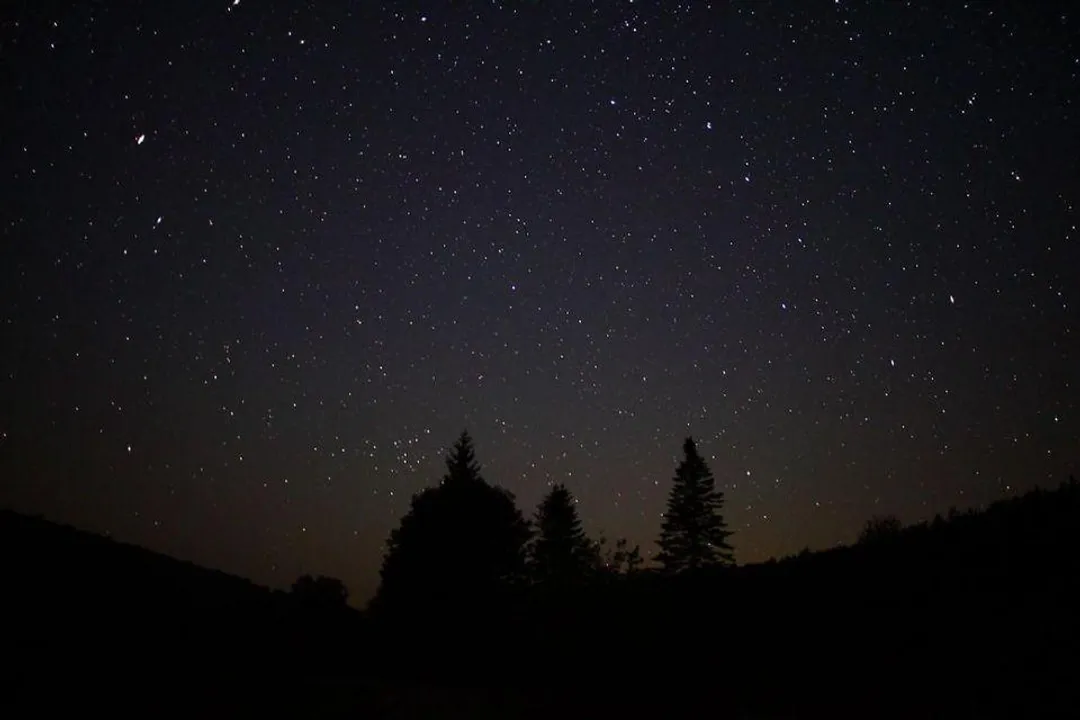
The sky at night appears dark to our eyes, a simple observation that belies one of the most profound questions in the history of physical cosmology. If the universe were infinite in both extent and age, and uniformly filled with light-emitting stars, then every line of sight should eventually terminate on the surface of a star, rendering the entire celestial sphere as bright as the Sun’s surface. [1][4] This expected overwhelming brightness stands in direct contradiction to the observed reality of dark, seemingly empty patches in the night sky. This historical conundrum is famously known as Olbers' paradox. [1][4]
# Paradox Formulated
The paradox is most often associated with the German astronomer Heinrich Wilhelm Olbers, though historical review suggests others, like Thomas Digges and Johannes Kepler in the 17th century, had wrestled with similar concepts before him. [1][4] Olbers popularized the argument in the nineteenth century. [4] The core idea relies on an assumption of a universe that is static, infinite, and infinitely old. [1][4]
Two common ways to frame this problem exist: the flux form and the line-of-sight form. [1]
The flux form involves mentally dividing space into concentric shells, each one light-year thick. Because the universe is assumed to be homogeneous (the same everywhere on large scales), every shell, no matter how far out it is, should contain a proportional number of stars. [1] While the stars in a farther shell appear dimmer due to the inverse square law of distance—they look one-quarter as bright as the stars in a shell twice as near—the farther shell also contains proportionally more stars. In this model, the light received from each successive shell of the same thickness remains constant, meaning that if you add up infinitely many shells, the total light received becomes infinite, leading to a sky as bright as a star's surface. [1] Even if intervening gas and dust blocked some of this light, that matter would eventually absorb the energy, heat up, and begin to glow itself until it radiated with the brightness of the stars it was meant to obscure. [1][4]
The line-of-sight form is perhaps more intuitive: imagine pointing a telescope in any random direction. If space is infinite and uniformly filled with stars, that line must eventually hit a star’s surface. [1][4] Since there are stars everywhere we look, the entire sky should glow perpetually. This expectation clashes sharply with the darkness we observe. [4]
# Modern Resolution
The reason the night sky is dark is that the initial assumptions underpinning the paradox—that the universe is infinitely old and static—are incorrect according to modern cosmology. [4] The solutions lie in two fundamental properties of our actual universe: it has a finite age, and it is expanding. [1][4]
# Age Limit
The finite age of the universe is a direct consequence of the Big Bang model, suggesting the cosmos began about 13.8 billion years ago. [1][4] This beginning imposes a temporal limit on how far we can see, often referred to as the particle horizon. [1] Light travels at a finite speed (), so there is a maximum distance from which light could have reached us since the universe started. [3] Any light originating from stars or galaxies beyond this horizon simply has not had enough time to complete its journey to Earth. [1][3] This naturally limits the number of stars contributing light to our night sky to a finite number, which is insufficient to illuminate the whole celestial sphere. [1]
It is important to note that even within the observable volume defined by this particle horizon, there are still countless stars. If these were the only factor, the sky might still be significantly brighter than it is. [4] In fact, if we look far enough back in time, past the formation of the first stars, we do not see true blackness but rather the faint remnant of the Big Bang itself. [3]
# Expansion Effect
While the finite age sets a boundary on where we can see from, the expansion of space addresses what we see from the light that does reach us, particularly the ancient light. [4] The universe is expanding, meaning that the space between distant galaxies is stretching. [2][4] As light travels across this expanding space, its wavelength is stretched—a phenomenon known as cosmological redshift. [4]
The farther away an object is, the faster it recedes, and the greater the redshift applied to its emitted light. [2][3] Light emitted by the earliest structures in the universe would have been high-energy, similar to the light from a star surface (visible or even ultraviolet). [3] However, due to extreme stretching from the universe’s expansion, this ancient, energetic light has been shifted dramatically down the electromagnetic spectrum, landing mostly in the microwave range. [1][3]
This redshifted radiation is the Cosmic Microwave Background (CMB). [1][3] To the human eye, which is only sensitive to visible light (a narrow band of wavelengths), this microwave radiation appears effectively dark. [3] If the universe were static, this background radiation would still be present, but it would have the temperature and brightness comparable to the surface of a reddish-orange star. [3] Because the expansion shifts this light out of our visible range, we perceive the background as dark, which is the main reason for the night sky’s non-luminous appearance. [2][3]
The two solutions—finite age and expansion—work together. The finite age ensures there is a limited number of sources, and the expansion ensures that the oldest and most distant of those sources contribute energy primarily outside the visible spectrum. [4]
# Visible vs. Invisible Brightness
It is a powerful, perhaps surprising, realization that the night sky is not truly dark, even outside the context of the CMB. [3] When we observe the cosmos, we are witnessing a cumulative background of light from all sources that have existed and whose light has reached us within the observable volume.
If we consider the total radiation budget, the energy contained within the relic radiation (CMB) is significant, but the energy converted from matter into radiation by stars and black holes throughout cosmic history is even greater. Stars convert only a tiny fraction of their mass into energy, about one part in twenty thousand, but they have processed a huge amount of matter over time.
When accounting for all the radiation produced by stars and black holes, much of it is absorbed by intervening dust and re-emitted as heat, peaking in the infrared wavelengths. Even if we could see infrared light, the night sky would still appear much dimmer than daytime because the total flux of diffuse cosmic radiation detected on Earth is minuscule compared to the direct flux from the Sun. The Sun delivers about $1.4$ kilo-watts per square meter, whereas the total diffuse cosmic radiation amounts to only $6$ micro-watts per square meter—a difference of about four billionths.
This comparison provides a useful way to frame the problem: the darkness we perceive is due to our limited biological sensitivity. To an observer with eyes sensitive to microwaves or far-infrared light, the night sky would never appear dark; it would be constantly illuminated by the CMB and stellar/dust emission, respectively. [3]
# Local Contributions
We must also consider our location within the Milky Way. Even if the universe were static and infinite, the light from nearby stars within our own galaxy contributes substantially, though not enough to make the sky as bright as day. The nearest Sun-like stars, for instance, contribute a tiny fraction of the solar flux because they are so distant. The entire disk of the Milky Way, however, contributes a greater amount, though still orders of magnitude less than the Sun on our planet. This suggests a third, minor factor in the resolution, already touched upon in historical debates: light from stars within our galaxy might be partially blocked or scattered by dust within the galactic plane, as noted in some contemporary discussions. [1][4] However, because the Big Bang solutions are so effective, this blockage effect is usually considered secondary to the cosmological explanations. [4]
# Contrast and Emphasis
It is helpful to distinguish between the two primary cosmological explanations, as they address different aspects of the puzzle. [1]
| Factor | Mechanism | Effect on Night Sky Brightness | Primary Resolution of... |
|---|---|---|---|
| Finite Age | Limits the total volume of space from which light has had time to arrive. | Limits the number of stars that can contribute light. | Line-of-sight paradox for the earliest epochs. |
| Expansion/Redshift | Stretches the wavelength of light emitted by distant objects. | Shifts high-energy visible/UV light into invisible infrared/microwave bands (CMB). | Overall luminosity, turning the expected stellar brightness into invisible background glow. |
One analysis suggests that while the finite age establishes the limit, the expansion is the more fundamental reason why the sky is dark in the visible spectrum specifically, as it is the expansion that causes the intense, early universe radiation to become invisible microwaves. [4] If the universe were not expanding, the CMB would still be visible, potentially making the night sky as bright as a dim, reddish-orange star surface everywhere. [3][4] The redshift thus effectively hides the background light from our perception. [3]
# Perception Boundary
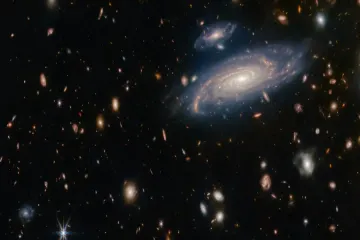
A fascinating conceptual point arises when considering the expansion and the horizon. Because space itself is expanding, there is a cosmological event horizon beyond which objects are receding from us faster than the speed of light. [1][4] Light emitted by sources beyond this horizon will never reach us, regardless of how long we wait. [4] This boundary further limits the observable universe, solidifying the impossibility of an infinitely bright night sky, even if the universe were infinitely old but not expanding. [4]
To place this in perspective, consider our local astronomical neighborhood versus the edge of the observable cosmos. The stars in our immediate galactic neighborhood, even without considering the vastness of space beyond the Milky Way, would still illuminate the night sky significantly if the universe were static and infinite. The required brightness to match the daytime sun only happens if the Milky Way were hypothetically extended out to the scale of the cosmic horizon, billions of light-years away. Since the universe does not extend infinitely in time, and because expansion stretches the light from the furthest reaches into non-visible bands, the required accumulation of visible light simply never materializes for our eyes. [4]
The fact that we see a dark sky tells us something deeply important about the nature of our cosmos: it has a history, and it is changing dynamically over large scales. [4] It’s an empirical constraint on physical models. If we were living in a universe where stars had been shining for an infinite duration, or if we somehow lived in a static pocket of the universe unaffected by large-scale expansion, the night would be day. [4]
# Night Sky Color
The appearance of the sky during the day is entirely dependent on our atmosphere, which scatters sunlight—specifically favoring shorter, bluer wavelengths (Rayleigh scattering)—making the sky look blue. On the Moon, which lacks an atmosphere, the sky is permanently black, even when the Sun is shining.
At night, even in the absence of light pollution, the sky is not perfectly black; astronomers refer to this faint background luminance as skyglow. This glow comes from two primary sources beyond the distant galaxies: a permanent, low-level atmospheric effect called airglow and light scattered by our own atmosphere from remaining starlight or zodiacal light (sunlight reflecting off interplanetary dust). While airglow contributes to a very faint, almost imperceptible illumination in the clearest terrestrial locations, it is negligible compared to the sheer darkness achieved by the absence of the direct, unscattered solar disc and the cosmological explanations for the deep sky darkness.
In essence, the blackness of the night sky is a silent testament to the Big Bang and the ongoing expansion of space. The photons from the first moments of time are still traveling, but they have been stretched into an invisible background hum. We see the darkness because the light we do see comes from a relatively small, accessible portion of the universe, and the light from the rest is either too young to have arrived or too old and redshifted to be registered by our eyes. [3]
The silence of the night sky is thus not a sign of an empty universe, but rather a sign that the universe is young, has a history, and is actively unfolding in a way that cools and stretches the light from its oldest features into an imperceptible state of microwave stillness. [3][4] It requires us to think not just about where the stars are, but when they shone. [3]
#Videos
Why is it Dark at Night? - YouTube
Related Questions
#Citations
Olbers' paradox - Wikipedia
What causes space and the night sky to appear dark - Britannica
Why is it dark at night? (actually a physics question, I promise) - Reddit
Why is it Dark at Night? - YouTube
Why is the Sky Dark at Night? - Avi Loeb - Medium
Blue or black sky? | Causes of Color - Webexhibits
Why is the sky dark at night? [duplicate] - Physics Stack Exchange