Why is the night sky mostly dark?
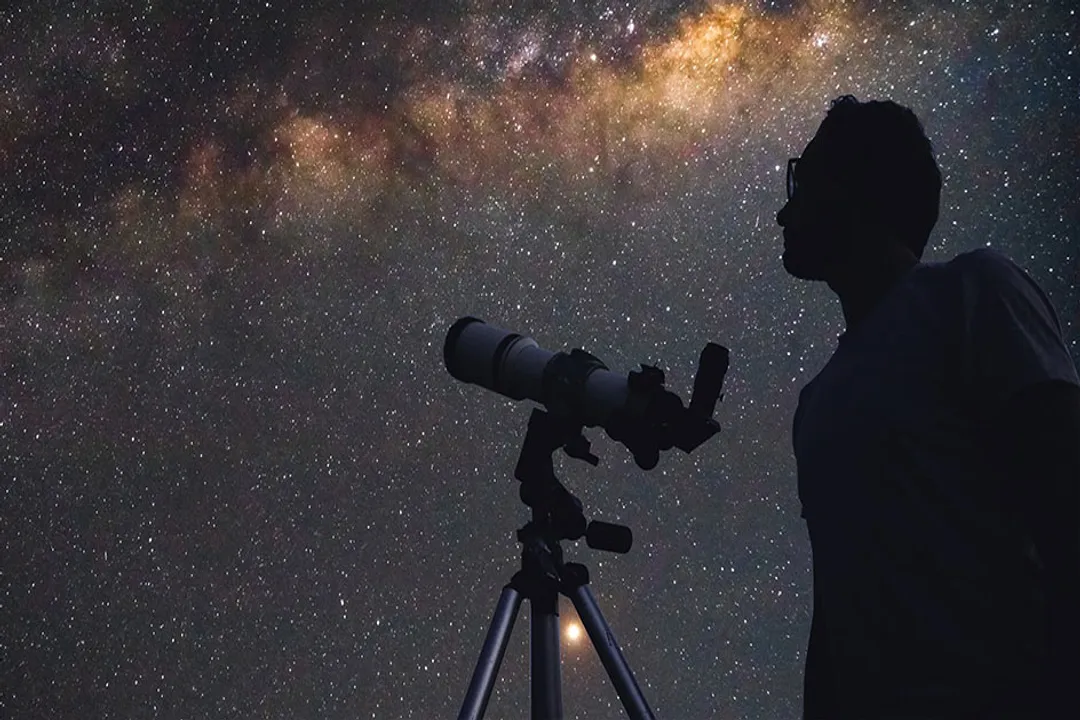
The reason the night sky is dark is one of the oldest, most profound questions in astronomy, leading to a paradox that baffled thinkers for centuries. If the cosmos were truly infinite, eternally old, and uniformly sprinkled with stars like our own neighborhood, then no matter which direction you looked, your line of sight should eventually land directly on the surface of a star. [3] In such a scenario, the entire expanse of the night sky should glow with the blinding intensity of our daytime Sun. The fact that we instead see vast stretches of blackness is known as Olbers' Paradox, a riddle so persistent that it only found its true solution with the development of the Big Bang model of cosmology. [1]
# Infinite View
The premise of the paradox rests on simple geometric assumptions prevalent until the last century: an infinite, static, and eternal universe. [3] Imagine standing in an infinitely large forest. If the trees are distributed everywhere, even if they get sparser the further you look, your vision will eventually be blocked by the trunk of some tree in any direction you face. [1] The stars, in this analogy, are the trees. If the universe were infinite and unchanging, the light from the countless galaxies beyond our own would add up, layer by layer, until the entire sky was completely illuminated. [3]
Early attempts to resolve this failed spectacularly. For instance, one suggestion was that intervening cosmic dust absorbed the light from distant stars. [1] While this seems intuitive—dust clouds certainly obscure stars in our own Milky Way—this explanation falls apart under scrutiny. If there were enough dust to absorb the light from an infinite number of stars, that dust would absorb so much energy that it would heat up and begin to glow just as brightly as the stars themselves, recreating the original problem of a bright sky. [1][3] The riddle persisted, even as astronomers like Heinrich Olbers formalized the argument in the early nineteenth century. [1] The true answers required understanding that the universe is neither static nor eternal.
# Time Limit
The first fundamental piece of the solution comes from the finite age of the cosmos. [2] We now know the universe began with the Big Bang approximately 13.8 billion years ago. [1] Since light travels at a finite, albeit very fast, speed, there is a maximum distance from which light could have reached us since that beginning point. [2][3] This sets a definitive boundary on what we can observe, often called the particle horizon. [3]
If a star exists right now, but it is situated farther away than the distance light could have traveled in $13.8$ billion years, its light has simply not arrived yet. Think of the universe as having been “switched on” only $13.8$ billion years ago. [3] Any hypothetical stars beyond that specific radius are invisible to us not because they don't exist, but because their photons are still traversing the void on their way here. [2] This realization fundamentally changes the geometry: instead of an infinite ceiling of stars, we are looking out into a sphere defined by time, which contains only a finite number of visible light sources. [3]
This means that even if the universe is spatially infinite beyond our current sightline, the observable universe is not. [2] We can calculate the maximum distance light has traveled to reach us in the universe's history. Interestingly, due to the expansion of space itself, the actual radius of the observable universe today is significantly larger than $13.8$ billion light-years—it currently stretches to about 46.5 billion light-years in every direction. [1] It’s a remarkable contrast: the limit of our sight is set by the time light has had to travel, yet the size of the region from which that light originates is larger due to the expansion happening while the light was traveling. [2] This distinction between the age-defined horizon and the current size of the observable sphere is a key insight that moves beyond the simple "not enough stars" argument. [3]
# Stretching Light
The second, and perhaps more powerful, resolution also stems from the Big Bang theory: the expansion of space itself. [1][2] When the universe was very young, it was incredibly hot and dense, flooded with high-energy radiation—the "primordial fire". [2] This ancient light, if it were still in its original form, would be bright enough to make the night sky luminous. [3]
However, as space expands over cosmic timescales, it stretches the wavelengths of the photons traveling through it. [2][3] This stretching effect is known as cosmological redshift. [2] Visible light from extremely distant sources gets stretched so much that it shifts out of the visible spectrum and into the lower-energy infrared or microwave ranges. [2][3]
This is why the sky isn't bright with this ancient, pervasive light—our eyes are not equipped to see microwaves. [2][3] The relic radiation from the Big Bang, known as the Cosmic Microwave Background (CMB), is indeed present everywhere, but because of this stretching, it appears incredibly cold and dim to our visible light sensors. [1] If an observer had eyes sensitive only to microwave wavelengths, they would find the night sky is, in fact, quite bright, completely resolving Olbers' original paradox by showing that the light is there, just invisible to us. [3] Therefore, the darkness we perceive is an artifact of our visual limitations interacting with an expanding cosmos. [3]
# Beyond the Visible Glow
While the finite age and cosmological redshift are the two primary, conclusive explanations, it's worth considering how these concepts relate to our everyday experience. On a perfectly clear, dark night far from city glow, the sky is a deep black punctured by pinpricks of light. Yet, perfect blackness is rare, even in remote deserts. You may notice a faint, grayish, or slightly luminous quality to the darkest part of the sky, which can sometimes be mistaken for distant light pollution. This subtle background glow that exists even without artificial light is due to atmospheric phenomena and faint, integrated sources. Factors like airglow—light produced by chemical reactions in the upper atmosphere—and the integrated light from all the galaxies beyond our immediate view (the cosmic ultraviolet, optical and infrared background) contribute to this non-inky blackness. [1]
This brings us to a fascinating implication for the future. If the universe were static, the night sky would remain as it is now, with light from the farthest visible stars taking eons to reach us. But because the universe is expanding, space itself is accelerating its outward rush. [2] This means that for the most distant galaxies, the space between them and us is expanding faster than their light can cross it. [2] The photons they emit today will never reach us, because the gap will open faster than the light can close it. [2] This suggests a chilling, long-term consequence: over many billions of years, even stars currently within our observable horizon will eventually cross that boundary of no return due to accelerated expansion, causing the night sky to become progressively darker than it is today, eventually making the ancient stories of visible stars sound like myth to our distant descendants. [2]
Thus, the dark night sky is not merely a consequence of distance, but a profound indicator of the universe's history and structure. It tells us the universe had a beginning, and it confirms that space is actively stretching, turning the expected blinding light of an infinite cosmos into the faint, ancient microwave whispers we now study to map our origins. [1][3]
Related Questions
#Citations
eli5:with billions of stars emitting photons why is the night sky not ...
Why is the sky dark at night? [duplicate] - Physics Stack Exchange
Why is the sky dark at night? The 200-year history of a question that ...