What defines a habitable zone?
The search for extraterrestrial life often begins by defining the perfect neighborhood for a planet to call home, a concept astronomers call the habitable zone (HZ). [8] This zone is fundamentally defined by the orbital distance from a star where temperatures could theoretically allow liquid water to exist on a planet's surface. [1][2][5][7][9] Since liquid water is considered the absolute prerequisite for all life as we currently understand it, the HZ acts as the primary filter astronomers use when scanning the cosmos for potentially life-bearing worlds. [2][5]
The distance involved is often described using the colloquial term, the “Goldilocks Zone”—conditions must be just right. [2][5][7][8] If a planet orbits too close, water vaporizes; if it orbits too far, water freezes. It is a narrow band of opportunity dictated by the energy pouring out from the parent star. [1][3]
# Star Light
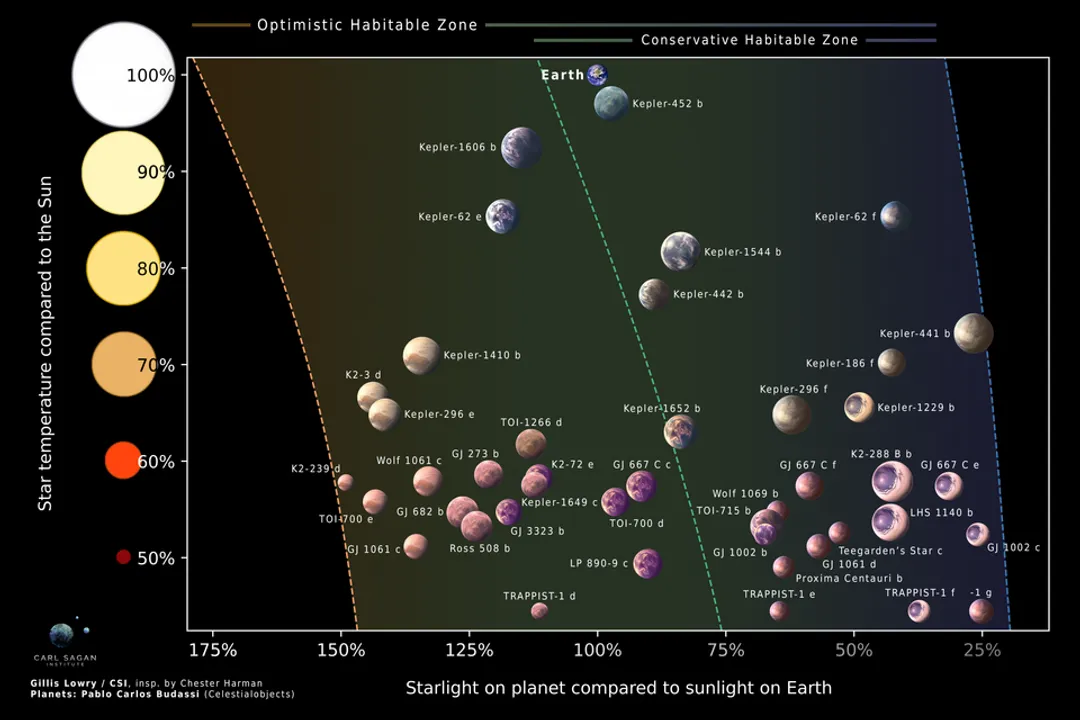
The primary characteristic governing the location of the habitable zone is the star itself, specifically its luminosity, or how much energy it emits. [1][5][8] A star’s mass dictates its temperature and lifespan, which in turn sets the required distance for liquid water. [1]
For stars much like our own Sun, which is classified as a G-type main-sequence star, the habitable zone currently sits roughly between the orbits of Venus and Mars in our own Solar System. [1][5] However, this is entirely star-dependent. Larger, hotter, and brighter stars—such as massive A or F-type stars—emit far more energy, pushing their habitable zones significantly outward. [1][3] Conversely, the vast majority of stars in the galaxy are smaller, cooler, and dimmer M-dwarfs (red dwarfs). [3][8] For these stars, the HZ is situated much closer to the stellar body, perhaps only a fraction of the distance we are from the Sun. [1][8]
This difference in stellar output means that the habitable zone itself is a dynamic, moving target relative to the star over cosmic timescales. For instance, as our Sun ages and becomes slightly brighter, the HZ is gradually migrating outward into the Solar System, meaning Mars might eventually move into the zone while Earth moves out. [1][7] For the planets orbiting dimmer stars, this shift happens much more slowly, but the initial proximity places them in a precarious position from the start. [7]
# Edge Limits
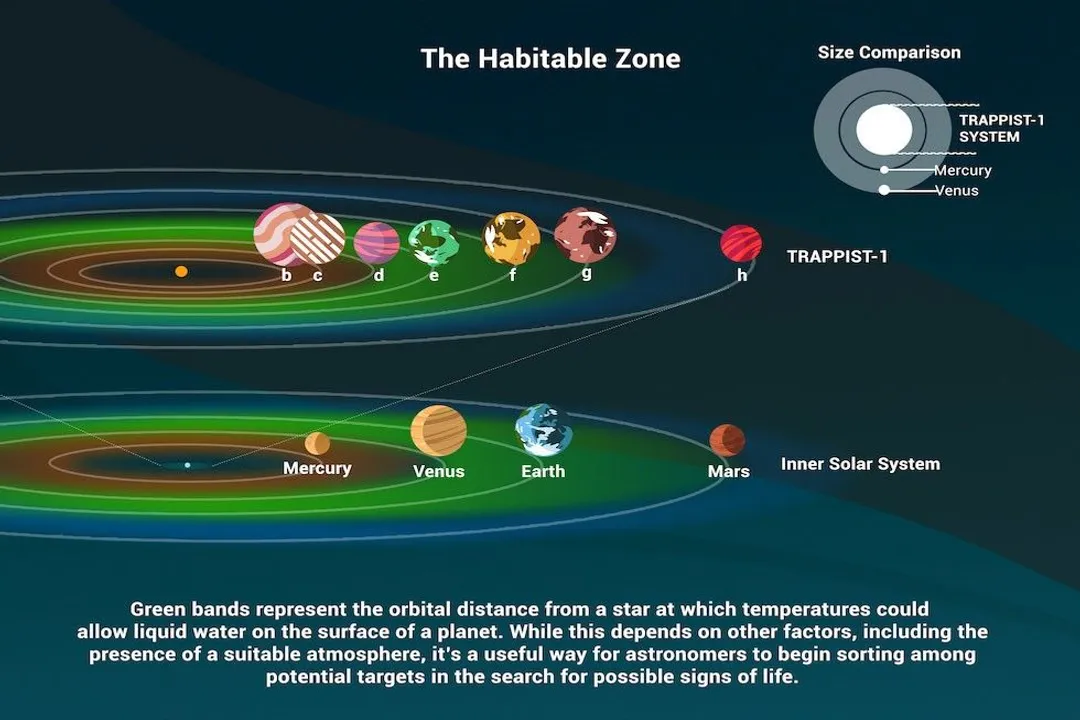
The habitable zone is not a single line but a range demarcated by two critical thermal tipping points, both tied to the presence of water. [1]
The inner boundary defines the point where a planet experiences a runaway greenhouse effect. [1][7] If a planet orbits closer than this line, the stellar radiation is so intense that any surface water boils into the atmosphere, creating an increasingly dense blanket of water vapor. Water vapor is a powerful greenhouse gas, which traps more heat, leading to further evaporation, until the entire ocean is boiled away and lost to space, similar to what is thought to have happened on Venus. [1][7]
The outer boundary marks the region where a planet experiences a maximum greenhouse effect. [1] At this distance, a planet would need an atmosphere rich in potent greenhouse gases—perhaps even thicker than Earth’s current one—just to maintain liquid water on the surface. [1] If the atmosphere is thin or lacks sufficient greenhouse components, the temperature drops below the freezing point, and surface water becomes permanently locked up as ice, rendering the planet outside the HZ. [1]
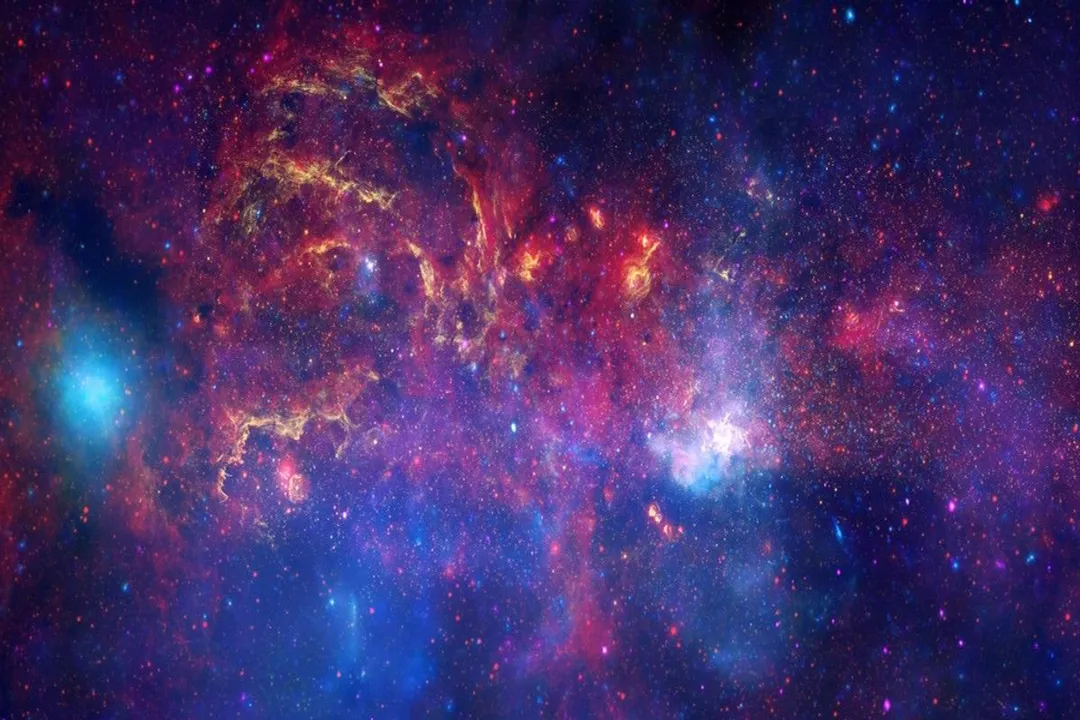
It is important to distinguish this concept from the Galactic Habitable Zone. [2] While the former describes the orbital sweet spot around a star, the latter describes the safe region within a galaxy, avoiding areas too close to the chaotic, radiation-heavy galactic center, or too far out in the sparse, metal-poor outer regions. [2]

# Atmospheric Effect
While the distance calculation provides a neat, simple model, the true location of a planet's actual habitability zone is heavily modified by its atmosphere. [5][9] The standard HZ calculation often assumes an Earth-like atmosphere, but this assumption frequently fails in the real universe. [1][5]
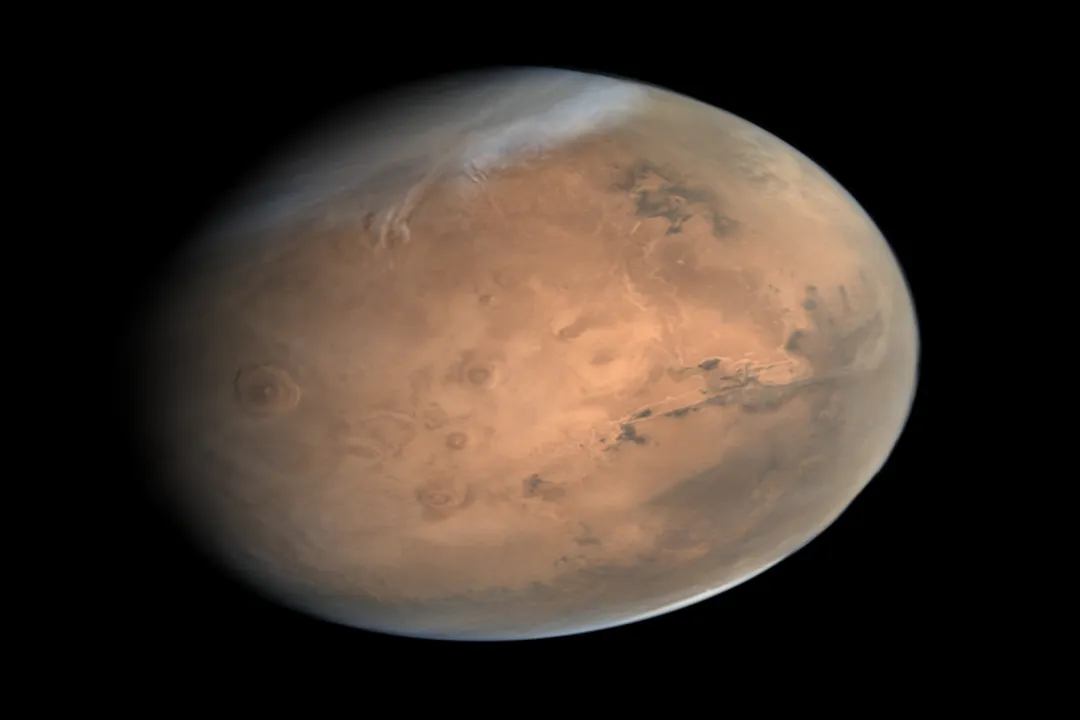
The atmosphere acts as a thermal blanket. For example, if a planet orbits at the outer edge of a star's HZ, a sufficiently thick atmosphere containing gases like carbon dioxide or methane can trap enough heat to raise the surface temperature above freezing, effectively pulling the planet into the habitable range. [5][7] Conversely, a planet orbiting comfortably within the HZ might find itself too cold if it possesses a very thin atmosphere, like Mars, where heat easily escapes into space. [1][9]
This reliance on atmospheric composition is what allows astronomers to investigate planets like Mars. Mars resides just outside our Sun's traditional HZ, yet if we could restore a thicker, warmer atmosphere, liquid water might flow again. [1][5] This dynamic reveals that the habitable zone is a first-order estimate; it tells us where to look first, but not where life must be. [9] For an exoplanet hunter, calculating the HZ tells you the range of distances for a star of a known type to search for terrestrial planets, but follow-up analysis must always account for the unknown planetary envelope. [1]
# Stellar Types
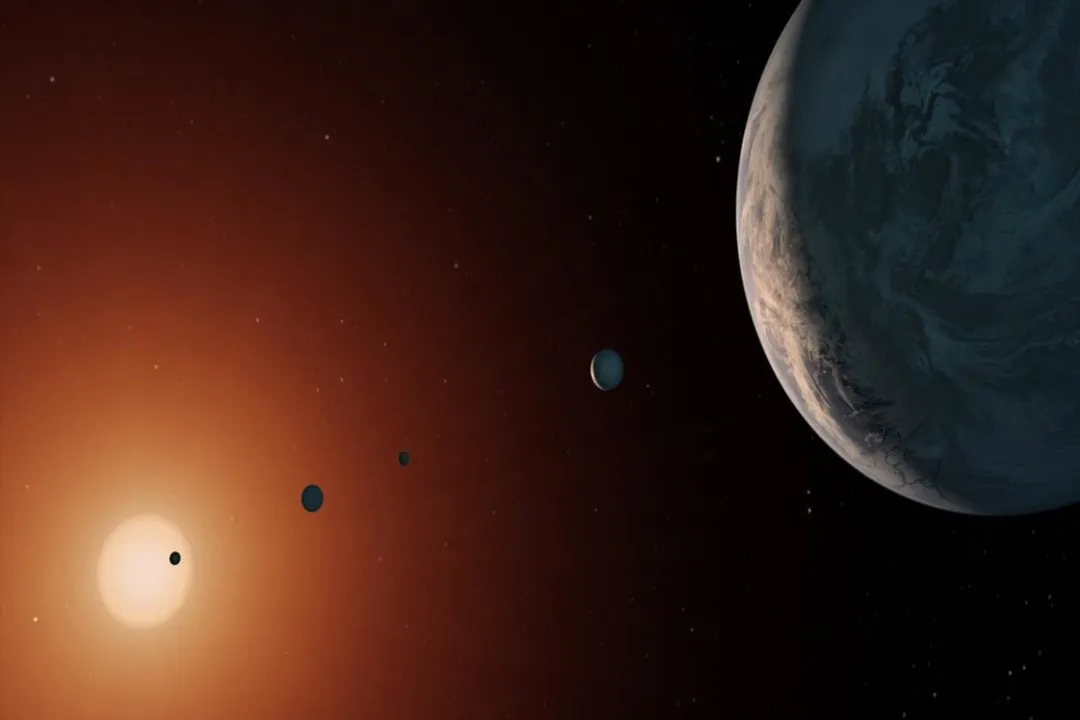
The challenges of habitability change drastically depending on the type of star orbited, especially concerning the tidal forces exerted on close-in planets. [3][8] As noted, M-dwarfs host their HZs very near the star, often closer than Mercury orbits the Sun. [3]
Planets in such tight orbits are subject to tidal locking. [3][8] This occurs when the gravitational pull of the star causes one side of the planet to constantly face the star, resulting in a permanent day side and a permanent night side. [3][8] In such a scenario, one side would be searingly hot, potentially vaporizing surface materials, while the other would be perpetually frozen. [3] Life, if it existed, would likely be confined to a narrow, temperate twilight zone between the two extremes, where atmospheric circulation might manage to distribute some heat. [3] This contrasts sharply with Earth, which rotates relatively quickly, giving us a day/night cycle that helps moderate global temperatures. [8]

# More Factors
Even if a planet orbits perfectly within the calculated HZ and possesses the right amount of water, habitability is not guaranteed. [9] The definition of the habitable zone focuses exclusively on thermal conditions necessary for liquid water, but life requires several other conditions that are much harder to measure remotely. [9]
For complex, Earth-like life to thrive over billions of years, several other planetary mechanisms must be in place:
- Plate Tectonics: This process is vital for recycling carbon dioxide and maintaining a stable climate over geological timescales. [9]
- A Magnetic Field: A strong magnetosphere is necessary to deflect harmful cosmic rays and prevent the stellar wind from stripping away the protective atmosphere. [9]
- Composition: The planet must possess the correct chemical building blocks for life, often referred to as being "metal-rich" in astronomical terms. [9]
Considering these layers of complexity, the habitable zone is best viewed as a sophisticated selection criterion used to narrow down targets for further, more detailed atmospheric characterization. [9] It sets the stage where water can be liquid, but it doesn't ensure that the planet is hospitable in the biological sense.
In essence, defining the habitable zone involves balancing the energy output of a star against the orbital distance of a planet, with the critical caveat that the planet's own physical characteristics, particularly its atmosphere, act as a powerful modifier to that initial calculation. [1][5] The current state of astronomical research focuses on refining the models for stellar evolution and atmospheric dynamics to create an ever more precise map of where that liquid water might actually exist in the galaxy. [1][7]
#Videos
What Is the Habitable Zone? - YouTube
Related Questions
#Citations
The Habitable Zone - NASA Science
Habitable zone - Wikipedia
What Is the Habitable Zone? - YouTube
Habitable Zone - ESA/Hubble
What Is the Habitable Zone? | The Planetary Society
Habitable zone | Astrobiology, Exoplanets & Habitability - Britannica
Habitable Zones - Center for Astrophysics | Harvard & Smithsonian
The Habitable Zone - Understanding Evolution
Habitable Zone