What does the radioactive zone do?
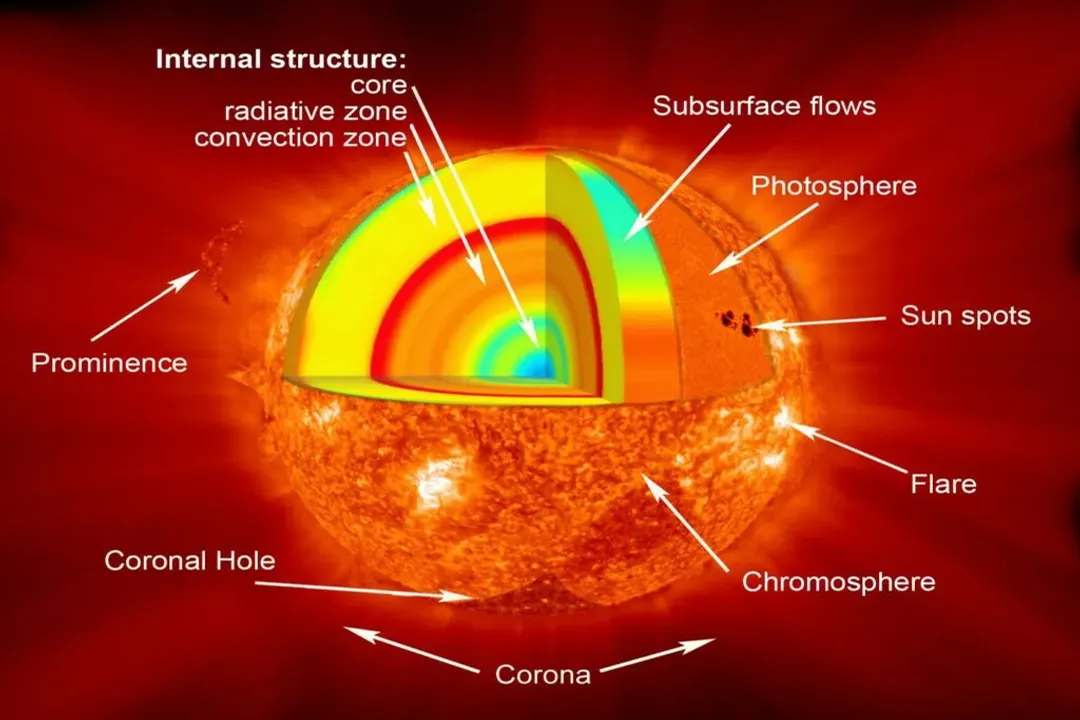
The Sun, that massive, luminous sphere dominating our sky, is far more complex on the inside than its smooth, bright surface suggests. Deep beneath the visible layers lies a series of distinct regions, each performing a critical task in the star’s life cycle. Chief among these internal compartments, situated between the blazing nuclear furnace at the center and the roiling outer surface, is the radiative zone. [3][7][10] This region is primarily responsible for ferrying the immense energy generated in the core outward toward the surface, a process that takes eons due to the extreme conditions found there. [1][5]
# Sun Interior
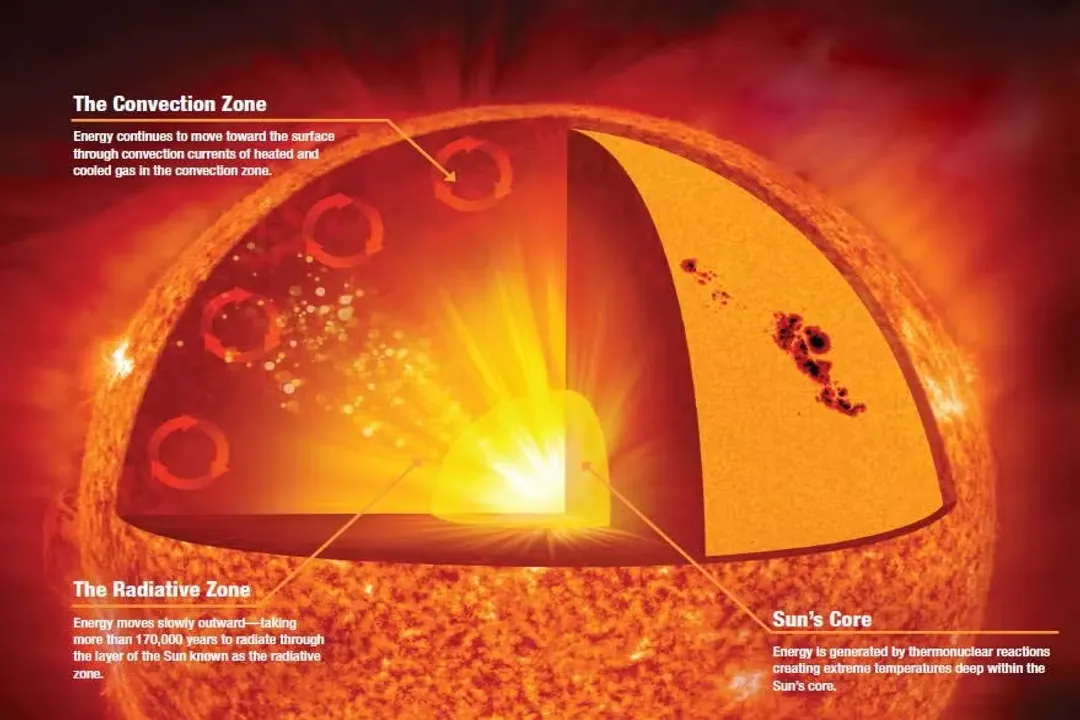
To properly appreciate the radiative zone, one must first understand its address within the Sun’s anatomy. [8] The Sun is generally described as having three primary internal layers: the core, the radiative zone, and the convective zone. [3][7][10] The core is the innermost section where nuclear fusion actively converts mass into pure energy. [1] Directly surrounding this powerhouse is the radiative zone. [5][8] Moving outward from the radiative zone, one encounters the convective zone, the outermost interior layer where heat is transported via bubbling, churning plasma, similar to a pot of boiling water. [1][7]
In terms of scale, the Sun’s radius is measured in solar radii, denoted as . [1] The radiative zone does not occupy the entire remaining volume; rather, it is a vast shell extending outward from approximately $0.25$ solar radii from the center up to about $0.75$ solar radii. [1] This means it constitutes a significant portion of the Sun's interior volume, situated well away from the visible surface layers like the photosphere. [10]
# Energy Transport
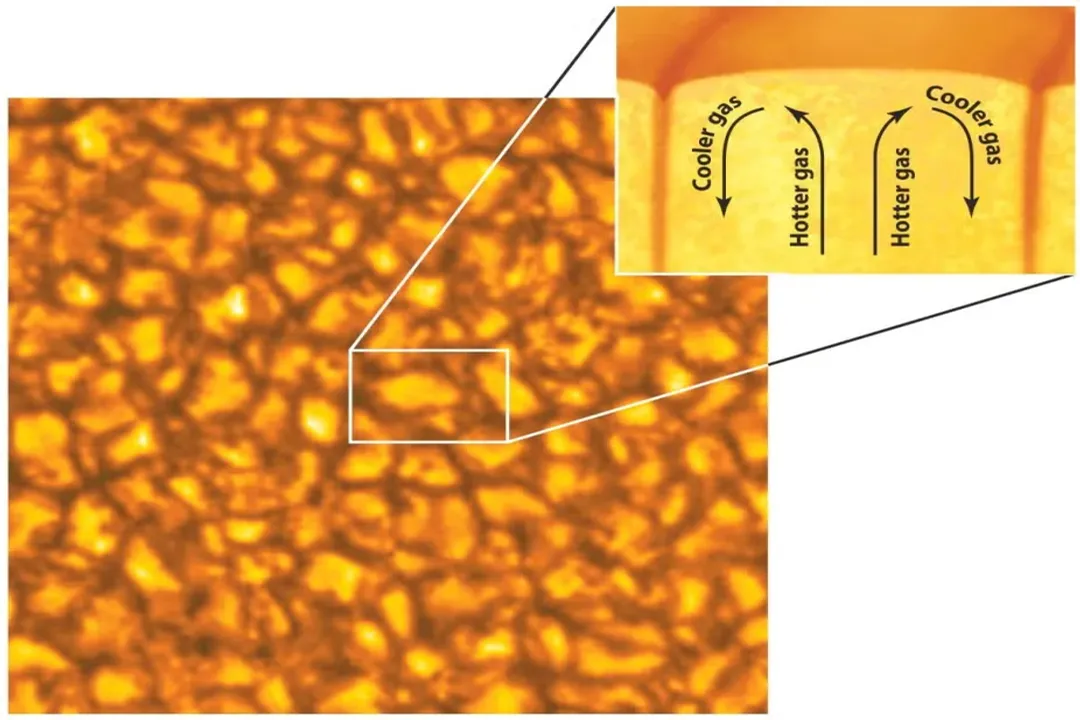
The function that defines the radiative zone is the transport of energy generated in the core. [3][4] Unlike the core, where fusion creates energy, the plasma in the radiative zone is too dense and hot for convection to be an effective mechanism for moving that energy outward. [1] Instead, energy travels by radiation, [8] specifically through the movement of photons. [3][7]
Imagine these photons, tiny packets of light energy, being born in the core. They stream outward, but they do not travel unimpeded toward the surface. [10] The material in the radiative zone—a superheated, ionized plasma—is incredibly dense. [5][7] This density means that any photon trying to move outward immediately interacts with the surrounding particles. [1]
The process is one of absorption and re-emission. [1][10] A photon travels a very short distance before it is absorbed by an atom or ion. [5] Almost instantaneously, that particle re-emits a new photon, often in a completely random direction, including backward toward the core. [1][5] This continuous cycle of being absorbed, held momentarily, and then spat out again is the essence of radiative energy transfer. [4]
This mechanism stands in sharp contrast to the core’s energy generation and the convection zone’s energy transfer. [1] While the core is fusing hydrogen, the radiative zone is purely a relay station, and while the convective zone moves heat via bulk fluid motion (convection), the radiative zone moves it via electromagnetic radiation (photons). [1][8]
# Photon Travel Time
The consequence of this constant absorption and re-emission is a staggeringly slow net outward migration of energy. [5][10] A photon generated in the Sun’s core might take mere seconds to traverse the core itself. [1] However, once it enters the radiative zone, its progress slows dramatically. [1][5]
The journey through this dense shell can take hundreds of thousands of years. [1][5] In some estimates, the time required for energy to pass through the radiative zone is cited as over a hundred thousand years. [5] This incredible delay means that the light we see now left the core of the Sun long before modern humans existed, perhaps even before the last Ice Age ended. [1] It is a stark reminder of the vast timescales involved in stellar physics. [5]
The reason for this protracted transit time is the region’s opacity. [1] Because the plasma is so dense with ionized matter, the photons are constantly being scattered, effectively preventing any straight-line path toward the exterior. [1][4] While the plasma in this zone is significantly less dense than the core, it is still extremely dense compared to anything we experience on Earth—one source suggests densities comparable to water, though at millions of degrees. [5][8]
This process is sometimes referred to as the random walk of the photon, where the net movement outward is only achieved after countless steps in all directions. [1] It’s an inefficient but necessary relay system that keeps the energy moving from the extreme gravitational pressure cooker of the core to the cooler, less compressed layers above. [7] If you could somehow witness this process in action, you would see an area that is continuously glowing brightly, but the actual energy itself is shuffling along at a pace almost imperceptible on a human lifespan scale. [5] It provides a useful context for thinking about how long the Sun has been 'burning'; the photons reaching us today are the end product of fusion events that happened deep in the past, locked up in this dense medium for millennia.
# Conditions Density
The physical parameters within the radiative zone set the stage for this slow energy march. [7] While the core reaches temperatures of millions of Kelvin (though the exact temperature varies slightly across sources, it is extremely high) and extreme pressure, the radiative zone begins where those conditions taper off slightly. [1]
As one moves outward from the core boundary, the temperature drops from the core's peak to roughly 2 million Kelvin near the transition to the convection zone. [1] Even at 2 million Kelvin, the environment is overwhelmingly energetic, but the pressure is lower than in the core. [8]
Density remains a defining characteristic. [5] Although the layer is only about a quarter as dense as the core, it is still far denser than the material in the outer layers. [8] This density, coupled with the high temperature, ensures that the matter remains fully ionized, creating the perfect plasma environment for scattering photons. [1]
To provide a clearer picture of the contrast:
| Feature | Core | Radiative Zone (Outer Edge Approx.) | Convective Zone (Inner Edge Approx.) |
|---|---|---|---|
| Primary Energy Mechanism | Nuclear Fusion | Photon Transport (Radiation) | Bulk Plasma Movement (Convection) |
| Temperature (Approx.) | million K | million K | million K decreasing to surface |
| Density Relative to Water | Extremely high | Comparable to water [5] | Much lower |
| Photon Travel Time | Immediate escape (relative) | Hundreds of thousands of years [1][5] | Rapid movement via rising bubbles |
The very act of this zone existing as a radiative layer instead of a convective one tells us something profound about the physics of the Sun’s interior. [1] Convection, which is the physical mixing of material, relies on a sufficient temperature gradient where hotter, less dense material can rise, and cooler, denser material can sink. [1] In the radiative zone, the gradient is too shallow relative to the density, meaning that attempting to move energy via bulk motion would be less efficient than the highly organized, albeit slow, diffusion of photons. [1]
Consider the energy budget passing through a hypothetical cross-section at the mark. Every single bit of energy generated since the Sun began fusing hydrogen that has not been lost or consumed by fusion in the core must pass through that area via radiation before it can power the surface. [3] If the physical properties—temperature, density, and the ionization state of the hydrogen and helium—were to change such that the opacity dropped significantly, say by a factor of ten, the energy transport mechanism would instantly flip to convection because the radiation pressure would no longer be sufficient to maintain the necessary slow diffusion rate against the gravitational pull and temperature gradient. [1] This delicate balance dictates the structure of the entire star.

# Surface Delivery
The work of the radiative zone is complete when the photons finally reach the boundary where the plasma becomes cool and diffuse enough that convection takes over—the convection zone. [1][7][8] At this point, the temperature is low enough, and the plasma density has decreased enough, that the material can physically boil and churn. [1]
The long, slow haul through radiation effectively homogenizes the energy profile as it moves outward. By the time the energy arrives at the convection zone, it has been processed through the random walk, ensuring a relatively even distribution of energy flux before it gets churned up to the visible surface. [10]
Without the radiative zone acting as this massive, slow-motion buffer, the energy generated by the core would dump into the outer layers too quickly. Such a rapid influx of energy might cause catastrophic structural instability, potentially leading to extreme fluctuations in the Sun’s luminosity or even internal structural failure, although modeling such an event relies on complex physics beyond describing the zone itself. [3] The radiative zone ensures a stable, predictable outflow of the immense power generated by fusion. [5] It is the stellar equivalent of a massive, slow-release mechanism that allows the Sun to burn steadily for billions of years, rather than flaring out its energy in a short, intense burst. [1] The energy we receive daily is therefore the culmination of a journey that started deep within the star hundreds of thousands of years ago, finally released into the churning currents that carry it to our view.
#Videos
How Do Convection And Radiation Zones Work In Stars? - YouTube
Related Questions
#Citations
Radiative zone - Wikipedia
Radiative Zone | Definition & Layers of the Sun - Lesson - Study.com
NASA: The Solar Interior
Glossary term: Radiative Zone - IAU Office of Astronomy for Education
Radiation Zone - Solar Physics at MSU
Inside the Sun - UCAR Center for Science Education
Interior of the Sun | CK-12 Foundation
How Do Convection And Radiation Zones Work In Stars? - YouTube
Layers of the Sun - NASA Science