What causes radioactivity in unstable nuclei?

The spontaneous emission of radiation from an unstable atomic nucleus is a fundamental process in physics, known as radioactivity. [1][6] At its heart, radioactivity is nature’s mechanism for an unstable atom, or radioisotope, to transition into a more stable configuration. [6][8] This instability arises directly from an imbalance within the atom's core, the nucleus, where the fundamental forces are locked in a constant tug-of-war. [3]
# Nuclear Architecture
To understand why a nucleus decides to break down, one must first picture its components. The nucleus is packed with two types of particles: protons, which carry a positive electrical charge, and neutrons, which are electrically neutral. [8] The protons, being positively charged, naturally repel one another due to the electrostatic force. [3] Counteracting this repulsion is the strong nuclear force, a powerful attractive force that binds protons and neutrons—collectively called nucleons—together. [3][8]
For a nucleus to remain stable, this powerful, short-range strong nuclear force must successfully overcome the long-range electrostatic repulsion between the protons. [3] For the lighter elements, the ratio of neutrons to protons needs to be approximately one-to-one for stability. [8] As elements become heavier, however, the number of protons increases, leading to greater overall repulsive force. To maintain the binding energy necessary for stability against this growing repulsion, more neutrons are required to add to the strong nuclear glue without adding more electrical repulsion. [8] Consequently, heavier, stable nuclei tend to have a higher ratio of neutrons to protons, sometimes exceeding 1.5 neutrons for every proton. [8]
# Imbalance Drivers

The cause of radioactivity lies in the nucleus deviating too far from this optimal neutron-to-proton balance, or when the nucleus is simply too large to remain bound by the strong nuclear force alone. [3][6][8] A nucleus that has too many protons, too many neutrons, or is simply too massive will possess excess internal energy, making it inherently unstable. [2][4] Such an unstable nucleus is often described as being in an "excited state" or possessing too much potential energy. [2]
When a nucleus becomes unstable, it seeks to shed this excess energy and achieve a lower, more energetically favorable state by transforming its composition or structure. [2][6] This shedding process is radioactive decay. [2]
The primary reasons for this instability can be categorized based on the imbalance:
- Too Many Neutrons: If the nucleus has too many neutrons relative to its protons, it is considered neutron-rich. [8] The nucleus lowers its neutron count by converting a neutron into a proton, accompanied by the emission of an electron (or beta particle) and an antineutrino. [2]
- Too Many Protons: Conversely, a proton-rich nucleus has too many protons repelling each other. [8] It achieves stability by converting a proton into a neutron, emitting a positron (the anti-particle of an electron) and a neutrino. [2]
- Too Large: Very heavy nuclei, such as those beyond lead (atomic number 82), are inherently unstable because the strong nuclear force is short-ranged, while the electrical repulsion between protons is long-ranged. [3][8] Even with an appropriate neutron-to-proton ratio, the sheer size of the nucleus means the repulsive forces dominate over the strong force holding the extremities together. [3] These nuclei often reduce their size by emitting an alpha particle, which consists of two protons and two neutrons. [1][2]
An interesting observation, often mentioned in nuclear physics discussions, is that nuclei with "magic numbers" of protons or neutrons (analogous to the electron shells in chemistry) tend to be exceptionally stable, highlighting just how critical the balance is. [3] This suggests that instability isn't just about the ratio, but the shell structure within the nucleus itself.
# Decay Pathways
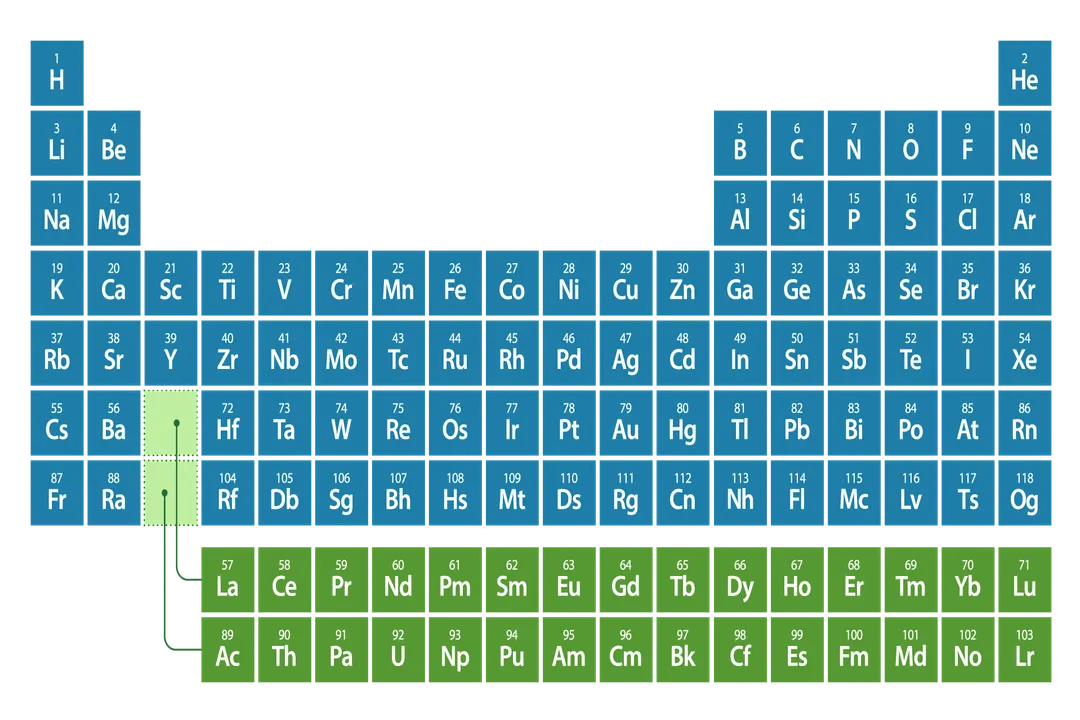
The method a radioisotope uses to achieve stability defines the type of radiation it emits. [6] Because the nucleus must release energy and correct its internal composition, there are several recognized modes of transformation:
# Alpha Decay
This mechanism is typical for very heavy, large nuclei. [2][8] The nucleus ejects an alpha particle (), which is identical to a helium nucleus (), consisting of two protons and two neutrons. [1][2] By losing two protons and two neutrons, the atomic number decreases by two, and the mass number decreases by four. [8] This effectively moves the nucleus to a different element lower down the periodic table, closer to stability. [1] This process releases energy, which becomes the kinetic energy of the alpha particle and the recoil energy of the daughter nucleus. [5]
# Beta Decay
Beta decay involves transformations within the nucleus to adjust the neutron-to-proton ratio. [2] There are a few common types:
- Beta-minus () Decay: Occurs in nuclei with an excess of neutrons. [2] A neutron transforms into a proton, releasing an electron ( particle) and an electron antineutrino (). [2] The atomic number increases by one, while the mass number remains the same. [8]
- Beta-plus () Decay (Positron Emission): Occurs in proton-rich nuclei. [2] A proton transforms into a neutron, releasing a positron () and an electron neutrino (). [2] The atomic number decreases by one, keeping the mass number constant. [8]
# Gamma Emission
Sometimes, a nucleus achieves the correct neutron-to-proton ratio through alpha or beta decay, but the resulting daughter nucleus is still in an excited energy state. [6] This leftover energy is not related to particle emission but is released as high-energy electromagnetic radiation called a gamma ray (). [1][2][7] Gamma emission is a purely energetic release; it does not change the number of protons or neutrons, so the element remains the same, just dropping from an excited state to its ground state. [8]
# Spontaneity and Time

A crucial characteristic of radioactivity is that it is a spontaneous process. [2] When an atom possesses the necessary conditions for instability, there is no external force—no change in temperature, pressure, or chemical bonding—that can influence when it will decay. [2][4] This randomness at the individual atom level is counterintuitive to our everyday experience, where events usually have predictable causes.
However, while we cannot predict which nucleus will decay next, we can predict the behavior of a large collection of those unstable nuclei with remarkable accuracy through the concept of half-life. [2] The half-life () is the time required for exactly half of the radioactive nuclei in a sample to undergo decay. [2][9] This value is unique to each specific radioisotope and is a direct measure of its decay constant. [9] For example, the half-life of Carbon-14 is about 5,730 years, whereas some isotopes have half-lives measured in microseconds. [9]
A helpful way to visualize this is to imagine a collection of atoms. After one half-life, atoms remain. After two half-lives, atoms remain, and so on. [9] This exponential decay model allows scientists to date ancient materials or determine the safe storage time for radioactive waste.
# Energy Release and Ionization
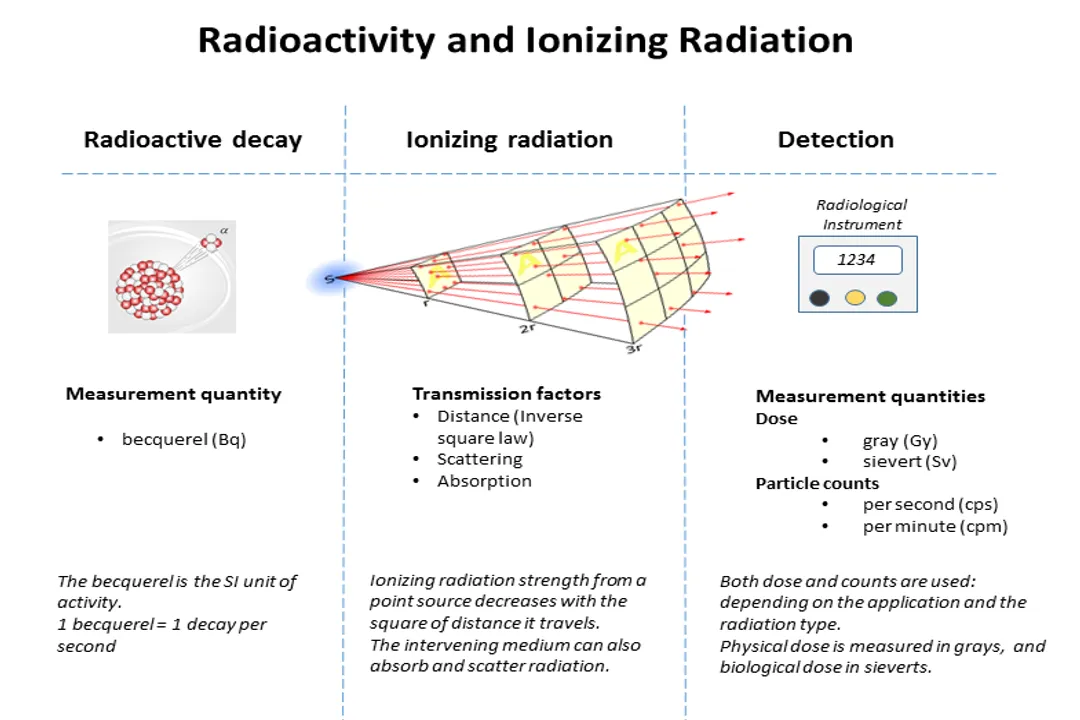
The energy released during radioactive decay is a manifestation of the conversion of mass into energy, as described by Einstein's famous equation, . [5] When a nucleus transitions from a higher-energy configuration to a lower-energy one, the mass of the initial system is slightly greater than the mass of the final system; the difference in mass is converted directly into the kinetic energy of the emitted particles (alpha, beta) and the energy of any gamma rays. [5] This released energy is substantial relative to chemical reactions, which involve only the outer electrons. [7]
The ejected particles carry kinetic energy which, upon interaction with surrounding matter, leads to ionization. [1][7] Ionizing radiation is characterized by its ability to knock electrons out of the atoms or molecules it passes through, creating charged ions. [1][7] This ionization is what makes radiation potentially harmful to living tissue, as it can disrupt biological molecules like DNA. [7]
When comparing the penetrating power of these emissions, a clear hierarchy emerges based on their mass and charge:
| Type of Radiation | Particle Composition | Charge | Penetrating Power |
|---|---|---|---|
| Alpha () | 2 Protons + 2 Neutrons | +2 | Very Low (stopped by paper or skin) [1][7] |
| Beta () | Electron or Positron | Moderate (stopped by aluminum or thick plastic) [7] | |
| Gamma () | High-Energy Photon | 0 | High (requires dense material like lead or concrete) [7] |
Understanding the cause of the instability—the need to balance nuclear forces—is what allows us to predict the decay path and thus the associated risk or utility of the emitted radiation. For instance, if we know an isotope decays via alpha emission, we know its danger is primarily internal, as the particles are easily stopped externally. [7]
# Insight on Stability Margins
It is fascinating to consider the tight margins of stability. If the strong nuclear force were even a tiny fraction stronger, perhaps all protons would bind perfectly with neutrons in a near one-to-one ratio, meaning elements like Beryllium-7 (4 protons, 3 neutrons), which currently decays via electron capture, might have been stable. [3] Conversely, if the electrostatic repulsion were slightly stronger, even lighter nuclei like Carbon-12 might struggle to exist in their current form, leading to a universe dominated by much lighter, perhaps exclusively hydrogen-like, atomic structures. The existence of heavy elements like Uranium is a direct testament to the precise, yet precarious, balance between these two fundamental forces operating over incredibly small distances.
Furthermore, the method of decay often points to the specific type of imbalance. When observing an unknown radioactive substance, the decay mode—alpha, beta, or gamma—acts as a diagnostic signature. For example, if a sample decays by increasing its atomic number (beta-minus emission), a chemist or physicist immediately knows the parent nucleus was suffering from a neutron excess. [2][8] This diagnostic capability is what allows us to chart the decay chains across the chart of nuclides, following the path back to eventual stability, often involving a chain of several different decay types. [8]
Radioactivity, therefore, is not a random malfunction but a necessary, energetic response to an unsustainable configuration of protons and neutrons, driven by the fundamental laws governing the strongest forces in the universe. [3][4]
#Videos
Stable and Unstable Nuclei | Radioactivity | Physics | FuseSchool
Related Questions
#Citations
Radioactivity - ARPANSA
Radioactive decay - Wikipedia
Why do unstable nuclei form? - Physics Stack Exchange
What makes a particle radioactive? : r/askscience - Reddit
Stable and Unstable Nuclei | Radioactivity | Physics | FuseSchool
DOE Explains...Radioactivity - Department of Energy
Radiation Basics | Nuclear Regulatory Commission
Atoms – Nuclides, isotopes and radioactivity
Radioactivity and Radioisotopes - NDE-Ed.org