What fundamental conclusion resulted from Edwin Hubble's 1925 publication regarding the Andromeda Nebula?
Answer
Andromeda was an independent galaxy, fundamentally changing the scale of the cosmos.
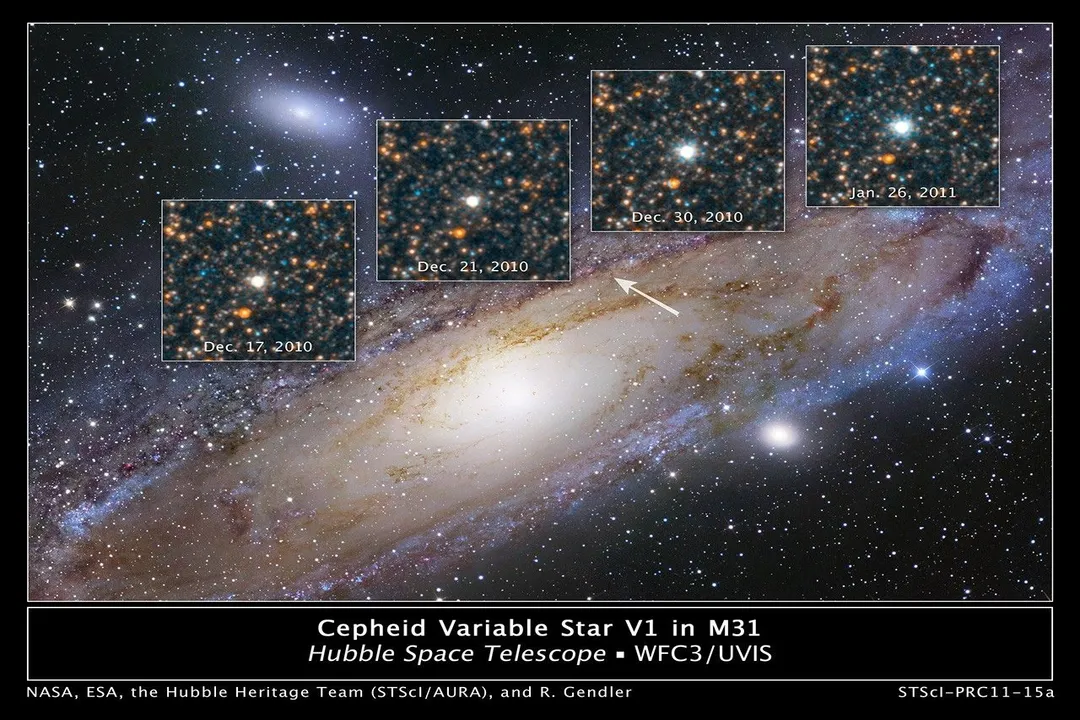
Hubble's finding that Andromeda was hundreds of thousands of light-years away—exceeding the size of the Milky Way—settled the Great Debate by proving Andromeda was an external galaxy, transitioning the view of the cosmos from one galaxy to a vast expanse of many.
Related Questions
What was the central issue in the cosmological controversy known as the "Great Debate" regarding Andromeda?Which astronomer discovered the crucial relationship that provided a 'cosmic yardstick' for measuring distances?What specific characteristic of Cepheid variables did Leavitt find correlated directly with their absolute luminosity?What was the required instrument for Hubble to successfully isolate and identify a faint Cepheid variable in Andromeda?If a Cepheid's period allowed the calculation of its Absolute Magnitude (M), what measurement provided the Apparent Magnitude (m)?What fundamental conclusion resulted from Edwin Hubble's 1925 publication regarding the Andromeda Nebula?What was the initial distance estimate for Andromeda published by Hubble based on the calibration constants available at the time?What fundamental law of physics allowed the calculation of distance once the difference between true brightness (M) and apparent brightness (m) was known?What term describes the successful demonstration that astronomers could measure distances reliably far outside the immediate stellar neighborhood using Cepheids?What process was essential for Hubble to confirm a star in Andromeda was a true Cepheid variable, rather than noise or a foreground star?