What is the longest unit of measurement in astronomy?
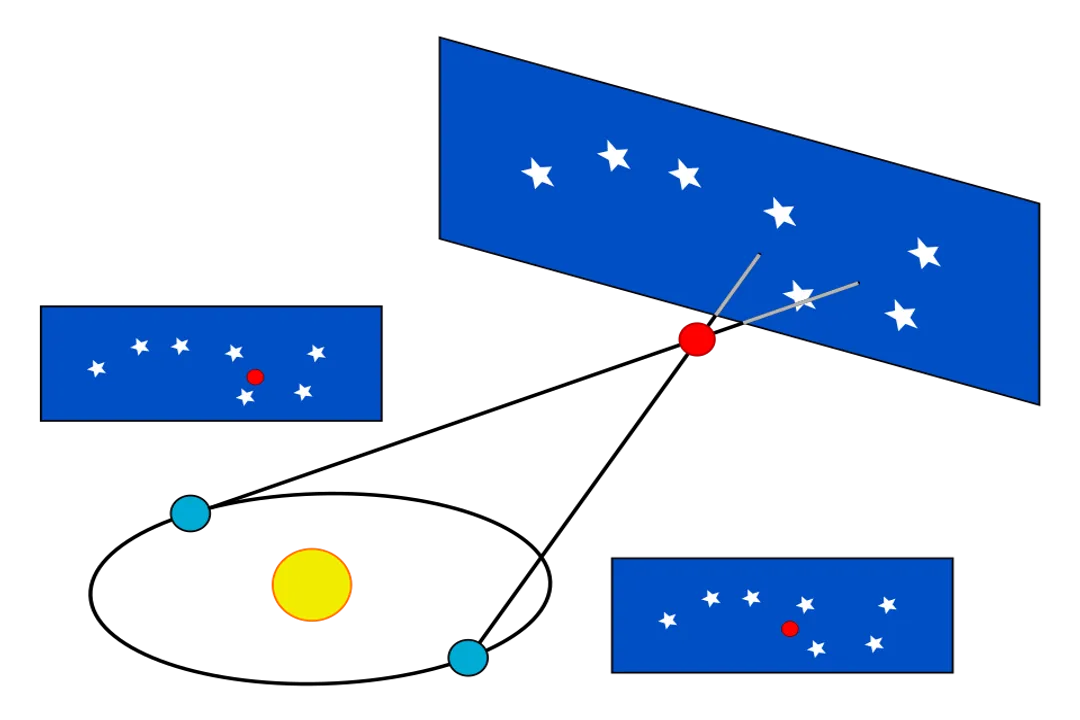
The sheer scale of the universe forces us to adopt specialized measuring sticks far beyond our everyday meters or miles. When we gaze up, whether at the Moon or at a galaxy millions of light-years away, the numbers involved become so large that they lose meaning unless framed within a unit designed specifically for cosmic distances. Determining the longest unit in astronomy isn't a simple matter of picking one name off a list; it requires understanding the context for which each unit was created, ranging from measurements within our own solar system to the mapping of the observable cosmos itself. The primary contenders for the title of "longest" are the light-year and the parsec, though the parsec, with its larger multiples, ultimately takes the crown for professional astronomical discourse. [1][4]
# Solar System Scale
To grasp the astronomical scale, we must start locally, with the unit astronomers use for objects primarily within our Sun's gravitational embrace: the Astronomical Unit (AU). [7][9] This unit is fundamentally defined by the Earth's orbit. The AU is taken as the average distance between the center of the Earth and the center of the Sun. [6][9] This distance is approximately 150 million kilometers (or about 93 million miles). [6][7] While the AU is essential for solar system calculations—for instance, telling us Jupiter orbits at about $5.2$ AU—it becomes far too small when we look to objects outside our local neighborhood. [9] When discussing objects like the Voyager spacecraft, the AU is convenient, but when discussing the nearest star system, Alpha Centauri, using AUs would yield a number in the hundreds of thousands, making the unit unwieldy. [4]
# Light Travel
As distances increase, astronomers pivot to a unit based on the speed of light itself: the light-year (ly). [4][7] This unit is defined as the distance that light travels in a vacuum over the course of one Earth year. [4][9] Since light travels incredibly fast—about $299,792$ kilometers per second—a light-year represents a staggering distance: roughly $9.46$ trillion kilometers. [4][9] Light-years are intuitive for many general readers because they connect distance directly to time—when we see a star $100$ light-years away, we are observing light that left that star $100$ years ago. [7] This concept is critical for understanding the look-back time inherent in almost all astronomical observation. [3] However, for professional observations, especially those involving stellar motions or parallax measurements, this time-based unit often proves less mathematically convenient than its geometric cousin. [8]

# Parallax Measure
The true champion among the most frequently used standard professional units is the parsec (pc). [1][4] The name itself is a portmanteau derived from parallax and arcsecond. [1] It is defined geometrically based on stellar parallax, which is the apparent shift in a star's position when viewed from opposite sides of Earth's orbit. [8][9] Specifically, one parsec is the distance at which one Astronomical Unit subtends an angle of exactly one arcsecond ($1''$). [1][8] This geometric definition allows astronomers to use triangulation, a foundational technique for distance measurement, directly translating an observed angle into a distance in parsecs. [8][9]
Converting the parsec into more familiar terms reveals its magnitude relative to the light-year: One parsec is equivalent to approximately $3.26$ light-years. [1][9] This immediately establishes the parsec as a significantly longer standard unit than the light-year for measuring interstellar and intergalactic space. [4] For example, Proxima Centauri, the closest star to our Sun, is about $1.3$ parsecs away, which translates to just over $4.2$ light-years. [1] Because the parsec is directly linked to the observable geometric effect of parallax, it became the preferred unit for measuring distances to nearby stars and defining the scale of our Milky Way galaxy. [8]
It is fascinating to consider the inherent mathematics of the parsec versus the light-year. While the light-year offers a direct connection to the age of the light we receive, the parsec offers a direct link to the method used to measure that distance via trigonometry. [8] A measurement taken in parsecs is essentially a direct output of the parallax angle observation (, where is in arcseconds), whereas a light-year measurement requires converting the distance calculation into a temporal measure, which can sometimes feel slightly less immediate to someone performing observational work based on angular measurements. [9]
# Comparing Scales
To visualize how these common units stack up, it helps to put their approximate values side-by-side:
| Unit | Abbreviation | Approximate Value in Kilometers | Equivalent in Light-Years | Primary Use Context |
|---|---|---|---|---|
| Astronomical Unit | AU | Within the Solar System [6][9] | ||
| Light-Year | ly | Interstellar distances [4][7] | ||
| Parsec | pc | Galactic and nearby extragalactic [1][8] |
# Beyond Parsecs
While the parsec is longer than the light-year, the universe continues to stretch beyond even that substantial yardstick. Astronomers quickly realized that when measuring distances between galaxies or across the structure of the Milky Way itself, even the parsec was too small for practical use. [4] To handle these vast scales, the parsec is scaled up using standard metric prefixes:
- Kiloparsec (kpc): One thousand parsecs. This unit is commonly used to describe distances within our own galaxy, the Milky Way. [1][4] For instance, the distance from the Sun to the center of the Milky Way is estimated to be around $8$ kiloparsecs. [1]
- Megaparsec (Mpc): One million parsecs. This is the workhorse unit for extragalactic astronomy, used to measure distances to nearby galaxy clusters and superclusters. [1][4] The Andromeda Galaxy, our closest major neighbor, is located about $0.77$ Megaparsecs away. [4]
- Gigaparsec (Gpc): One billion parsecs. This is the scale required to map the largest known structures in the universe, such as the filaments and voids that make up the cosmic web. [1]
Therefore, the longest standard, systematically named unit routinely employed by astronomers is the Gigaparsec ($10^9$ pc). [1][5] When scientists discuss the scale of the observable universe, they are often dealing with distances approaching $14$ Gpc, representing the farthest look-back time possible given the universe's age. [1]
# Cosmic Context
The choice of unit heavily depends on what one is trying to measure. The AU keeps us grounded in our solar system. [6] The light-year offers an accessible way to describe the time-lag of distant stars. [3][7] However, when moving into deep space, the parsec and its multiples become indispensable tools for professional research. [4]
Consider the difference in notation: stating the distance to the Virgo Cluster as $16$ Megaparsecs is far cleaner and more commonly seen in scientific literature than stating it as about $52$ million light-years or over $312$ quadrillion AUs. [1][4] The Megaparsec (Mpc) allows researchers to discuss the kinematics and distribution of galaxies without constantly dealing with astronomical numbers that bury the actual physics being studied. [4] The sheer convenience provided by these large, standardized, geometrically-derived units is what cements the parsec and its derivatives as the longest useful units in the modern astronomical toolkit. [1][8]
While the Gigaparsec represents the practical limit for mapping superclusters, it is worth noting that some researchers occasionally use even larger, though less standardized, terms like Teraparsec (Tpc) or Yottameter when modeling the entire observable universe, pushing into scales where the metric expansion of space itself dominates the distance measurement. [5] However, in terms of commonly accepted, defined, and cited units, the Gigaparsec remains the longest name in regular circulation. [1]

# Practical Usefulness
For anyone engaging with serious astronomical data, understanding the transition point where one unit becomes superior to another is a key piece of expertise. If you are using a backyard telescope to image nebulas in the Orion Arm of the Milky Way, light-years or even thousands of parsecs (kiloparsecs) will suffice. [4][9] But the moment you start tracking the motion of galaxy groups, the Mpc becomes mandatory. If you are reading a cosmological paper discussing the distribution of quasars across the entire observable sky—the largest possible distance we can measure—you will see distances expressed in Gpc. [1]
This gradual progression reflects a necessary adaptation to expanding observational capabilities. As we develop instruments capable of seeing farther—from measuring stellar parallax to detecting the faint redshift of the most distant galaxies—our measuring tape must lengthen accordingly to keep the numbers manageable and the resulting calculations direct. [8] The parsec system, built on a solid geometric foundation, simply scales up more elegantly than the light-year when dealing with the sheer immensity beyond our galactic home. [1][9]
#Videos
What is Parsec ? How 1 parsec is measured? - YouTube
Related Questions
#Citations
Parsec - Wikipedia
What is the longest unit of measurement? - Quora
What is Parsec ? How 1 parsec is measured? - YouTube
Astronomical Distances - Redshift Sky
What is a parsec in astronomy? - Facebook
TIL of the Astronomical Unit, or AU, a unit of length equivalent to the ...
Cosmic Distances - NASA Science
Parsec definition (video) | Stellar parallax - Khan Academy
Basic Units of Measurement