What do SI units stand for?

The designation "SI units" is an abbreviation for the Système International d'Unités, which translates from French to the International System of Units. [1][4] This system is the definitive, modern form of the metric system, adopted globally by most nations for science, commerce, and everyday measurement. [2][3] Its purpose is to provide a standardized, coherent set of units that ensures consistency, whether you are calculating the speed of light or determining the ingredients for a recipe. [6][8]
# System Origins

The SI system has evolved over time, but its current structure, formalized and maintained by the General Conference on Weights and Measures (CGPM) under the guidance of the International Bureau of Weights and Measures (BIPM), rests on a bedrock of seven fundamental measurements. [1][2] Prior to major revisions, some of these units were defined by physical objects, such as the definition of the metre relying on a specific metal bar stored in France. [8] This reliance on artifacts, however, introduced potential for drift or error over time, which the scientific community sought to eliminate. [2]
# Seven Bases
The entire system flows from seven independent base units. Every other measurement unit in the system—the derived units—can be constructed purely by multiplying or dividing combinations of these seven base quantities. [4][6] Understanding these building blocks is key to understanding the coherence of the SI system. [3]
Here are the seven base units and what they represent:
| Quantity | SI Unit | Symbol |
|---|---|---|
| Length | metre | m |
| Mass | kilogram | kg |
| Time | second | s |
| Electric Current | ampere | A |
| Thermodynamic Temperature | kelvin | K |
| Amount of Substance | mole | mol |
| Luminous Intensity | candela | cd |
The definition of time as the second remains tied to the radiation corresponding to the transition between two energy levels of the caesium-133 atom. [1] This atomic definition provides remarkable stability and accuracy for timekeeping worldwide. [7] Similarly, electric current is defined through the elementary charge of the electron. [7]

# Defining Constants
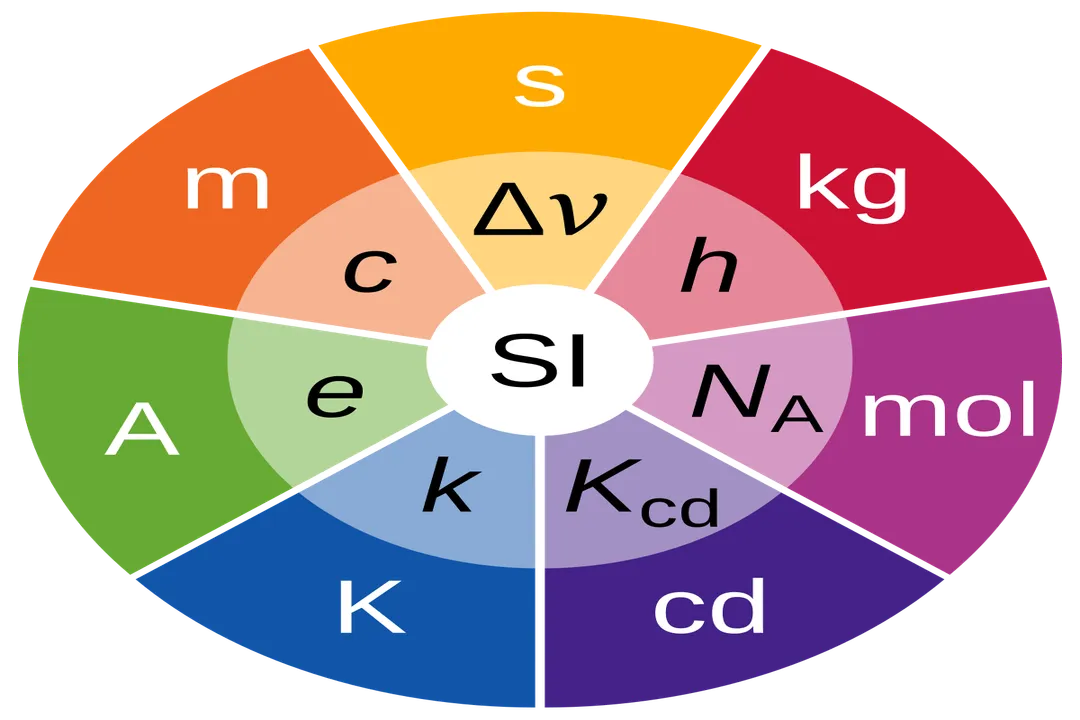
A crucial evolution occurred in 2019 when the SI units were officially redefined. [2][7] This shift moved the entire system away from physical artifacts toward definitions based on nature’s inherent constants—quantities believed to be unchanging everywhere in the universe. [2][7] For instance, the mole is now defined by fixing the value of the Avogadro constant (). [7]
This transition is perhaps the most significant conceptual leap in modern metrology. Previously, the kilogram was defined by the International Prototype Kilogram (Le Grand K). [2] If a laboratory needed a precise measurement of mass, they compared their standard against this physical cylinder. [8] Now, the kilogram is derived by fixing the value of the Planck constant (). [7] For the general user, this change has virtually no impact on daily measurements. However, for specialized engineering or high-energy physics where uncertainty must be minimized, moving the definition off a physical object means that any lab, anywhere, using the defined constants, can reproduce the exact kilogram standard without ever needing access to the prototype itself. [2] This solidifies the system's authority and trust globally. [8]
# Derived Measurements
Once the seven base units are established, one can construct derived units for nearly any physical quantity imaginable. [6] These units are simply combinations of the base units, often given special names for convenience. [4][8]
For example, Force is defined as mass times acceleration (length/time squared), resulting in the newton (), which is equivalent to . [6] Similarly, Pressure is force applied over an area, giving us the pascal (), equal to . [4] In chemistry, concentration is often discussed in terms of the mole, making the mole indispensable even in fields where mass (kilogram) and volume (derived from metre cubed) are more commonly used for bulk materials. [9]
The system’s coherence means that if you use SI units throughout a complex calculation—say, calculating the power output of an electrical device using voltage, current, and time—the resulting answer will naturally emerge in the correct derived SI unit, the watt (), without requiring manual unit conversion factors within the equation itself. [3]
# Scaling Magnitude
The SI system also incorporates a standardized set of prefixes that allow measurements to be conveniently scaled up or down from the base unit. [1][5] These prefixes are universal, meaning the prefix for $10^3$ is the same whether applied to the metre (kilometre) or the second (kilosecond), although the latter is far less common. [5]
The ability to bridge vast scales is essential. Consider the difference between the macro and the micro:
| Scale Prefix | Factor | Example (Length) | Use Case Context |
|---|---|---|---|
| Mega | $10^6$ | Megametre () | Large geological distances |
| Base | $10^0$ | Metre () | Human-scale measurement |
| Micro | Micrometre () | Cell biology, fine machining | |
| Nano | Nanometre () | Semiconductor fabrication, optics | |
| [1][5] |
When working with integrated circuits, for instance, measurements are often in the nanometre range. If a design specification calls for a feature to be wide, converting this mentally to metres () is cumbersome. Using the prefix keeps the numbers manageable, providing an immediate, intuitive sense of scale. [5] The standardized nature of these prefixes prevents ambiguity that plagues non-metric systems where local names or historical variations often lead to errors in large-scale projects or international documentation. [3]
# Scientific Unity
The adoption of SI units is less about the specific number chosen (e.g., in a metre) and more about the systematic organization. [8] Its universal acceptance builds expertise and trust across scientific disciplines globally. [2][3] A chemist in Japan can interpret the results of a physicist in Germany immediately, provided both report data in SI terms. [9]
This shared language is particularly apparent when tracking energy conversions or flow rates. If an engineer designs a fluid system, they can confidently use the joule (derived from ) for energy content and the watt (joules per second) for power, knowing that any manufacturer or regulatory body relying on the SI will interpret those figures identically, regardless of geographical location. [4] This intrinsic link between base and derived units simplifies the construction of scientific models and the verification of experimental results, underpinning trust in published data. [7]
Related Questions
#Citations
International System of Units - Wikipedia
The SI - BIPM
SI Units | NIST - National Institute of Standards and Technology
International System of Units (SI) | Measurement Library - keyence
S.I. Units
SI Units in Physics - BYJU'S
SI Unit | Importance, Chart & Uses - Study.com
SI units - NPL - National Physical Laboratory
What are SI units in Chemistry? | The Science Blog