Can you see the Pinwheel Galaxy with binoculars?
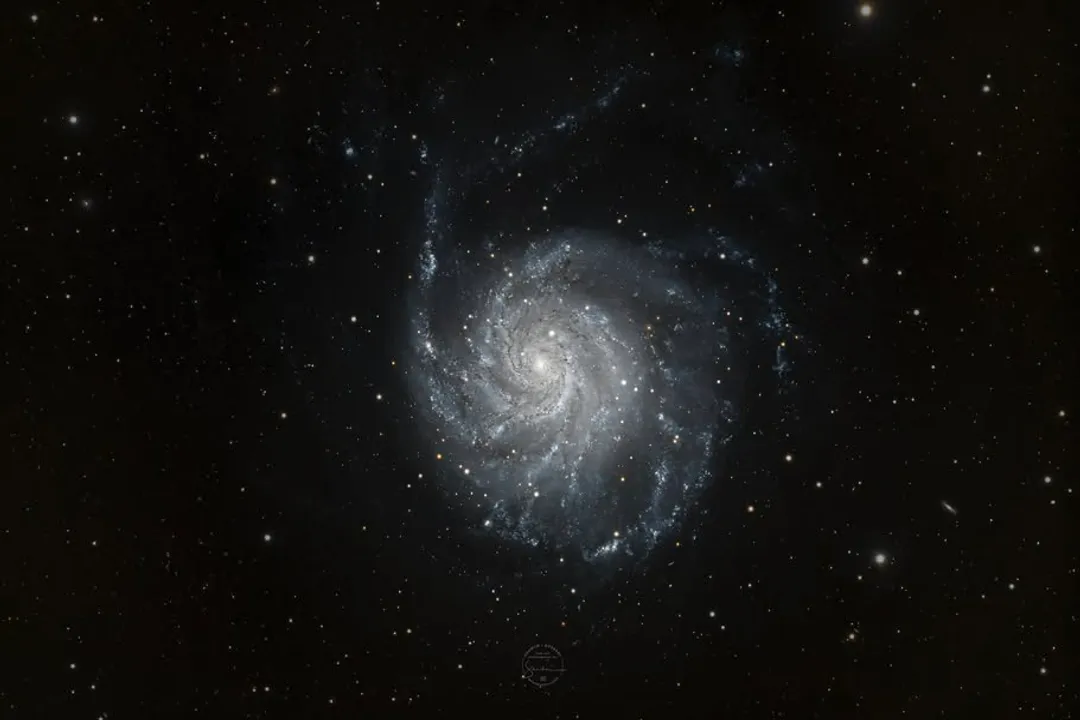
The Pinwheel Galaxy, , is one of the largest and most magnificent spiral galaxies visible from Earth, yet catching sight of it through modest optical aids presents a genuine challenge for backyard astronomers. For those who prefer the simplicity and portability of binoculars over setting up a telescope, the question often arises: can the grand spiral structure of actually be resolved, or at least detected, through a pair of handheld lenses? The answer leans heavily toward the latter, requiring exceptional conditions and a good deal of patience, even for experienced observers. [1][7]
# Galaxy Scale
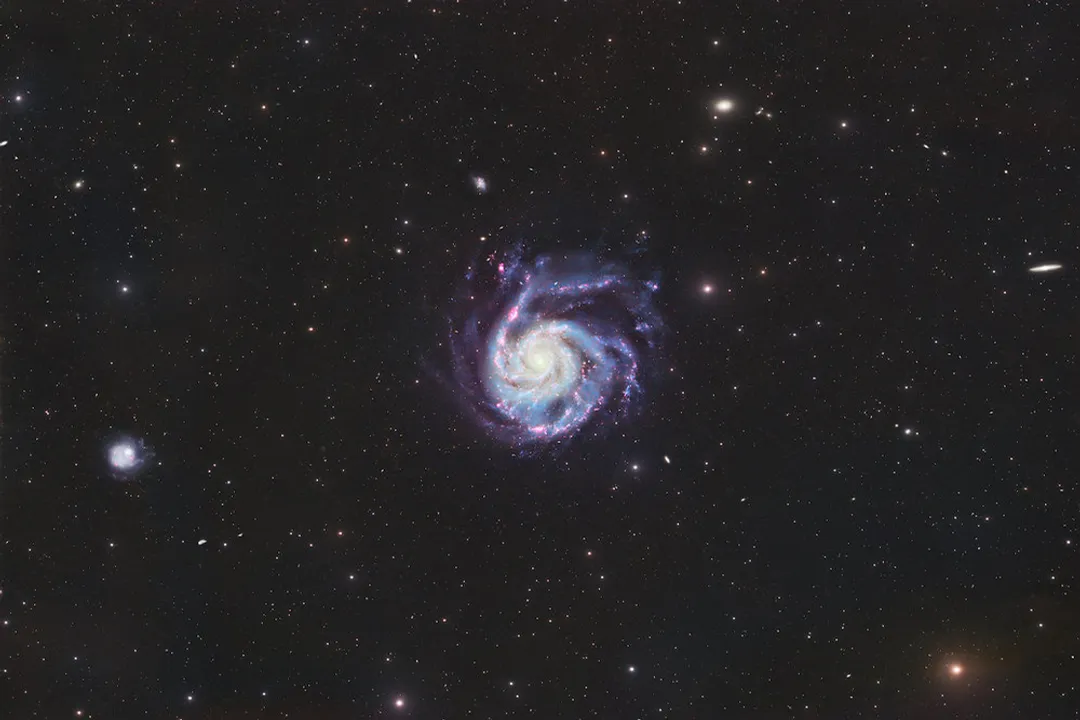
resides approximately million light-years away in the constellation Ursa Major, the Great Bear. [2][7] It earns its nickname, the Pinwheel Galaxy, because of its grand, face-on spiral structure, which is one of the largest known spirals in the local universe. [2] This orientation is key to its appearance; unlike galaxies viewed edge-on, where light is concentrated along a line, 's light is spread out over a vast area of the sky. [2]
Its sheer physical size is astounding, measuring about light-years across, making it significantly larger than our own Milky Way galaxy. [2] This large apparent size, however, is deceptive when considering visual observation. A galaxy's visibility depends not just on its size but on its integrated apparent magnitude, which is the total light collected from all its stars spread across that area. [7] has a visual magnitude hovering around to depending on the source or measurement technique, but the critical factor is its surface brightness. [7] Because its light is diffused over a large angular area—about arcminutes in diameter—the surface brightness is extremely low, making it a textbook example of a challenging extended object. [6]
# Binocular Limits
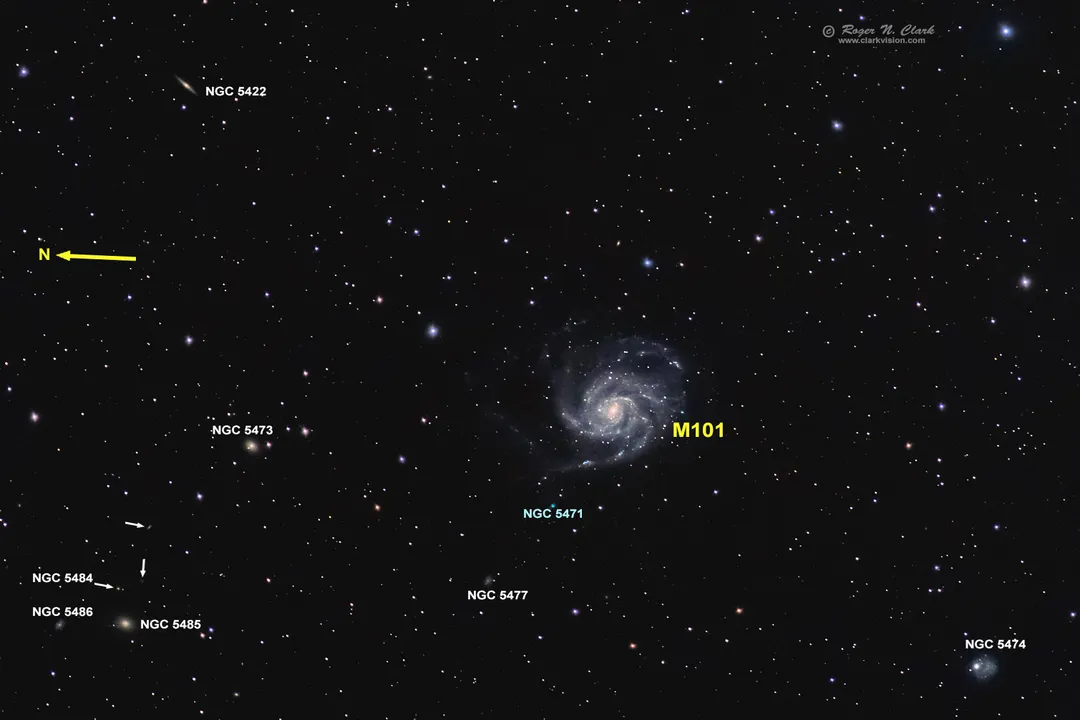
For typical backyard observers using standard binoculars, like an or pair, is generally not an easy target, and for many, it remains entirely invisible. [1][6] Binoculars excel at gathering light and presenting a wide field of view, which is excellent for star clusters or the brighter Andromeda Galaxy (). [6] However, when viewing faint, extended objects, the light-gathering power of binoculars is spread too thinly across the large apparent disk of to register as anything more than a faint, indistinct patch of sky glow, if that. [7]
The primary limitation stems from aperture and sky darkness. While a small pair of binoculars might show brighter galaxies like or () under moderately dark skies, 's low surface brightness puts it just beyond the reach of anything smaller than high-power, large-aperture binoculars, often specified as or even models. [1][6] Even with these larger instruments, what an observer might see is not the swirling pinwheel structure seen in long-exposure photographs, but perhaps a faint, elongated, greyish smudge against the black backdrop. [1] Finding this smudge requires near-perfect conditions and a very dark observing site.
It is helpful to frame this difficulty by comparing it to other common targets. is a naked-eye object under dark skies, boasting an integrated magnitude near . [6] , another spiral in the same general region of the sky, is usually listed around magnitude and is often considered the limit for good binoculars ( or in excellent skies). [6] At magnitude , is significantly fainter than , suggesting that if is a tough binocular target, is likely off the table for all but the most dedicated observers with the best portable equipment. [7]

# Locating The Quarry
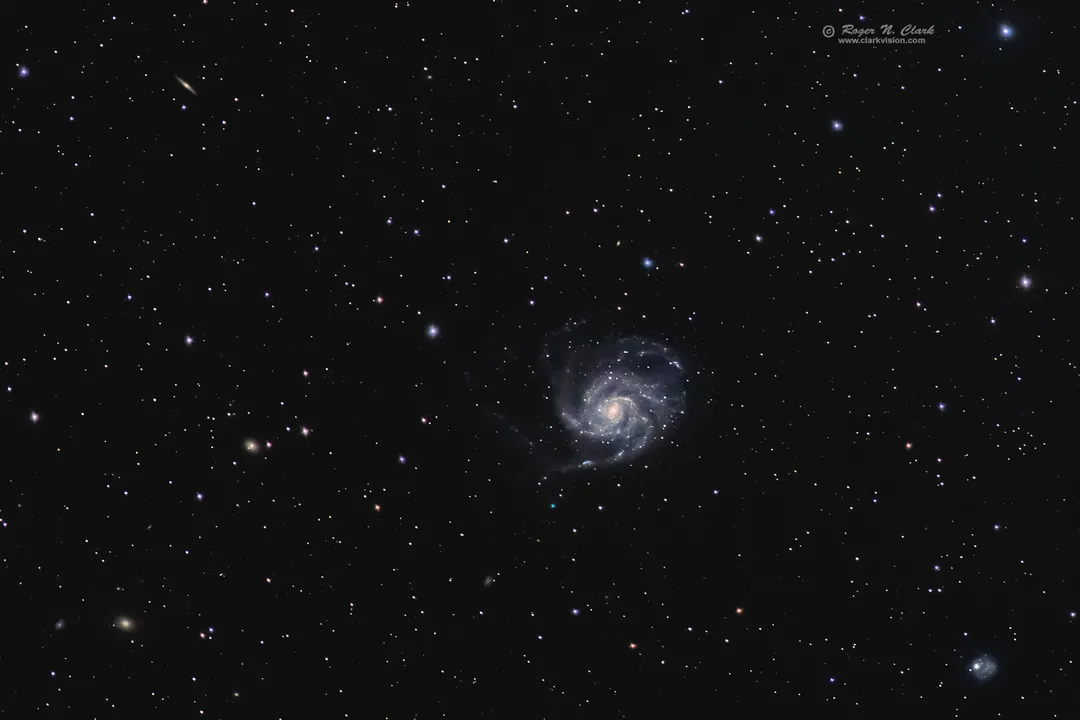
Success in spotting any deep-sky object relies on precise location, especially when the object itself is faint. Since binoculars offer a wide field but lower magnification, star-hopping techniques are essential to pinpoint 's location within Ursa Major. [1]
One established method involves using the handle of the Big Dipper. Starting from Alkaid (the star at the tip of the Dipper's handle), one traces a path roughly twice the distance between Alkaid and Mizar (the second star from the tip) towards the northwest. [1] This general direction leads the observer toward the galaxy's position. [1] Another common, though slightly less precise, set of directions suggests looking to the west of the asterism, between the stars and . [5] For those attempting to locate it with binoculars, it is wise to center the field of view on a slightly brighter star near the predicted location, then slowly scan the immediate surrounding area, allowing the eyes to adapt fully. [1]
When observing from a location with a high Bortle scale rating (meaning significant light pollution), the guide stars might be visible, but the faint glow of will be completely washed out, regardless of the magnification or aperture of the binoculars used. [6] The galaxy’s visibility is directly tied to the ambient darkness.
# Optimal Viewing Conditions
To give yourself any chance of detecting with binoculars, the observing environment must be as perfect as possible. This involves managing both celestial and terrestrial light sources. [6]
The moon is the most significant terrestrial factor. Even a quarter moon can severely hamper the observation of objects below magnitude . [6] Therefore, the ideal time to hunt for is during the new moon phase, or when the moon is well below the horizon. [1][6] Furthermore, the sky must be truly dark. Areas classified as Bortle Class or (truly dark rural skies, far from city lights) are necessary for these attempts. [6] If you live in an area with significant light pollution (Bortle Class or higher), the necessary faint contrast will simply not be available, even if you possess very large binoculars. [6]
Dark adaptation is another critical component. The human eye requires at least to minutes of exposure to complete darkness before its rod cells—the light-sensitive cells responsible for night vision—become fully operational. [1] During this period, one must avoid all bright light, including looking at a cell phone screen. Red light filters can preserve some night vision, but for the initial star-hopping location phase, absolute darkness is best. [1]
# Technique for Detection
Assuming one has dark skies and large, stable binoculars (like mounted on a tripod), the technique for seeing this faint galaxy shifts from simple looking to active visual searching. This is where an observer can gain an edge over just sweeping the sky aimlessly.
The trick is to use averted vision. [1] The center of the human eye, the fovea, is optimized for detailed color vision but is less sensitive to low light levels than the peripheral retina, where the rod cells are concentrated. [1] Instead of looking directly at the calculated position of , the observer should focus on a nearby, slightly brighter star just to the side of where the galaxy should be. Keep the averted vision trained on that reference star, and slowly let the faint glow of the galaxy drift into the sensitive, dark-adapted periphery of the eye. [1] If the galaxy is present, it might appear as a subtle, non-stellar puff of light that seems to vanish when you try to look straight at it.
A useful exercise for building this skill, which can be done before even attempting , is to locate the much fainter (the Smudge Galaxy, magnitude ) using a telescope first. If you can mentally map the appearance of a very faint, extended object in your peripheral vision with the telescope, you will be better prepared to recognize the same subtle signature from when viewing through binoculars under challenging conditions. This mental preparation—understanding what a "faint smudge" looks like versus a star—is as important as the optics themselves. [7]
If you are using a tripod-mounted pair of large binoculars, the image will be much steadier, which is crucial. Hand-holding even binoculars introduces slight tremors that can cause a very faint extended object to "swim" out of view, making detection impossible, especially if the object is only slightly above the absolute threshold of visibility. [6] Investing in a sturdy tripod or parallelogram mount is often the single greatest upgrade for observing faint targets with binoculars, far surpassing the gain from slightly larger lenses alone, simply because it eliminates motion blur against the background sky. [6]
# Beyond Binoculars
While the dedication required to see with binoculars is admirable, most astronomical resources agree that a rewarding, more certain view of this majestic spiral requires a telescope. [7] Even a modest reflector or refractor, often considered entry-level for serious deep-sky work, will usually reveal as a distinct, if still faint, oval patch under moderately dark skies. [7]
For the observer who has managed to detect with their binoculars—perhaps a pair under Bortle conditions—that experience should be recognized as a significant achievement in practical observational astronomy. It proves that the observer has mastered dark adaptation, found a superb dark site, and executed precise star-hopping techniques. [1] However, to truly appreciate the structure is famous for, one must eventually move to a telescope capable of gathering enough light to overcome that low surface brightness and reveal the galaxy's spiral arms, which often requires apertures of inches or more for good detail. [2]
In summary, seeing the Pinwheel Galaxy with standard binoculars ( or less) is highly improbable due to its low surface brightness, despite its large physical size. [7] Only in the darkest skies, using the largest portable binoculars ( or greater) mounted stably, and employing careful averted vision, might a dedicated observer manage to glimpse the faint, nebulous glow that marks the position of this distant island universe. [1][6]
Related Questions
#Citations
Finding M101 - the Pinwheel Galaxy - Binoculars - Cloudy Nights
M 101: The Pinwheel Galaxy - NASA Science
Star in Pinwheel Galaxy Just Went Supernova: How You Can See It
Pinwheel galaxy in northern sky - Facebook
Does the Pinwheel actually exist? - Getting Started With Observing
The PinWheel (M101)
M101 - The Pinwheel Galaxy | Astrophotography Tips and Pictures
The Pinwheel Galaxy M101 - ClarkVision Photograph
Why cant I find the pinwheel galaxy? : r/telescopes - Reddit