Who discovered that the Milky Way was not the only galaxy?

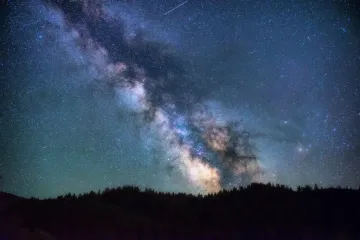
For centuries, the boundary of existence seemed pretty clear: the stars we saw scattered across the night sky were merely pinpricks of light embedded within our own vast collection of stars, the Milky Way. [6] This luminous band, stretching across the darkness, was considered the entirety of creation. This idea was a comfortable, established notion, but by the early 20th century, a few curious, fuzzy patches of light in the sky—the "spiral nebulae"—were beginning to challenge that cosmic certainty. [8] These objects, like the bright smudge known as Andromeda (M31), were the focus of intense scientific scrutiny and disagreement, setting the stage for one of the most profound re-evaluations of our place in existence. [8]
# Cosmic Question
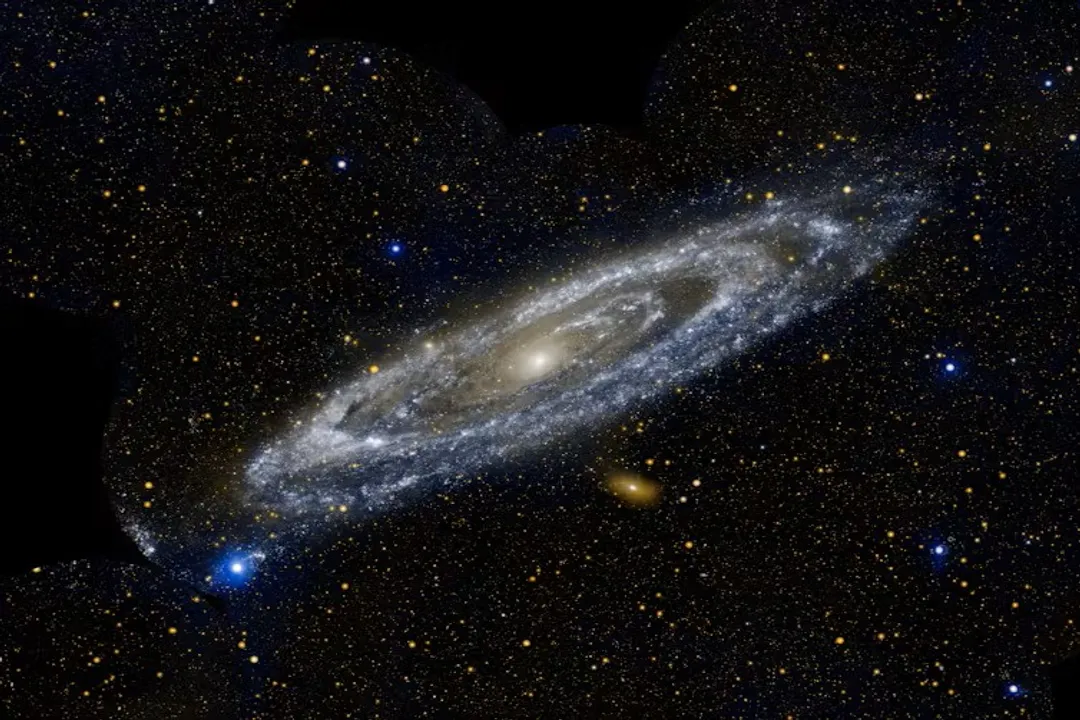
The early 1900s were marked by a scientific battle known as the Great Debate, centered precisely on the nature of these spiral nebulae. [8] On one side stood the belief that these smudges were relatively small gas clouds existing within the confines of our own Milky Way galaxy. [8] Proponents of this view, often including astronomers like Harlow Shapley, argued for a massive Milky Way that encompassed everything. [8] On the other side, astronomers like Heber Curtis posited that these nebulae were, in fact, entirely separate, island universes—galaxies in their own right, lying far outside the Milky Way’s edges. [8] The main hurdle was distance; without a reliable method to gauge how far away these nebulae were, the argument remained purely theoretical. [8] Edwin Hubble, an American astronomer, would bring the necessary observational muscle to finally settle this epochal dispute. [2][5]
# Hooker Telescope
The ability to resolve the question wasn't just about better theory; it required a significant technological leap in observational power. [1] The key instrument that unlocked the universe’s true scale was the massive 100-inch Hooker Telescope located at the Mount Wilson Observatory in California. [1][8][9] At the time, this was the world’s largest telescope, a behemoth capable of gathering enough light to resolve details previously invisible. [8] It was here, working at Mount Wilson, that Edwin Hubble began his meticulous work cataloging and measuring these enigmatic celestial bodies. [8][9] The sheer aperture of the 100-inch mirror provided the necessary sensitivity to detect the incredibly faint objects Hubble needed to find to make his calculations. [1]
# Cepheid Proof

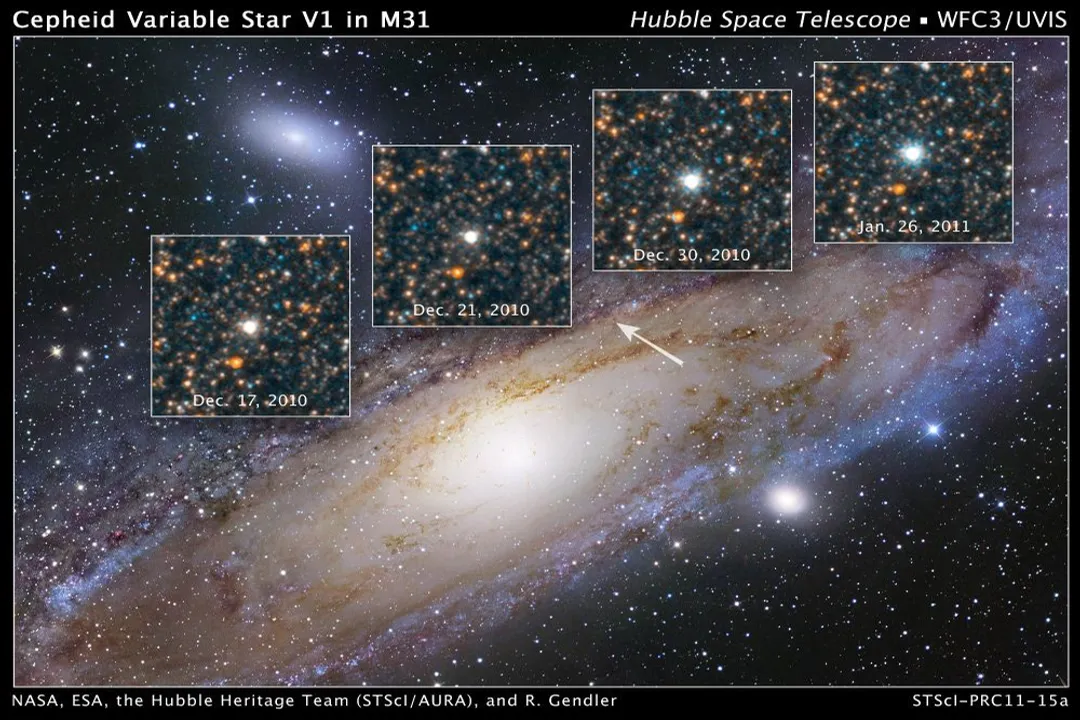
Hubble's breakthrough hinged on identifying a specific type of star within the Andromeda Nebula: Cepheid variables. [1][6] These stars are special because their luminosity—how bright they truly are—is directly related to the period of their brightness variation. [1][6] If you can measure how long it takes for the star to cycle from dim to bright and back, you know its absolute intrinsic brightness. [1] By comparing this absolute brightness to how faint it appears from Earth, astronomers can calculate its distance with remarkable accuracy. [1] This relationship, known as Henrietta Swan Leavitt's period-luminosity law, was the crucial tool. [1]
In a demonstration of exceptional observational skill, Hubble managed to spot and track these Cepheid variables within M31. [1] He announced his findings, which mathematically proved that Andromeda was far, far distant—so distant that it could not possibly be a small cloud inside the Milky Way. [6] The implication was immediate and staggering: Andromeda was an entirely separate galaxy, a massive collection of stars existing independently across the void. [3][6] His initial calculations suggested Andromeda was about 900,000 light-years away, though subsequent refinement would place it much farther, around 2.5 million light-years away. [1] What this meant was that our home galaxy, the Milky Way, was not alone; it was simply one island in a potentially infinite archipelago of galaxies. [3][4]
If we think about the measurement process itself, the feat is quite astonishing. Imagine trying to find a single candle flickering in a vast, dark stadium from miles away, and then needing to time its flickering rate precisely over weeks or months to determine its true wattage—that is the kind of measurement challenge Hubble overcame across millions of light-years. [9] This was more than just confirming Curtis's idea; it was a complete re-scaling of the known universe, moving it from a relatively confined neighborhood to an unimaginably immense cosmic ocean. [8]
# Universe Expands
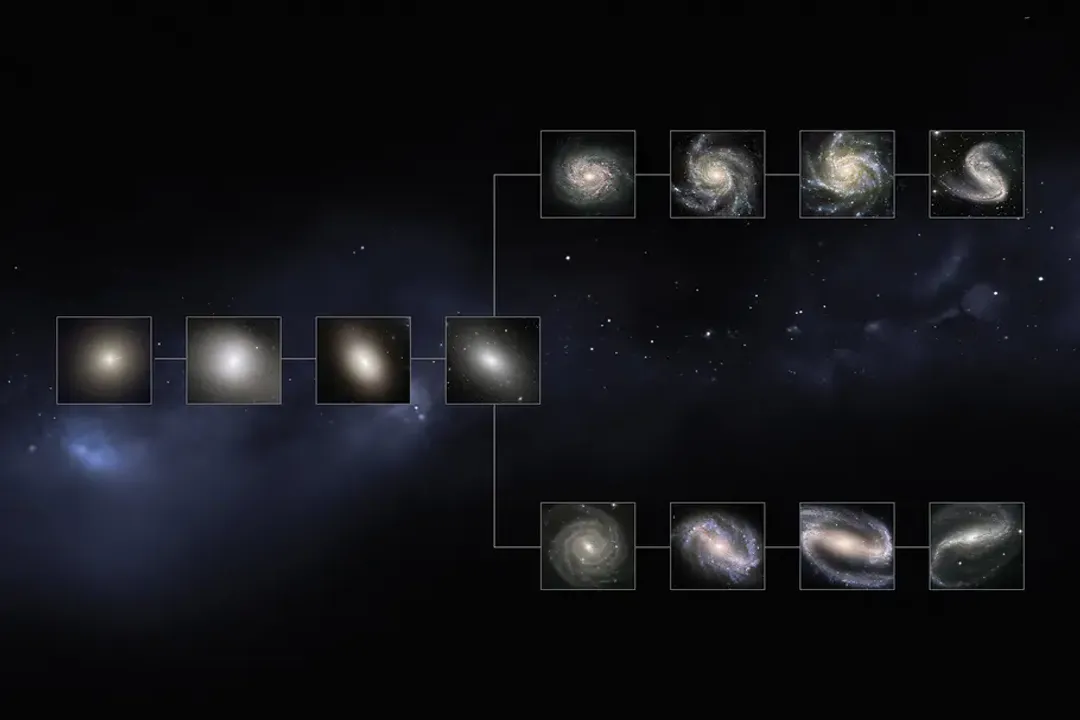
Hubble’s declaration that the Milky Way was not the sole galaxy fundamentally redefined cosmology. [2][5] The universe, previously thought to be static and relatively small, suddenly ballooned in perceived size. [3][4] This discovery provided the first observational evidence that what we observe is only a tiny fraction of reality. [3]
| Feature | Pre-Hubble Assumption | Post-Hubble Understanding |
|---|---|---|
| Universe Size | Limited to the Milky Way | Contains countless galaxies |
| Spiral Nebulae | Gas clouds within the Milky Way | Independent Island Universes |
| Andromeda Distance | Relatively close (within our galaxy) | Millions of light-years away |
This newfound perspective also set the stage for Hubble’s next major revelation, which built directly on the first. [2] Once he established the existence of other galaxies, he began measuring their distances relative to their recession velocity—how fast they were moving away from us. [2] This led directly to Hubble’s Law, demonstrating that virtually all galaxies are moving away from us, and the farther away they are, the faster they recede. [2] This observation, made possible by the initial realization that M31 was outside, provided the bedrock for the Big Bang theory. [2][3] In a sense, recognizing that Andromeda was a neighbor instead of a resident set the entire cosmos in motion in the minds of scientists. [8]
# Enduring Legacy
Edwin Hubble’s work remains a cornerstone of modern astronomy. [2] His initial proof, announced around 1924 and publicized widely later, transformed astronomy from a study of local celestial mechanics into a science of the structure and evolution of the cosmos. [1][6] He wasn't just identifying new objects; he was charting the very geography of existence, showing that our galaxy is merely a member of a vast collection called the Local Group, which itself is part of superclusters. [5]
The methods and realization persist today. Every time we view images from modern observatories, like the Hubble Space Telescope—named in his honor—we are seeing galaxies that Hubble first proved were out there. [3] His demonstration provided the foundational expertise needed for the entire field of extragalactic astronomy to flourish. [9] The simple, yet profound, realization that the night sky is populated by billions of other Milky Ways stands as one of the most significant paradigm shifts in human history, marking the moment we stopped looking at the edge of creation and started looking into the deep unknown. [4]
Related Questions
#Citations
100 years ago, Edwin Hubble proved our Milky Way galaxy isn't alone
Edwin Hubble - Wikipedia
NASA Celebrates Edwin Hubble's Discovery of a New Universe
100 years ago this week, Edwin Hubble announced his ... - Reddit
Edwin Hubble was an American astronomer who changed the way ...
The Milky Way isn't the only galaxy: 100th anniversary - EarthSky
Edwin Hubble, the astronomer who discovered there are galaxies ...
100 Years after the “Great Debate”: How Edwin Hubble Expanded ...
Who is the Man That Discovered the Universe?