Which way did the Earth tilt?

The way our planet is oriented in space is fundamental to life as we know it, dictating the rhythm of our years and the stark contrast between summer heat and winter cold. This orientation is defined by the Earth's axial tilt, an angle that measures roughly $23.5$ degrees relative to the perpendicular line of its orbit around the Sun. This inclination, often called obliquity, is the reason why the Sun appears higher in the sky during the summer months in one hemisphere and lower during the winter months. If the Earth sat perfectly upright, with zero tilt, we would experience very little seasonal variation; the Sun would always track the same path across the sky year-round in any given location.
# Defining Obliquity
The established tilt of approximately is not arbitrary; it is the measurement between the plane of the Earth's equator and the plane of its orbit, known as the ecliptic. To be precise, the current accepted value is often stated as . This angle defines the planet’s orientation relative to its orbital path. It is important to differentiate this from other movements. The Earth experiences precession—a slow, $26,000$-year wobble—which causes the North Star to change over vast timescales, but the axial tilt itself remains relatively stable over human lifespans. The tilt is what causes the significant, predictable seasonal changes based on which hemisphere is leaning toward or away from the Sun during the yearly revolution.
# Ancient Formation Impact

The initial, massive tilt that defines our planet’s orientation is believed to stem from an event in the very early history of the solar system. The most widely accepted scientific explanation points to a colossal collision—often referred to as the Giant Impact Hypothesis. This impact involved a Mars-sized protoplanet, sometimes named Theia, striking the early Earth. This catastrophic, oblique collision imparted a massive angular momentum to the Earth system.
Instead of striking dead-on, which might have resulted in a merger or complete reorganization that left the planet spinning upright, the glancing blow provided the necessary rotational energy and directional force to knock the entire planet sideways relative to its orbital plane. This single, violent event set the foundational tilt that drives our modern seasons. While other minor gravitational influences exist, the initial violent push from this impact event remains the primary source of the orientation.

# Orbital Plane
Understanding which way the Earth is tilted requires defining a reference frame. The most common reference frame is the ecliptic plane, which is the plane defined by the Earth's path as it circles the Sun. The axis points toward the celestial poles, and the angle between the axis and the plane perpendicular to the ecliptic is the tilt.
If one were to look at the solar system from "above" the Sun's north pole, the planets generally orbit in a relatively flat plane. Earth's axis is tilted away from the line that would be perpendicular to that plane. The direction of the tilt itself—the specific direction in space that the North Pole points—is currently aligned near the star Polaris, though this changes over millennia due to precession.
# Mass Redistribution Effects
While the initial tilt was set by ancient cosmic violence, the precise degree and direction of the spin axis are not perfectly static in the modern era. Minor, measurable changes are happening continuously due to the movement of mass across the planet's surface and interior. These modern adjustments are not reversing the tilt—that remains fixed by inertia from the ancient impact—but they cause the axis to drift slightly over decades.
These shifts occur because the Earth is not a perfectly rigid body; it behaves somewhat like a spinning top that wobbles slightly when weight is added or removed from one side compared to the other. When mass moves, the moment of inertia changes, requiring the axis of rotation to adjust to maintain equilibrium relative to the rest of the planet’s mass distribution. This means that the direction the axis points in space is currently shifting in response to these contemporary mass movements.

# Groundwater Influence
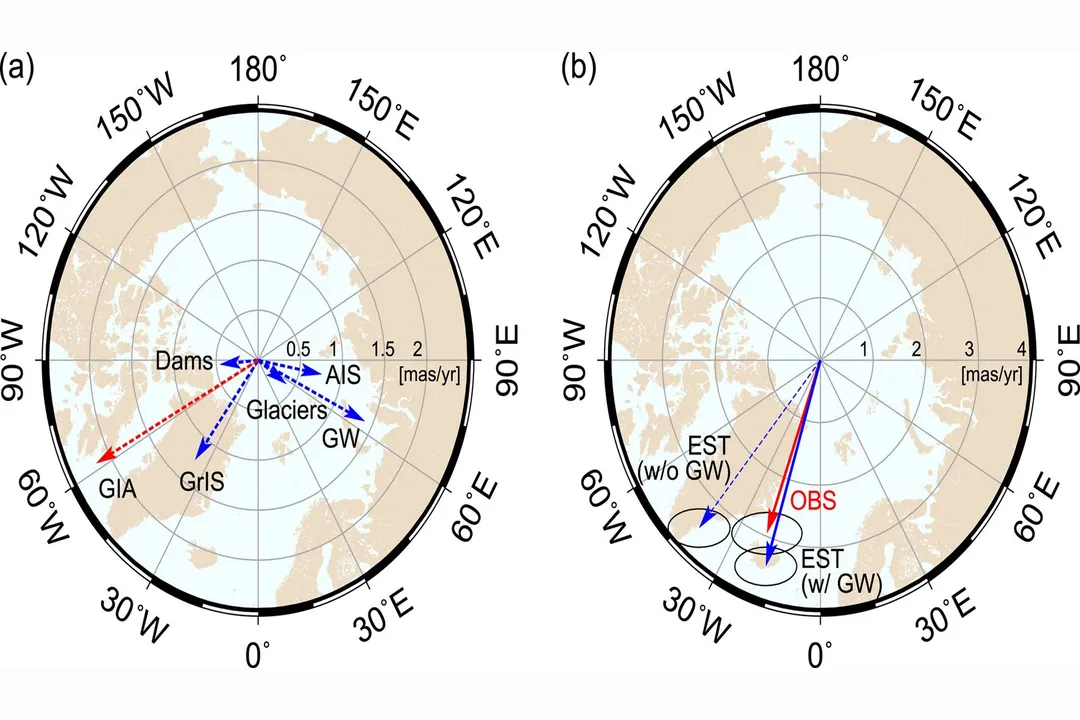
One of the most significant, quantifiable drivers of this modern axis shift over the past few decades has been the movement of water, specifically through large-scale human activities. Studies have shown that the massive extraction of groundwater for irrigation and consumption drastically alters the distribution of mass, particularly in areas like the northern mid-latitudes.
When vast quantities of water are pumped from underground aquifers and distributed onto the surface for agriculture, it effectively shifts mass from beneath the ground to the surface, changing the rotational dynamics. According to analyses, the movement of water between reservoirs, aquifers, and the ocean has caused the Earth's rotational axis to shift by several centimeters per year. For instance, between $1993$ and $2010$, pumping an estimated 1.5 trillion tons of water from land into the oceans resulted in a measurable shift of the rotational pole. This movement is directed toward the east, meaning the North Pole coordinate on the planet's surface is drifting slightly in that direction.
The scale of this modern drift is precise but tiny compared to the overall tilt. If we consider the total tilt of , this corresponds to an angle of about $84,600$ arcseconds from the perpendicular. The shift attributed to groundwater pumping, while measurable, amounts to only a few centimeters of displacement at the surface per year. To put that movement into context, if the axis moves $4.3$ centimeters per year eastward, that equates to the geographic North Pole’s location drifting by roughly $1.5$ meters every decade. This displacement is tracked using the very precise measurements provided by NASA's space-based GPS systems, the Global Positioning System.
# Other Mass Factors
While groundwater is a major contributor because of the sheer volume of water moved, other factors also influence the axis's subtle directional drift. Changes in glacial ice mass, particularly the melting of ice sheets in places like Greenland and Antarctica, contribute significantly to the redistribution of mass toward the equator. Climate change driving the melting of glaciers and ice caps essentially adds mass to the ocean basins, which affects the overall inertia tensor.
Furthermore, changes in the solid Earth itself—such as tectonic movements or post-glacial rebound (the slow rise of landmasses that were compressed by ancient ice sheets)—also play a role. These geological and climatological changes act in concert with human activity to determine the current, ever-so-slight path of the rotational axis. Scientists studying these effects can actually use the observed axis drift rates to estimate how much water mass has been moved between storage locations, demonstrating an interesting feedback loop between Earth science and resource management.
In essence, the answer to "which way did the Earth tilt" has two distinct parts: the direction and angle were set by a gigantic ancient impact that established the obliquity relative to the orbital plane. However, the modern directional drift of that axis—the subtle leaning that is currently being observed—is predominantly dictated by the redistribution of surface water, pushing the rotational pole slightly eastward.
#Videos
The Earths Tilt - YouTube
Related Questions
#Citations
Axial tilt - Wikipedia
ELI5: In which “direction” the Earth's axis tilted? : r/explainlikeimfive
Earth's Tilt on its Axis | Seasonal Changes & History - Study.com
Why Did Earth Tilt 31.5 Inches? - Popular Mechanics
NASA-Funded Studies Explain How Climate Is Changing Earth's ...
The Earths Tilt - YouTube
Axis - National Geographic Education
The Earth's axis has tilted 31.5 inches – but why? - Geographical
1.3. Earth's Tilted Axis and the Seasons | EME 811
Humans are pumping out so much groundwater that it's changing ...