scienceanswers.net
Home
/
Tags A-Z
/
A
/
accuracy
accuracy articles
How does DNA replication ensure accuracy?
What is the most accurate way to measure distance?
What distinguishes precision from accuracy?
Which enzyme is the first line of defense against replication mistakes due to its structural selectivity?
Approximately how often does DNA Polymerase incorporate the wrong nucleotide before dedicated repair mechanisms intervene?
What structural feature causes an incorrect base incorporated by DNA Polymerase to be less stable in the active site?
What is the name of the built-in corrective mechanism that acts as an immediate editor during replication?
What action does the $3'$ to $5'$ exonuclease activity perform when it detects an error?
By what factor does the $3'$ to $5'$ exonuclease proofreading step typically improve fidelity over the initial insertion rate?
What is the name of the final safety net system that scans DNA after the replication fork has moved on?
In *E. coli*, how does the Mismatch Repair (MMR) system identify which strand contains the error?
What is the approximate overall error rate achieved after the Mismatch Repair (MMR) system has corrected the remaining mistakes?
What state accelerates when the checkpoints ensuring DNA replication accuracy are compromised?
What common source of potential error affects distance readings taken with a standard retractable tape measure?
What principle do most laser distance measures commonly employ to calculate distances?
For measuring very small components requiring sub-millimeter resolution, which tools are generally superior to laser measures?
What practical technique minimizes uncertainty related to the hook's slack when measuring a long object with a tape measure?
What key feature distinguishes Electronic Distance Measurement (EDM) technology used in Total Stations for high-accuracy terrestrial surveying?
What must surveyors constantly account for when using EDM technology to maintain millimeter-level precision over kilometers?
For relatively nearby objects within our solar system, such as the Moon, what is the most accurate distance measurement method mentioned?
Which factor significantly limits the accuracy of distance measurements determined by trigonometric parallax for distant stars?
What fundamental difference exists in the nature of error between terrestrial EDM measurements and astronomical distances derived from standard candles?
What limits the accuracy of ultrasonic sensors used for measuring robot travel distance?
What does precision primarily measure regarding repeated measurements?
Accuracy in measurement fundamentally describes closeness to what value?
What is the relationship between high accuracy and bias?
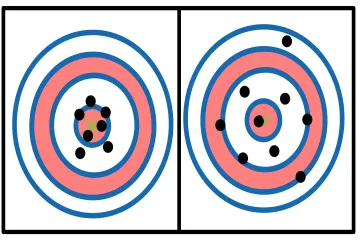
In the target analogy, what scenario represents low accuracy but high precision?
What type of error is typically attributed to measurements showing poor precision?
How is trueness technically defined in relation to systematic error components?
Which factor is a common cause of systematic error, leading to low accuracy?
If struggling with consistency across operational measurements, what procedural improvement should be prioritized first?
What distinguishes resolution from precision?
What metric integrates both the random scatter (imprecision) and the estimated systematic offset (bias) into a single budget?