According to the text, how much brighter can a typical giant star shine compared to our Sun?
Answer
10 to 1,000 times brighter
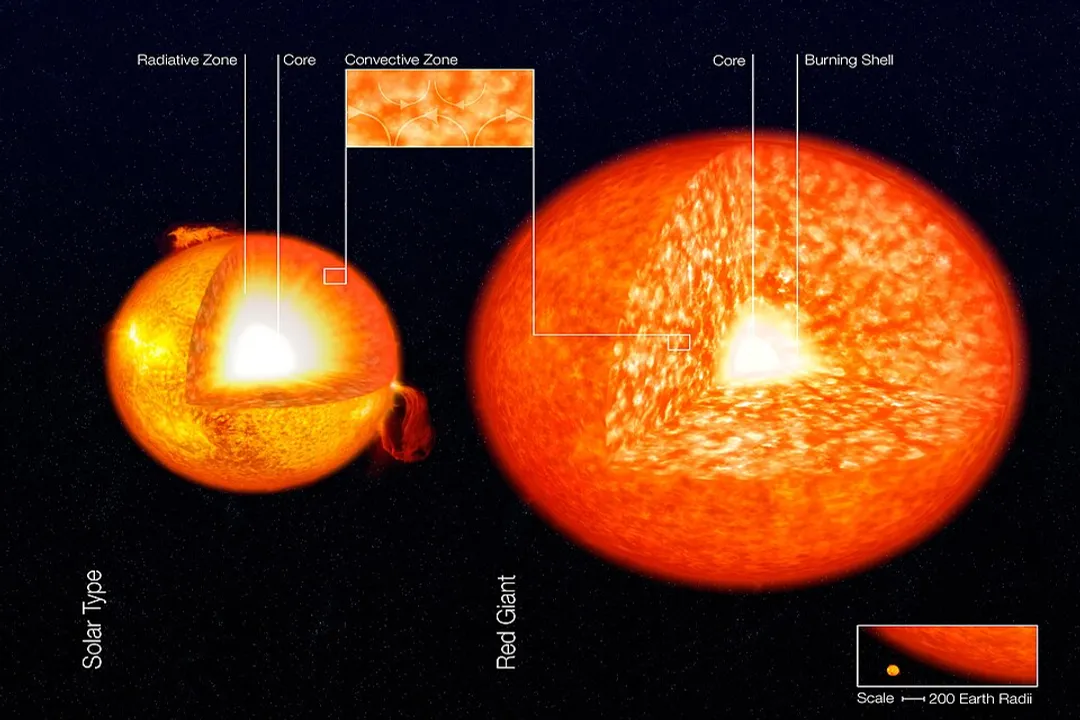
Typical giant stars are stated to shine anywhere from 10 to 1,000 times brighter than the Sun, though red supergiants can reach much higher outputs.
Related Questions
What primarily distinguishes a giant star from a dwarf star of the exact same surface temperature?According to the text, how much brighter can a typical giant star shine compared to our Sun?What internal event triggers a star like our Sun to evolve into a giant?What physical outcome results from the core contraction of an intermediate-mass star after hydrogen exhaustion?Why do red giants appear redder despite their high luminosity?In the Yerkes spectral classification system, what luminosity class do standard giant stars generally fall into?Which classification category represents stars that shine more powerfully than typical giants but are less luminous than a full supergiant?What governing physical law relates a star's total luminosity ($L$) to its radius ($R$) and surface temperature ($T$)?How does the primary energy generation mechanism affect luminosity rules when a star evolves off the main sequence?Why are giants significantly over-represented when counting stars visible in the night sky?