What determines if a star becomes a red giant or a supergiant?
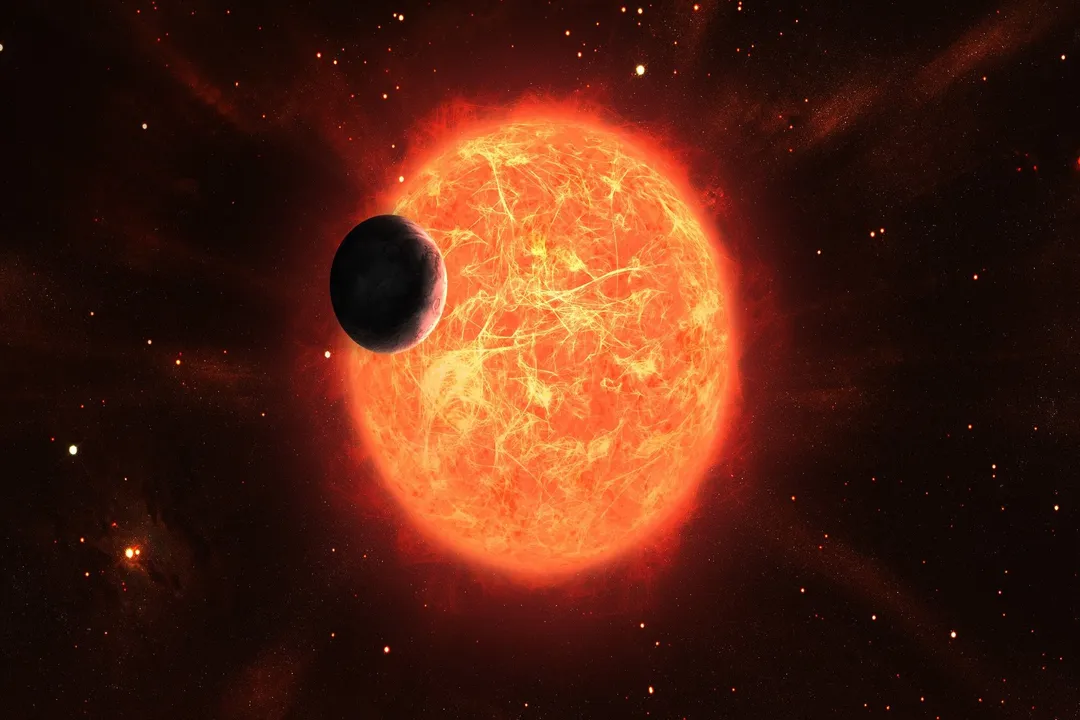
The destiny of a star, whether it swells into a moderate Red Giant or erupts into a colossal Red Supergiant, is not a matter of chance or atmospheric conditions; it is pre-written in its very first moments by a single, overwhelming factor: its initial mass. [1][6] When a star exhausts the primary fuel in its core—the hydrogen that has sustained it for eons—it begins to change dramatically. This transition marks the end of its main sequence life, setting it on a path toward expansion, but the degree of that expansion and its subsequent fate hinges entirely on how massive it was when it first formed from the stellar nursery cloud. [8]
# Birth Mass Matters
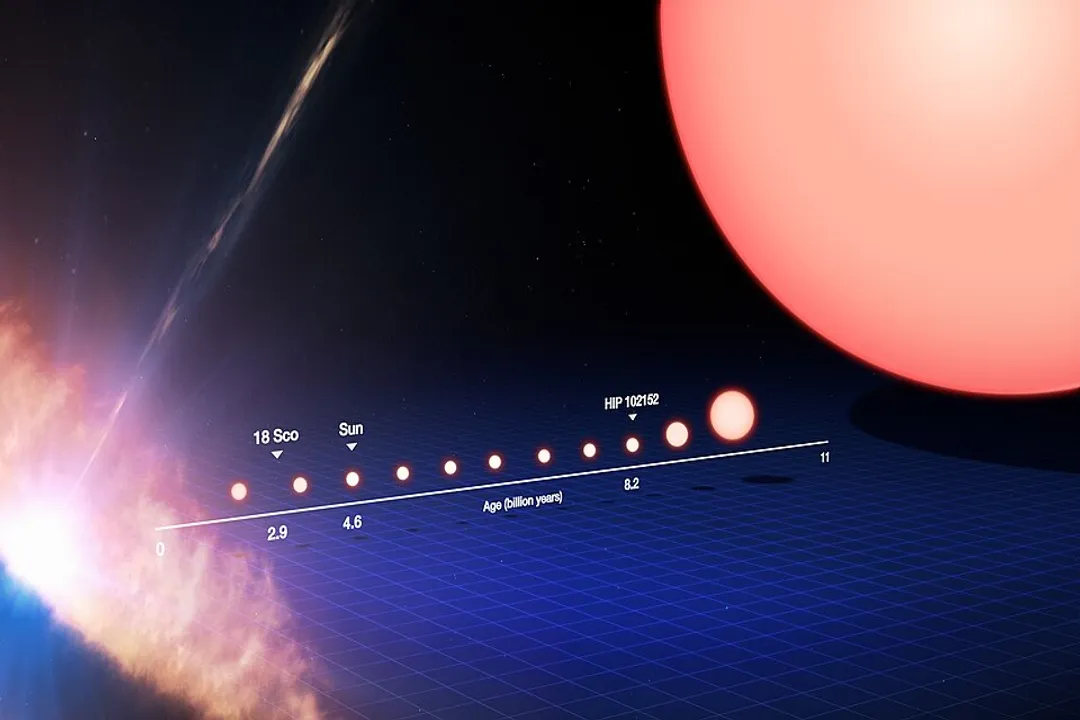
A star's life is a constant tug-of-war between the outward pressure generated by nuclear fusion in its core and the inward crush of its own immense gravity. [7] The more massive a star is at birth, the greater its gravitational force, meaning it must burn its nuclear fuel at an astonishingly higher rate just to maintain equilibrium. [7] This fundamental difference in fuel consumption rate dictates the entire evolutionary timeline and the eventual size the star will achieve when it leaves the main sequence. [1][6]
For relatively low- to intermediate-mass stars, those perhaps starting with masses between about $0.5$ and $8$ times that of our Sun (solar masses), the end-of-life expansion leads to the familiar classification of a Red Giant. [2][6] Our own Sun is destined for this path when it runs out of core hydrogen. [5][9]
In stark contrast, stars born with much greater heft, typically exceeding $8$ to $10$ solar masses, skip the Red Giant phase and instead balloon into Red Supergiants. [6] These objects are the true behemoths of the galaxy, capable of reaching diameters so vast that if one replaced our Sun, its outer layers would engulf the orbits of Mercury, Venus, Earth, and Mars, possibly even reaching Jupiter. [3]
# Giant Swelling
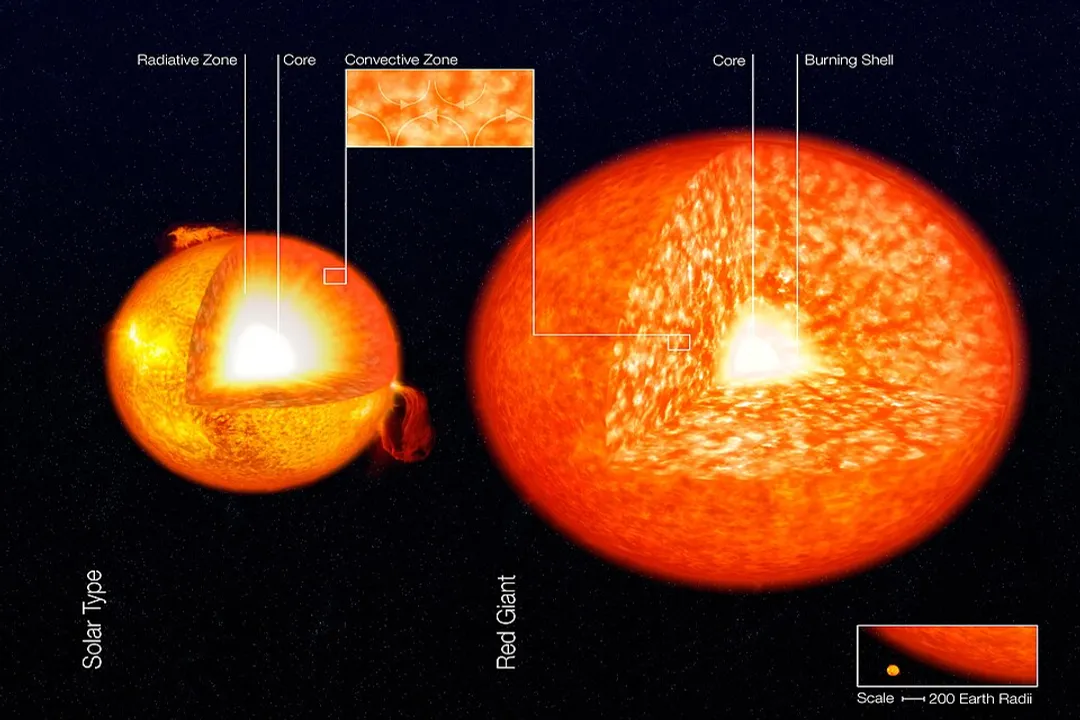
When an average main-sequence star depletes the hydrogen fuel at its center, the engine sputters to a stop in that region. [7] Without the outward pressure from fusion to counteract gravity, the inert helium core begins to contract under its own weight. [7] This gravitational compression heats the surrounding layers intensely. [5] This intense heat ignites a shell of hydrogen that lies outside the inert core, causing this shell to fuse furiously. [3][7]
This shell fusion burns hotter and faster than the previous core fusion ever did, driving the star's outer envelope to expand dramatically—sometimes to hundreds of times its original radius—while simultaneously cooling its surface, which causes the light to shift toward the red end of the spectrum. [5] This is the Red Giant phase. [2] During this stage, the star is enormous but relatively cool on its surface, offering a luminous, albeit less energetic, display compared to its earlier, hotter life. [5] For stars in the $0.5$ to $8$ solar mass range, this process is relatively orderly, leading to the next stage, which may involve helium ignition in the core, often called the helium flash, before eventually shedding its outer layers to form a white dwarf. [2]
# Supergiant Expansion
The story is far more dramatic for the high-mass stars that become Red Supergiants. [3] They also exhaust their core hydrogen, leading to core contraction and shell burning, just like their smaller cousins. [7] However, because their initial gravity is so much stronger, the contraction phase creates far higher temperatures and pressures in the core and surrounding layers. [6]
The scale of expansion in a Red Supergiant dwarfs that of a Red Giant. [3] While a Red Giant might swell to a few hundred solar radii, a Red Supergiant can swell past $1,000$ solar radii. [3] Antares, a famous example, is a classic Red Supergiant. [3] These massive stars fuse heavier and heavier elements in their cores sequentially—carbon, neon, oxygen, silicon—until they eventually form an iron core, which cannot produce energy through fusion. [1][8] The sheer energy released during these successive fusion stages in the shells drives the star to truly monstrous dimensions. [3]
# Delineation Of Scale
The difference between the two evolutionary paths can be summarized quite starkly by looking at the initial mass boundaries, even though the exact cutoff mass can vary slightly depending on the star's metallicity and rotation rate. [6]
| Stellar Type | Initial Mass (Solar Masses) | Final Remnant (Typical) |
|---|---|---|
| Red Giant | to $8$ | White Dwarf [2] |
| Red Supergiant | $> 8$ (often $> 10$) | Neutron Star or Black Hole [1][8] |
The critical difference between a star that becomes a giant and one that becomes a supergiant comes down to whether the star has enough mass left after its main sequence to initiate the fusion of heavier elements after the hydrogen shell burning phase. A star below the critical threshold ($>8$ solar masses) will run out of the necessary gravitational pressure to ignite carbon fusion in its core and will gently shed its layers. [2] A star above that threshold possesses the heft to force subsequent fusion reactions, leading to the greater, longer-lived expansion we call a supergiant phase. [8]
Consider the sheer rate of energy production: A star destined to be a Red Giant might only produce energy at a rate of a few hundred times that of the Sun. [5] A Red Supergiant, however, can be intrinsically hundreds of thousands of times brighter than the Sun, pouring out immense radiation that physically inflates its outer layers to incredible volumes. [3] It's not just about being bigger; it's about the power driving the expansion.
# Physics Of Expansion
To truly appreciate the size difference, one needs to understand the structure shift. When a low-mass star enters the Red Giant phase, the core contracts, and the hydrogen-burning shell acts as the primary heat source pushing the envelope outward. [7] This transition is relatively smooth in terms of the type of fuel being burned just outside the core. [2]
For a Red Supergiant, the internal engine is far more complex. After hydrogen burning, the core collapses until it’s hot enough to fuse helium into carbon and oxygen. Once that fuel is gone, the core contracts again, hot enough this time to fuse carbon, and so on, building an "onion-skin" structure of different burning shells. [1][8] Each successful fusion of a heavier element provides a temporary reprieve from collapse, resulting in a massive, temporary increase in luminosity and, consequently, a massive inflation of the outer layers. The star becomes so loosely bound that a slight imbalance in radiation pressure versus gravity can cause colossal ejections of mass. [3]
This continuous addition of heavier fusion stages provides a layer of physical insight often missed: the Red Giant phase represents a star adjusting to the loss of its first major fuel source (core hydrogen), whereas the Red Supergiant phase represents a star managing the catastrophic failure of multiple core fusion stages, each one leading to a larger, more unstable envelope structure. The resulting size disparity reflects the number of energy-generating layers the star can maintain before iron halts the process entirely. [8]
# Lifespan Differences
While not directly determining if it becomes a giant or supergiant, the initial mass profoundly affects the duration of these phases, which is a valuable point for comparison. A Red Giant phase, for a Sun-like star, lasts for a significant portion of its total post-main-sequence life, perhaps hundreds of millions of years for Sun-like stars before evolving further toward a white dwarf. [2]
Conversely, the Red Supergiant phase is often relatively brief on a cosmic timescale for the most massive stars. Their sheer energy output means they burn through the successive fuel supplies—hydrogen, helium, carbon, etc.—at a furious pace. [1] They might spend less than a million years as a Red Supergiant before the iron core forms and triggers a catastrophic collapse, culminating in a supernova explosion. [8] This difference in longevity is another measurable consequence of the initial mass distribution. If you could somehow observe a billion stars, you would find far more Red Giants lingering than Red Supergiants, simply because the latter are burning through their existence much faster. [1] This is a tangible demonstration of the "live fast, die young" principle applied to stellar physics, directly tied to that initial birth mass measurement.
Ultimately, the decision between becoming a gentle, though expanded, Red Giant or a terrifying, sprawling Red Supergiant is made the moment the star ignites. The mass sets the pressure, the pressure sets the temperature, and the temperature dictates which nuclear reactions can occur, thereby charting the course for the star's final, swollen chapter. [6][7]
#Videos
How Do Stars Become Red Giants Or Supergiants? - Physics Frontier
#Citations
Stellar Evolution - | The Schools' Observatory
Red giant - Wikipedia
How do we know red supergiants like Antares and Betelgeuse aren't ...
How Do Stars Become Red Giants Or Supergiants? - Physics Frontier
Red Giant - ESA/Hubble
What determines the size of a star? Why do some stars become red ...
Why do stars become red giants? - Astronomy Stack Exchange
The Life Cycles of Stars: How Supernovae Are Formed
Red giant stars: Facts, definition & the future of the sun - Space