Which metal hydroxides are explicitly named as common examples of amphoteric substances?
Answer
Aluminum ($ ext{Al}( ext{OH})_3$), chromium ($ ext{Cr}( ext{OH})_3$), zinc ($ ext{Zn}( ext{OH})_2$), and lead ($ ext{Pb}( ext{OH})_2$).
The text lists the hydroxides of aluminum, chromium, zinc, and lead as common examples of sparingly soluble compounds that exhibit amphoterism.
Related Questions
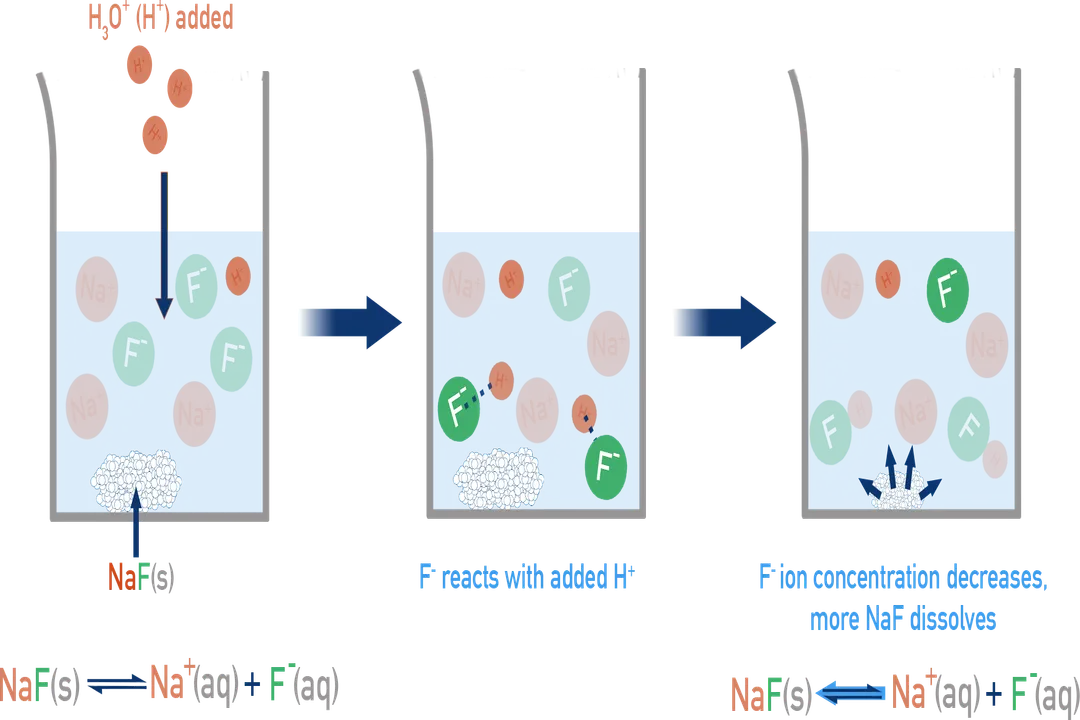
What general condition must be met for the pH of a solution to significantly alter a salt's solubility?How is the solubility of sodium chloride ($ ext{NaCl}$) affected by changes in the solution's $ ext{pH}$?When acid ($ ext{H}^+$) is added to calcium fluoride ($ ext{CaF}_2$), what primarily happens to the fluoride ions ($ ext{F}^-$)?For a salt containing an anion that is the conjugate base of a weak acid, what drives increased dissolution upon lowering the $ ext{pH}$?In a basic solution, how does the solubility of ammonium chloride ($ ext{NH}_4 ext{Cl}$) increase?What characteristic describes the solubility curve of metal hydroxides that exhibit amphoterism when solubility is plotted against $ ext{pH}$?Which metal hydroxides are explicitly named as common examples of amphoteric substances?At low $ ext{pH}$, how does the dissolution of an amphoteric hydroxide like $ ext{Al}( ext{OH})_3$ proceed?What is the mechanism causing increased solubility of amphoteric hydroxides in highly basic solutions (high $ ext{pH}$)?If $ ext{Salt A}$ ($ ext{MCl}$) and $ ext{Salt B}$ ($ ext{MF}$) share the same $K_{sp}$, how does their solubility compare in an acidic $ ext{pH}$ environment?