If $ ext{Salt A}$ ($ ext{MCl}$) and $ ext{Salt B}$ ($ ext{MF}$) share the same $K_{sp}$, how does their solubility compare in an acidic $ ext{pH}$ environment?
Answer
$ ext{Salt B}$ solubility will be significantly increased, while $ ext{Salt A}$ solubility will be unaffected.
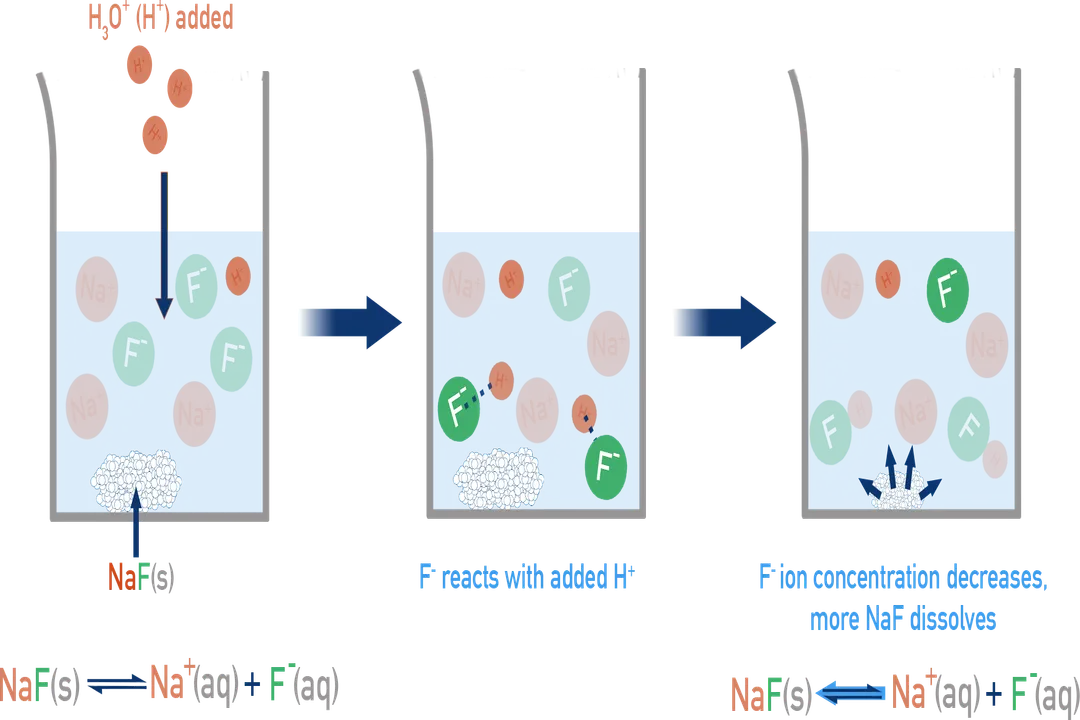
Since $ ext{Cl}^-$ is the conjugate base of a strong acid, it does not react with $ ext{H}^+$. $ ext{F}^-$, being the conjugate base of a weak acid, reacts readily with $ ext{H}^+$, causing the solubility of $ ext{Salt B}$ to increase significantly compared to $ ext{Salt A}$.
Related Questions
What general condition must be met for the pH of a solution to significantly alter a salt's solubility?How is the solubility of sodium chloride ($ ext{NaCl}$) affected by changes in the solution's $ ext{pH}$?When acid ($ ext{H}^+$) is added to calcium fluoride ($ ext{CaF}_2$), what primarily happens to the fluoride ions ($ ext{F}^-$)?For a salt containing an anion that is the conjugate base of a weak acid, what drives increased dissolution upon lowering the $ ext{pH}$?In a basic solution, how does the solubility of ammonium chloride ($ ext{NH}_4 ext{Cl}$) increase?What characteristic describes the solubility curve of metal hydroxides that exhibit amphoterism when solubility is plotted against $ ext{pH}$?Which metal hydroxides are explicitly named as common examples of amphoteric substances?At low $ ext{pH}$, how does the dissolution of an amphoteric hydroxide like $ ext{Al}( ext{OH})_3$ proceed?What is the mechanism causing increased solubility of amphoteric hydroxides in highly basic solutions (high $ ext{pH}$)?If $ ext{Salt A}$ ($ ext{MCl}$) and $ ext{Salt B}$ ($ ext{MF}$) share the same $K_{sp}$, how does their solubility compare in an acidic $ ext{pH}$ environment?