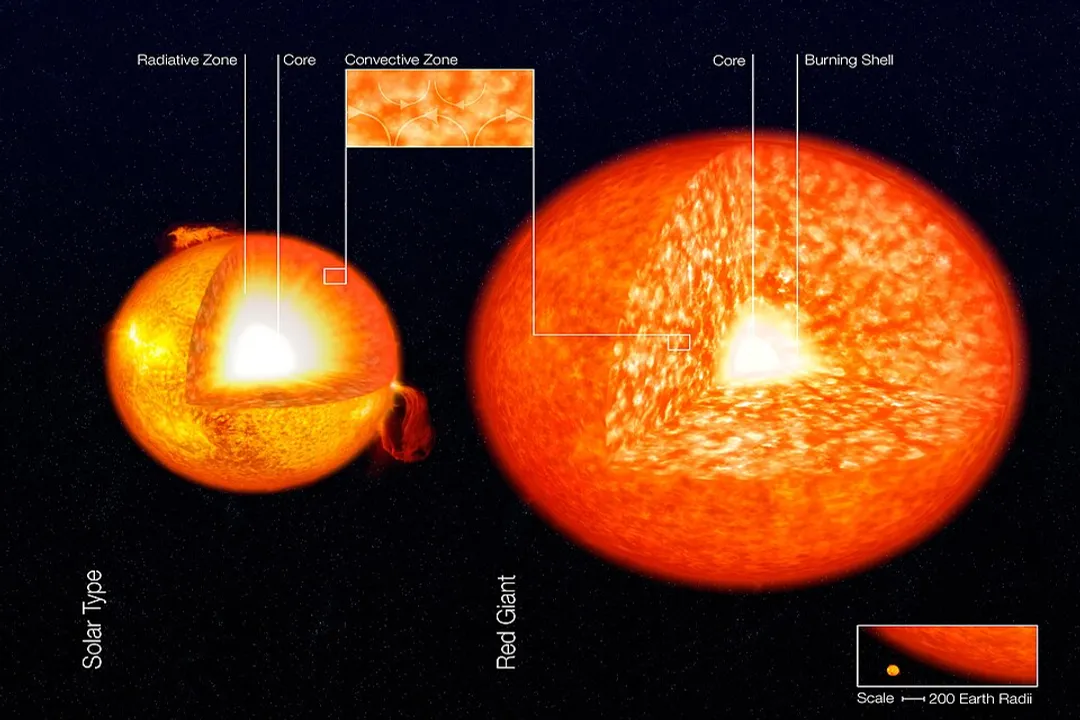
For a star similar in mass to the Sun, approximately how much can its total luminosity increase upon becoming a Red Giant?
Answer
By a factor of 1,000 to 10,000.
The text specifies that for a star like the Sun, the transition to a red giant can increase its luminosity by a factor ranging from 1,000 to 10,000 times its former output.
#Videos
How Do Main Sequence Stars Differ From Red Giants? - YouTube
Related Questions
What maintains the stable equilibrium of a star, like our Sun, while it is on the Main Sequence?What is the immediate trigger for the dramatic expansion of a Sun-like star into a Red Giant?According to the Stefan-Boltzmann Law, what causes the Red Giant phase to be vastly more luminous than the Main Sequence star?What causes the surface color of an evolved star to shift toward the red end of the spectrum?For a star similar in mass to the Sun, approximately how much can its total luminosity increase upon becoming a Red Giant?What is the primary difference in the mechanism driving energy output between a Main Sequence star and a Red Giant?Which class of stars evolves into the even grander objects known as Red Supergiants?What physical concept distinguishes between 'flux' and 'luminosity' in stellar physics?What governs the visual color of a star, linking it directly to its surface temperature?What astronomical phenomenon allows astronomers to observe Red Giants in distant galaxies across cosmological distances?What is the approximate radius change a Sun-like star experiences when expanding into a Red Giant?