Why do stars evolve off the main sequence?
Stellar Adulthood
A star spends the vast majority of its existence in a stable, predictable phase known as the main sequence. [10] This period represents stellar adulthood, a long stretch where the object maintains a relatively constant temperature and luminosity, appearing as a distinct band running diagonally across the Hertzsprung-Russell (H-R) diagram. [1] Our own Sun is currently in the middle of its main-sequence life, having been there for about four and a half billion years. [2] This stability isn't accidental; it is the direct result of a delicate, long-term balance within the star's interior, a condition called hydrostatic equilibrium. [5] For every star, regardless of its eventual fate, the reason for leaving this comfortable phase boils down to one inescapable astronomical fact: the primary fuel source in its core eventually runs out. [3][4][5]
Core Engine
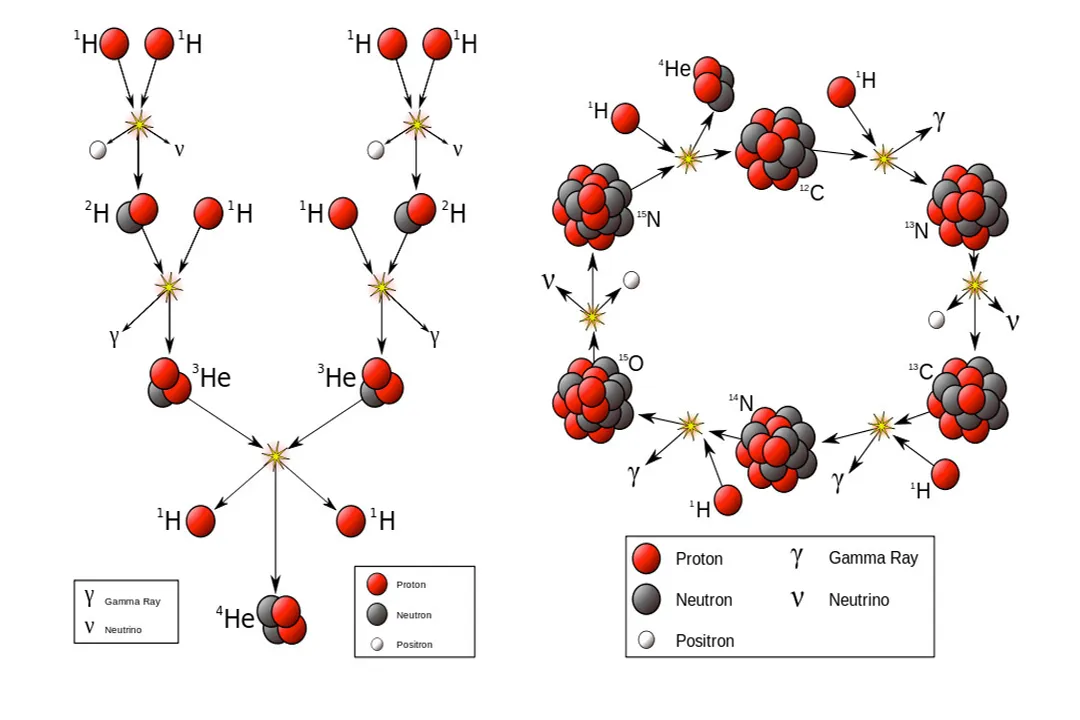
During the main-sequence phase, the star's internal furnace is running exclusively on hydrogen fusion occurring in the very center of its structure. [1][4] In this intensely hot and dense core, four hydrogen nuclei are converted into one helium nucleus, a process that releases immense amounts of energy via the proton-proton chain or, for more massive stars, the CNO cycle. [1] This outward pressure generated by the fusion energy precisely counteracts the inward crushing force of the star's own gravity. [5] This balance is what keeps the star stable, maintaining a consistent size and surface temperature for millions or billions of years, depending on its initial mass. [10]
Hydrogen Ends
The process of core fusion is finite. As time passes, the hydrogen atoms in the core are slowly but surely converted into inert helium "ash". [3][6] Because the helium nucleus has two protons and two neutrons, it does not fuse under the relatively moderate temperatures found in the core of a star like the Sun at this stage. [6] Eventually, a point is reached where the core consists almost entirely of this non-fusing helium, and the primary hydrogen fusion reaction in the center grinds to a halt. [3][5] This marks the definitive end of the main-sequence life for that star. [4] The duration of this phase is inversely related to mass: hotter, more massive stars burn through their core hydrogen supply much faster—perhaps in only a few million years—while a lower-mass star like the Sun is expected to remain on the main sequence for about ten billion years. [10][1]
Gravity Wins
With the central energy source extinguished, the primary outward pressure supporting the star vanishes instantly in the core region. [6] Gravity, which is relentless, takes over, and the inert helium core begins to contract under its own immense weight. [3][5] This gravitational collapse is a dramatic event, although it happens internally and is not immediately obvious at the surface. [6] As the core shrinks, its density and temperature increase sharply. [5]
Shell Fusion
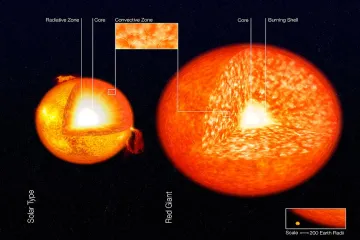
The increased pressure and temperature in the collapsing core acts like a cosmic bellows, heating the layer of fresh, hydrogen-rich gas surrounding the helium core to the point where fusion ignites there. [3][6] This process is known as shell hydrogen burning. [6] This shell fusion is often far more energetic than the core fusion that preceded it. [3] A star that previously generated energy steadily from a confined central volume is now generating a sudden surge of power from a thin shell encircling a dead core. [6]
Giant Swell
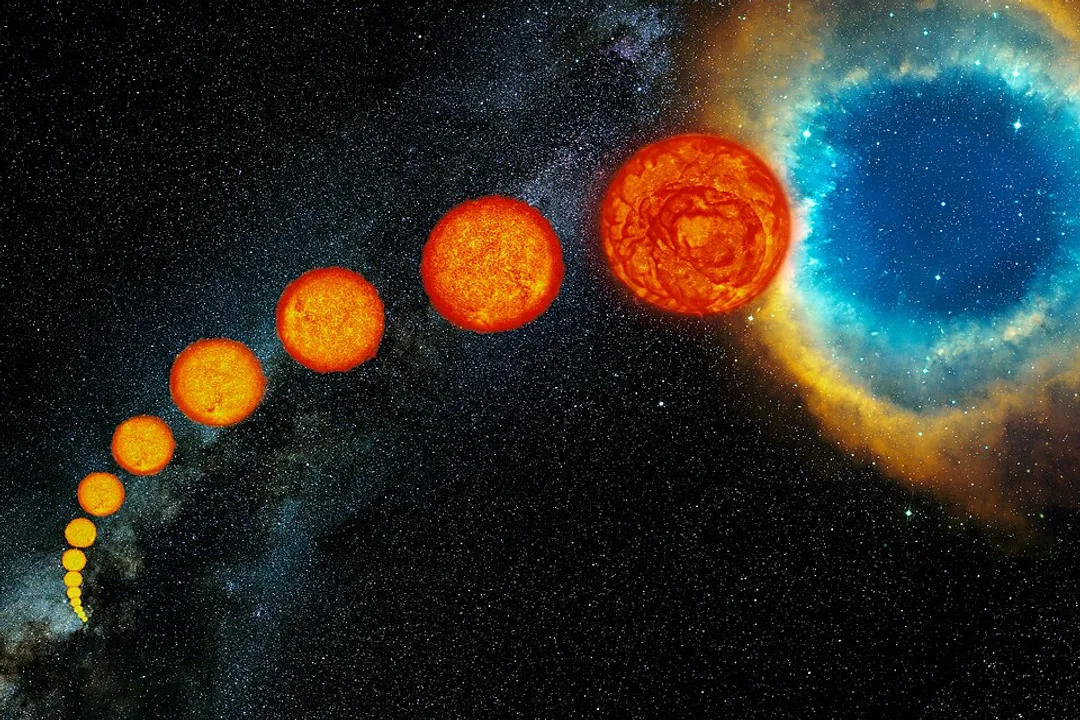
This intense, new burst of energy pours outward, dramatically overwhelming the star's previous equilibrium. [3] The outer layers, now being heated much more intensely, begin to expand rapidly and cool down. [3][6] For a star with the Sun's mass, this expansion is staggering; the radius can increase by a factor of one hundred or more, and the surface temperature drops significantly, causing the star to shift in color toward the red end of the spectrum. [3] The star has evolved off the main sequence and onto the path leading to the red giant branch. [1][10]
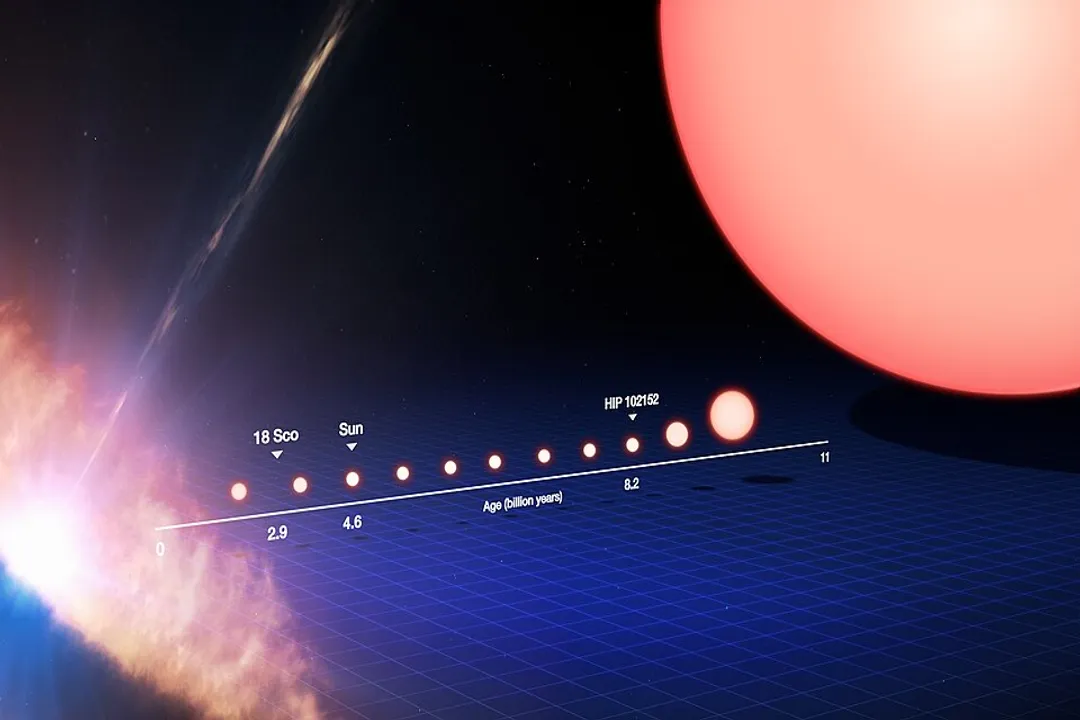
It is instructive to compare the star’s aging process while on the main sequence versus the dramatic leap off it. For the Sun's first four billion years, its luminosity increased by only about 30%. [6] This slow climb is barely noticeable over geological timescales. However, once core hydrogen is depleted, the expansion into a red giant phase can occur relatively quickly—over a few hundred million years—and results in a luminosity increase by a factor of thousands. [10] This highlights that the transition point—the moment core fuel runs out—is the fundamental switch that changes the star’s entire mode of operation, moving it from a slow burn to a rapid overhaul of its entire structure.
Stellar Mass
The star's initial mass is the single most important factor determining how it leaves the main sequence and what its subsequent life stages will look like. [10] While the general pattern is hydrogen depletion leading to shell burning and expansion, the specifics vary widely:
- Sun-like Stars (Low to Intermediate Mass): After leaving the main sequence, these stars swell into red giants. [3] Once the helium core reaches a critical temperature (around 100 million Kelvin), helium fusion into carbon and oxygen can begin, often igniting explosively in a helium flash for stars near solar mass. [1][5] This new core fusion allows the star to settle briefly into a horizontal branch phase before continuing its evolution toward a white dwarf. [1]
- Massive Stars (Greater than about 8 Solar Masses): Stars significantly heavier than the Sun do not experience a gentle transition. Their gravity is so immense that core contraction heats the core past the ignition point for heavier elements much more quickly. [10] They proceed rapidly through a series of burning shells—helium, then carbon, neon, oxygen, and silicon—building up an inert iron core. [10] This sequence happens incredibly fast, sometimes taking only a few million years in total for the star's entire active life. [10] The fate of these stars is a Type II supernova, which fundamentally alters the stellar remnant. [10]
In essence, a star is forced off the main sequence because the universe mandates that chemical reactions must conserve mass and energy, and the easiest, most stable reaction—core hydrogen fusion—is a temporary state. [5] The star does not "decide" to evolve; it is mechanically forced to change its energy source and structure when its primary fuel reservoir in the core is exhausted. The entire process is a cascading response to that initial chemical failure, where gravity, having been held at bay, forces the star to fuse progressively heavier elements at ever-higher temperatures to maintain some level of hydrostatic support. [5] The star is perpetually seeking the next, higher-energy nuclear reaction that can sustain the immense weight pressing down upon it.

#Citations
Main sequence
Star Basics
Stellar Evolution
Why does a star like the Sun leave the main sequence?
The Origin, Structure, and Evolution of the Stars
Why do main sequence stars get bigger and more ...
11: Birth of Stars to Main Sequence Stage
Stellar Evolution: Main Sequence
Main Sequence Stars: Definition & Life Cycle