If an astronomer calculates a minimum mass for an unseen companion that exceeds $3 M_ ext{sun}$, what is strongly suggested about that unseen object?
Answer
It is likely a black hole
Since the maximum mass for a neutron star is thought to be around 2 to $3 M_ ext{sun}$, a calculated lower mass limit exceeding this threshold suggests the unseen object must be more massive, indicative of a black hole.
Related Questions
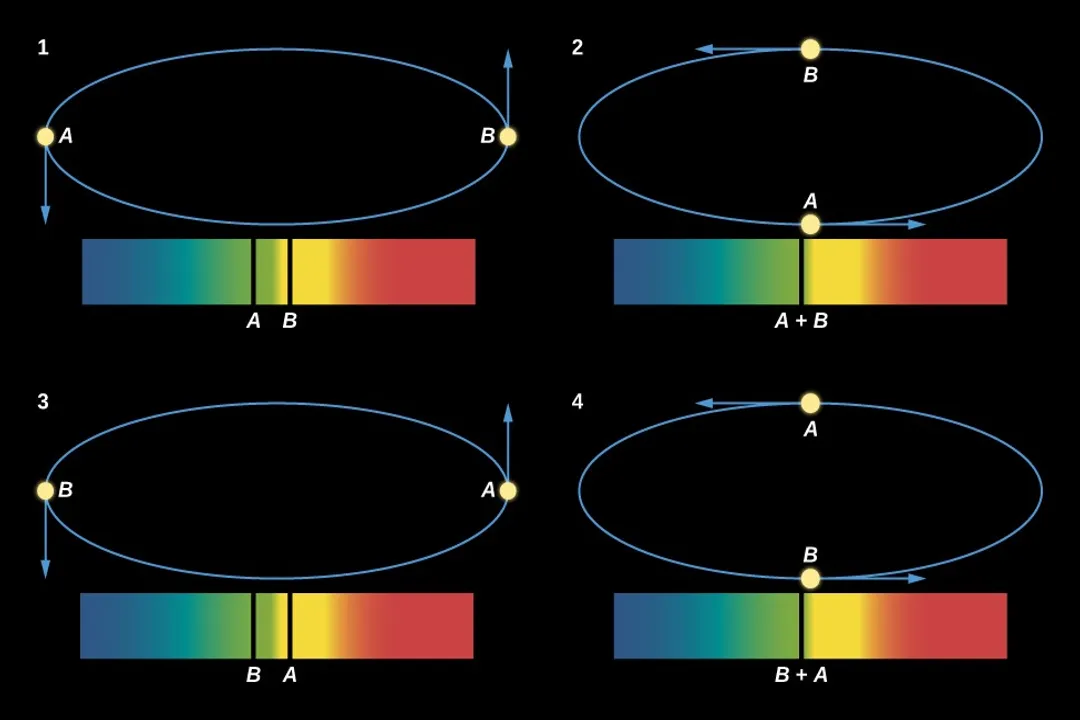
What system configuration is used by astronomers for the most direct method of weighing stars?What physical law, in its general form, connects the sum of the masses to the orbital period and semi-major axis in a binary system?When using standard astronomical units ($P$ in years, $a$ in AU), what quantity does the equation $(M_1 + M_2) = a^3 / P^2$ yield directly?In a binary system, how is the mass ratio $\frac{M_1}{M_2}$ determined based on the distances from the center of mass ($a_1$ and $a_2$)?If an orbital plane is tilted by an angle $i$ relative to the line of sight, what value represents the observed, foreshortened semi-major axis?What concept arises because the unknown inclination $i$ causes the mass equation to depend on $a^3$?If an astronomer calculates a minimum mass for an unseen companion that exceeds $3 M_ ext{sun}$, what is strongly suggested about that unseen object?How are orbital motions detected in Spectroscopic Binaries?For Eclipsing Binaries, why is the mass calculation generally more direct and accurate?What two conservation laws underpin the physics validating the Newtonian form of Kepler's Third Law in two-body orbits?What observational method produces a light curve by monitoring the total light from a system?