Why do stars with emission peaks in the violet/purple range not appear distinctly purple to an observer?
Answer
The sheer intensity of the associated blue and ultraviolet output dominates the visual perception.
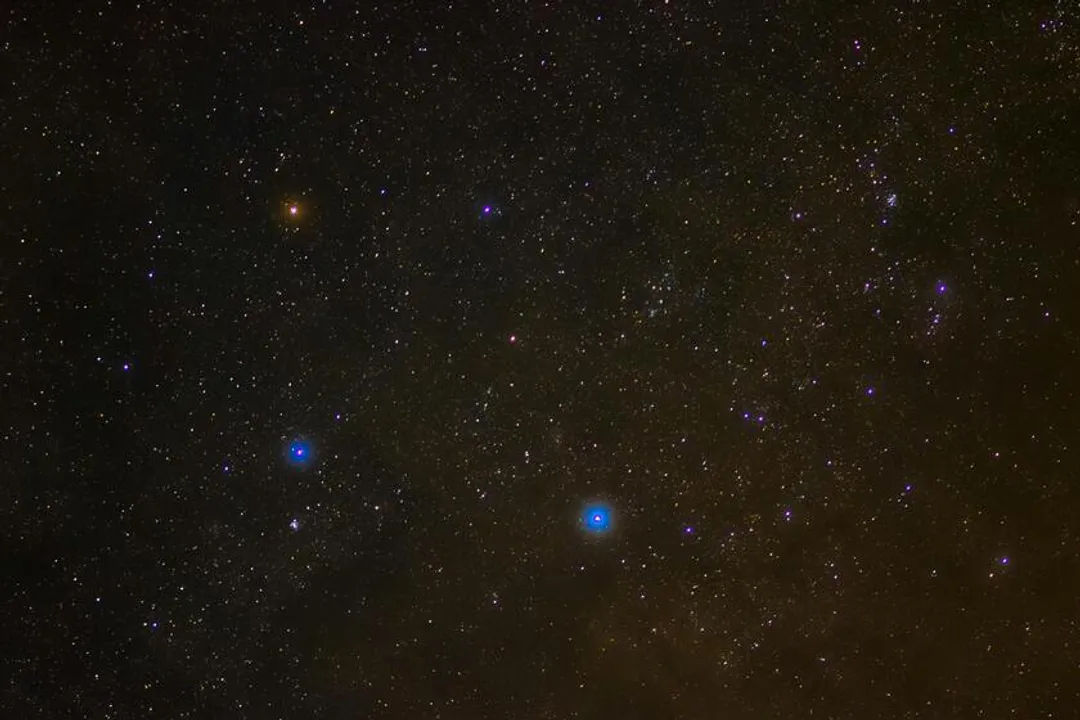
Even if the peak emission is in the violet range, stars that hot also radiate enormous amounts of energy in the blue and UV bands. This powerful blue output overwhelms the violet component, causing the eye to perceive the star as blue or blue-white.
#Videos
What Is The Hottest Color Star? - Physics Frontier - YouTube
Why are there no Purple Stars? or Green Stars? - YouTube
Related Questions
What physical law governs the relationship between a star's surface temperature and the wavelength of its most intense radiation?What is the perceived color of stars whose peak emission shifts toward the blue and then into the ultraviolet region?What spectral classes represent the hottest known stars in the sky?Why do stars with emission peaks in the violet/purple range not appear distinctly purple to an observer?What is the approximate surface temperature of the blue giants that represent the upper boundary of visible stellar color?What characteristic of stellar emission prevents us from seeing pure colors like green or purple?What is the perceived color of our Sun, despite its peak emission falling in the yellow-green part of the spectrum?How does the emission mechanism of a star differ from that of an engineered laboratory light source regarding color saturation?If observing starlight through instruments sensitive only to narrow bands, what might be isolated from a massive star that is otherwise perceived as blue?Which spectral class corresponds to stars with peak emission in the Green/Yellow range and a perceived color of White to Yellowish?What is the relationship between violet and ultraviolet on the electromagnetic spectrum regarding visible light?