What is the correct order of star colors from hottest to coolest?
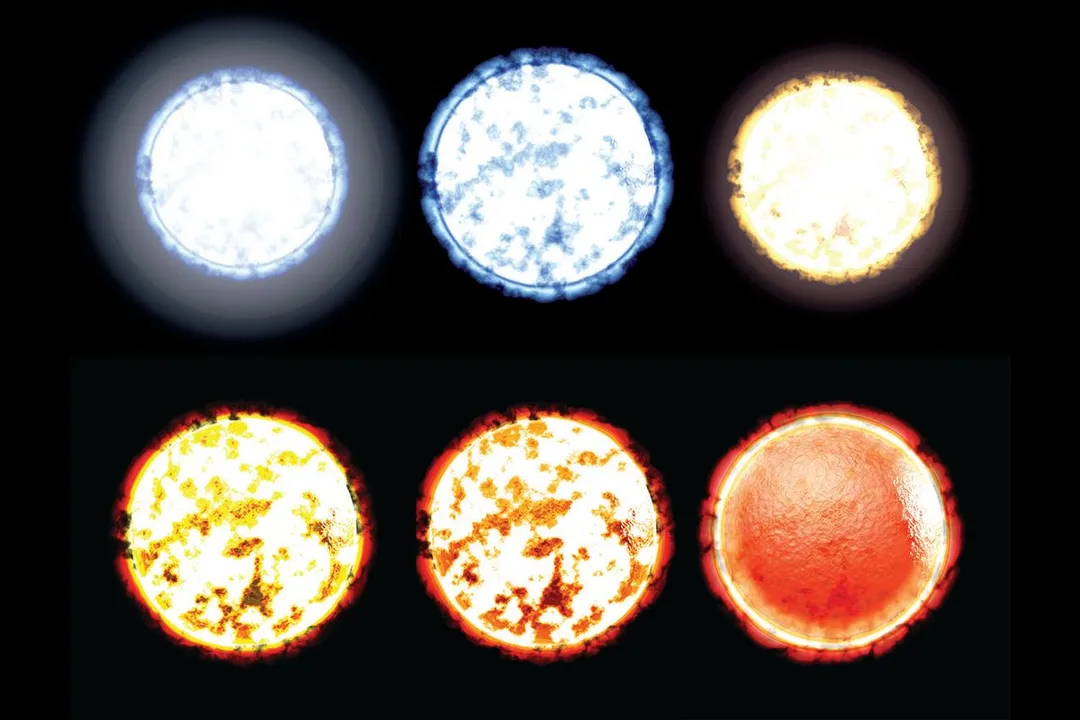
The color of a star, a captivating feature across the night sky, is far more than an aesthetic detail; it is a direct and immediate report on its surface temperature. When we observe the celestial sphere, we are not just seeing pinpricks of light, but rather millions of distant furnaces radiating energy across the electromagnetic spectrum. The fundamental principle governing this is that hotter objects radiate light at shorter, higher-energy wavelengths, while cooler objects radiate at longer, lower-energy wavelengths. This relationship allows astronomers to order stars reliably from the most searingly hot to the most gently glowing cool bodies based purely on their visible hue.
# Temperature Sequence

The arrangement of stellar colors, ordered from the hottest stars down to the coolest, follows a distinct sequence dictated by the laws of physics governing thermal radiation. At the extreme hot end are the blue stars. These giants burn with intense energy, boasting surface temperatures that can reach upwards of $25,000$ Kelvin (), and sometimes even exceeding $40,000$ K. [5][6] Following the blue stars, we find those that are blue-white or simply white. [5] Stars like Sirius and Vega fall into this category, with temperatures clustering around $10,000$ K. [5]
As the temperature drops further, the color shifts toward the middle of the visible spectrum. Stars like our own Sun are categorized as yellow or yellow-white, possessing surface temperatures near $6,000$ K. [5] Continuing the descent in temperature brings us to the orange stars, exemplified by Arcturus, which register temperatures around $4,000$ K. [5] Finally, at the coolest end of the observable spectrum are the red stars, such as Betelgeuse and Antares, whose surfaces hover around $3,000$ K, with the very coolest sometimes down near $2,000$ K. [5][6]
To organize this relationship cleanly, astronomers utilize the spectral classification system, originally devised by Annie Jump Cannon at Harvard, which categorizes stars based on their apparent color and later, their spectra. [5] This system assigns letters corresponding to the color-temperature scale, which is often remembered using the mnemonic "Oh Be a Fine Girl, Kiss Me". [5]
# Spectral Classes and Temperatures
The modern structure of this classification, often referenced via the Morgan-Keenan (MK) system, maps the colors directly to spectral classes: [5]
| Star Color | Spectral Class | Approx. Temperature (K) | Example Star(s) |
|---|---|---|---|
| Blue | O | $25,000$ K (up to $40,000$ K) | Rigel, Spica |
| Blue-White/White | B / A | K | Sirius, Vega |
| Yellow-White | F / G | K | The Sun, Proxima Centauri |
| Orange | K | K | Aldebaran, Arcturus |
| Red | M | K | Antares, Betelgeuse |
| [5] |
It is important to note that this relationship is tied not only to temperature but often to mass and evolutionary stage. The incredibly hot blue stars, for instance, are typically much larger and more massive than our Sun, leading to shorter, more energetic lives fueled by prodigious nuclear output. [5] Conversely, the smaller, cooler red stars possess less mass and radiate energy more slowly. [5]
# Wavelength Physics
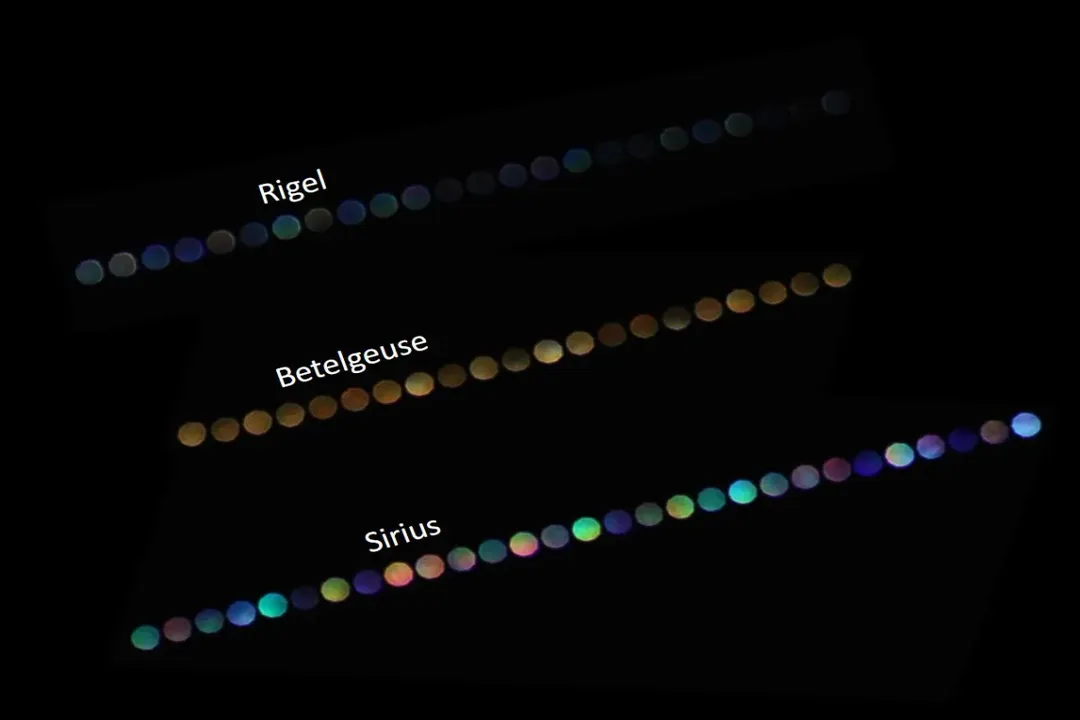
The physical underpinning for this precise color ordering lies in the concept of black-body radiation. [5] A theoretical black body, when heated, emits radiation across a continuous spectrum of wavelengths, and the peak intensity of that emission is solely dependent on its temperature, as described by Wien's law. A star’s perceived color is where the bulk of its visible light energy falls on this curve.
If a star's peak energy output is in the ultraviolet region of the spectrum, the light we see will be dominated by the shortest visible wavelengths—blue. [5] As the peak shifts toward the middle of the visible band (green), the star is still emitting large amounts of light at the red and blue ends. The way the human eye processes this composite signal, where energy levels across the entire visible spectrum are relatively high, results in the perception of white light. [5]
# Absence of Green
A common question arises regarding the existence of green stars. Since green sits near the middle of the visible spectrum, one might assume a star peaking in green light would appear green. However, there are no truly green stars because a star emitting light that peaks in the green portion of the spectrum—like our Sun at around $6,000$ K—simultaneously emits significant amounts of red, yellow, and blue light. [5] When all these colors mix, the eye perceives the resultant light as white or, in the case of the Sun, slightly yellow due to atmospheric interference. [5] For a physical object to appear green, it would need to emit only green light, or have its other emissions blocked, which does not happen naturally for a star governed by a black-body spectrum. [5]
One exception where an observer might perceive green is in a binary system, like the star Albireo, where a yellow star and a blue companion are close enough that the unaided eye blends their distinct colors into a single greenish point. [5] This is an artifact of resolution, not the intrinsic color of a single star.
# Extreme Hues
At the hottest extreme, stars whose peak emission lies near the border of visible and ultraviolet light are classified as blue. [5] Some of these incredibly hot O-class stars emit so much radiation in the ultraviolet that their true color, if our eyes could perceive that higher energy, would verge on violet. [5] However, since this radiation is outside the visible range for humans, the star appears blue, or perhaps white if it still emits sufficient red and yellow light to balance the perception. [5]
Conversely, stars that appear purple are generally an illusion. Purple is the result of the eye mixing blue and red light signals. [5] If a star genuinely emitted only strong red and blue light with a dip in the middle, the net effect registered by our vision is more often white, as the full spectrum is generally present to some degree. [5] Atmospheric distortion can sometimes shift a star’s true color, causing these bizarre perceived hues near the horizon.
# Distortions of Appearance

While color is an intrinsic property of a star's surface temperature, what we see from Earth is frequently a modified version of that true color. Several intervening factors can alter a star's apparent hue, leading to confusion if one is trying to map color directly to temperature without correction. [5]
One significant issue is interstellar reddening. [5] This phenomenon occurs when vast clouds of cosmic dust lie between the star and the observer. This dust preferentially absorbs and scatters shorter-wavelength light (blue and violet) more effectively than longer-wavelength light (red and orange). [5] The net result is that the starlight reaching us has had its blue component diminished, making the star appear redder than it actually is. For instance, a star that is intrinsically blue-white might appear merely white or even slightly yellow when viewed through a thick layer of intervening dust. [5]
Another physical phenomenon that shifts observed wavelengths is the Doppler effect. [5] If a star is moving rapidly away from us, its light waves are stretched, causing a "redshift" that shifts the apparent color toward the red end of the spectrum. [5] While this is a vital tool for measuring stellar motion, it complicates casual color assessment.
Finally, the limitations of human biology play an enormous role in what we report seeing. Our eyes contain two main types of light-sensitive cells: rods (for low light intensity) and cones (for color detection). [6] When starlight is faint, as it is for most stars, the cones are not sufficiently stimulated, and they effectively switch off, causing the star to register primarily as white. [6] We evolved as diurnal creatures, and our color perception is optimized for bright daylight conditions. [6] Even when color is perceived in brighter stars, our visual system averages the emitted wavelengths rather than isolating the spectral peak, defaulting many brighter point sources to a perception of white. [5]
# Our Sun’s Actual Hue
Our own Sun offers a perfect case study for these observational biases. Its surface temperature of approximately $6,000$ K means its peak light emission is in the greenish-yellow part of the spectrum. [5] If you were viewing the Sun from orbit, without the interference of Earth's atmosphere, it would appear white, as it radiates light nearly equally across the visible spectrum—the combined input yielding white.
The familiar yellow appearance of the Sun from Earth is a direct consequence of atmospheric scattering. Molecules in our atmosphere scatter the shorter, bluer wavelengths of sunlight far more effectively than the longer, redder wavelengths (this is the same mechanism that makes the sky blue). [5] By removing some of the blue light from the direct beam, what remains is a light source that appears biased toward the yellow end of the spectrum. As the Sun sinks toward the horizon during sunrise or sunset, the light must travel through a much greater volume of atmosphere, scattering even more blue and green light, resulting in the characteristic orange or red appearance. [5]

# Enhancing Color Perception
For the aspiring stargazer interested in verifying these color gradients, simple observation techniques can significantly improve the chances of seeing stellar color beyond just white. [6] The primary hurdle is overcoming the low light levels that deactivate the eye's cones. [6]
One excellent technique, especially for those using optical aids, is de-focusing. [6] If you use binoculars or a telescope and gently adjust the focus slightly out of perfect sharpness, the star’s light transitions from a near-perfect point source to a small, colored disc. [6] This increases the apparent size of the light hitting your eye, gathering more photons onto the light-sensitive areas and increasing the likelihood of stimulating the cones enough to register the true hue.
Furthermore, viewing conditions are paramount. Light pollution from terrestrial sources washes out faint details, including subtle star colors. [6] Seeking out a dark location, far from city sky-glow, is necessary to see the fainter, more subtly tinted stars. [6] Coupled with this, ensuring your eyes are fully dark-adapted—which takes about an hour in the dark—maximizes the sensitivity of your visual system to the meager light arriving from these distant suns. [6] Using a flashlight covered with red plastic when navigating in the dark is recommended, as red light minimally affects the dark adaptation process of the rods and cones. [6]
Another useful factor to consider when planning observations is the time of year. [6] While stars are always present, certain constellations rich in bright, colorful stars—such as the winter constellations that feature bright blue-white stars like Rigel—offer better opportunities to practice color identification. [6] Relying solely on the brightest few dozen stars visible on any given night will show you the most obvious colors, but the full spectrum from deep red to brilliant blue is only revealed when you maximize your collected light and minimize atmospheric interference. By understanding that the star's color is a direct temperature reading, you gain a fundamental piece of knowledge about its physical state, regardless of what the Earth’s atmosphere tries to tell your eyes.
Related Questions
#Citations
Colors of Stars | Astronomy - Lumen Learning
The Colors of the Stars From Hottest to Coldest - Science Notes
Star colours explained for beginners | BBC Sky at Night Magazine
At a Glance: Star Color and Temperature - ViewSpace
The color of stars, from hottest to and coolest, is blue, white, yellow ...
Star Color and Energy - StarDate Online