What is likely responsible for the visible glow accompanying the delayed ejection years later?
Answer
High-energy particles being accelerated or shocked as delayed gas is ejected.
The observed light is likely the result of high-energy particles being accelerated or shocked as the delayed gas is finally ejected or interacts with the black hole's magnetic field or corona.
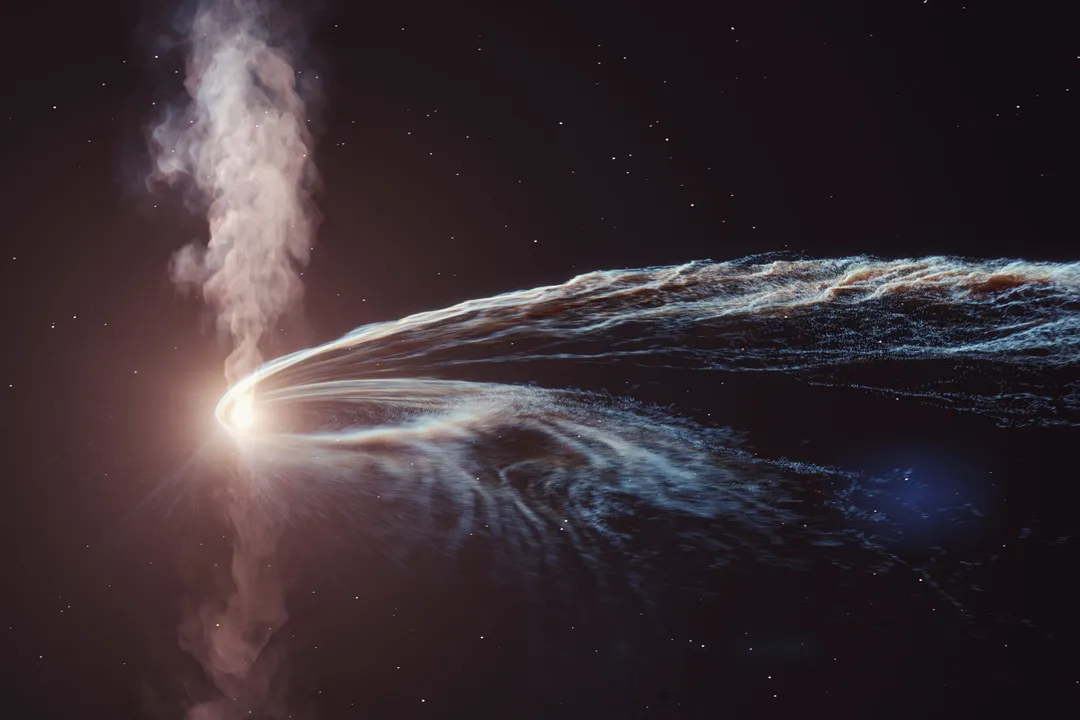
#Videos
Watch a Black hole 'burping out' a 'spaghettified' star it ... - YouTube
Related Questions
What unexpected phenomenon did astronomers witness regarding a black hole?What event initiates the process where a star is shredded by a black hole's gravity?What poetic term describes stretching a star into a long stream of gas by tidal forces?What swirling structure is typically formed by stellar debris orbiting a black hole after a TDE?Approximately how far away was the galaxy where this delayed ejection event was observed?What was the approximate time gap between the initial stellar shredding and the observed secondary flare?What normally causes the majority of the bright light signature observed shortly after a TDE begins?What does the delayed 'burp' suggest about the standard accretion process?How might delayed ejections affect how astronomers calculate the mass consumed by a black hole during a TDE?What is likely responsible for the visible glow accompanying the delayed ejection years later?